

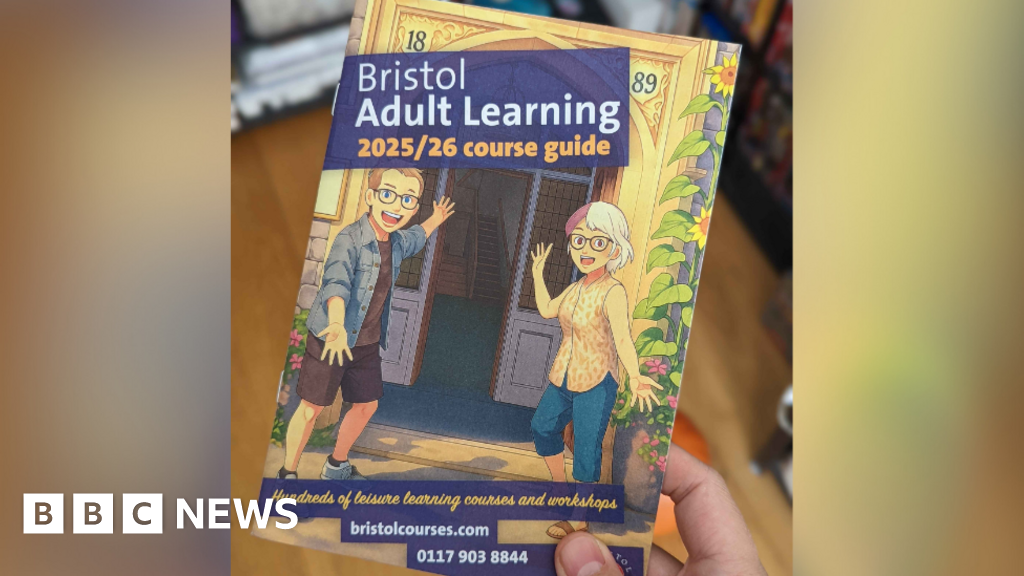
Controversy Over AI Artwork in Course Promotion
Bristol City Council has faced criticism from local artists and illustrators after it used artificial intelligence (AI) to generate the cover image for a booklet promoting adult learning courses. The decision to use AI-generated artwork has sparked a wider debate about the role of AI in creative industries and its potential impact on emerging artists.
Illustrator Adam Birch was among the first to raise concerns after noticing anomalies in the cover image, such as a woman with four fingers and seven toes — a common flaw in AI-generated images. Birch expressed disappointment that a guide meant to encourage participation in creative classes would feature artwork that, in his view, undermines the very skills being promoted.
Artists Raise Concerns About Devaluation
“My big concern was — is it sending the wrong message?” Birch questioned. “Why learn these creative skills if, right on the face of the book, you’re devaluing the use of them?” While he acknowledged the move may not have been malicious, he described it as misguided and urged the council to consider the message it sends.
Birch, who has created illustrations for various media outlets, emphasized that the cost of producing the AI image was minimal. However, he believes the council could have easily used a photograph from one of the classes or student artwork instead. “What you’re doing is wiping out a job,” he added.
Impact on Young Artists and Industry Entrants
Luke Oram, another illustrator based in Wick, South Gloucestershire, echoed Birch’s sentiments. He warned that AI could be especially harmful to recent graduates and young creatives trying to break into the industry. “I worry about the 22-year-old graduate who has no idea how to get into a career, or how to even find any work. They’ll just feel completely undervalued,” he said. “It’s the erosion of knowledge. AI is damaging.”
Pressure to Adopt AI
Despite the backlash, some professionals acknowledge a growing pressure to incorporate AI into creative workflows. An anonymous artist from Leamington Spa shared with the BBC that his company’s CEO is encouraging staff to embrace AI. “We’re being told to bring our heads out of the sand,” he said. “But the people who will be enriched by AI are at the top. For those expected to use it, they see it as the opposite of what we should be doing.”
He likened AI-generated content to fast food — convenient but lacking depth and quality. “We never stop to think about whether we should — it’s always whether we could,” he added.
Council Responds to the Criticism
In response to the concerns, Bristol City Council leader Tony Dyer acknowledged the feedback and assured residents that the council is re-evaluating its approach to AI. “While AI presents exciting opportunities for local authorities to improve and adapt their services, we recognize the strong feelings expressed by residents over our use of AI-generated imagery for this booklet,” said Dyer.
The council confirmed that the booklet, which was distributed in July, saw a total of 72,000 copies printed. Approximately 70,250 were sent to individuals and organizations within Bristol, with a few reaching South Gloucestershire and North Somerset. There are no plans for additional print runs.
Since the release of the booklet, the council has updated its internal guidelines on the use of AI. “We are currently trialling some limited use of AI and developing our policies and procedures as we learn,” Dyer added.
Balancing Innovation and Integrity
The incident has reignited discussions around the ethical use of AI in creative fields. While AI offers new possibilities in terms of efficiency and accessibility, critics argue that it should not come at the expense of human creativity and employment. The backlash in Bristol serves as a reminder that public institutions must tread carefully when integrating new technologies, especially in sectors that rely heavily on human expression and craftsmanship.
For now, local artists hope that the controversy does not discourage participation in the very courses the booklet was meant to promote. As Birch put it, “I hope my criticism doesn’t put people off going to the classes. They’re valuable, and we need to support them more than ever.”
This article is inspired by content from Original Source. It has been rephrased for originality. Images are credited to the original source.