

Artificial Intelligence Enhances LIGO’s Gravitational Wave Detection
Scientists from the UK, US, and Italy have developed a groundbreaking artificial intelligence (AI) technique that could significantly improve the Laser Interferometer Gravitational-Wave Observatory’s (LIGO) capacity to detect low-frequency gravitational waves. This innovation, called deep loop shaping, introduces real-time correction mechanisms for the interferometer’s mirrors, aiming to minimize vibrational noise and unlock new celestial discoveries.
Unlocking a New Frequency Range
Since its historic first detection in 2015, LIGO has recorded numerous gravitational waves, typically with frequencies between 30 and 2000 Hz. These signals have primarily originated from the mergers of small black holes and neutron stars. However, frequencies below 30 Hz, which could reveal the mergers of intermediate-mass black holes—ranging from 100 to 100,000 solar masses—remain largely undetected due to high levels of vibrational noise.
“Detecting gravitational waves at 10–30 Hz would open a new frontier in astronomy,” said Rana Adhikari from Caltech, a member of the research team. “It would let us observe larger black holes and provide early warnings for neutron star collisions.”
Precision Challenges at LIGO
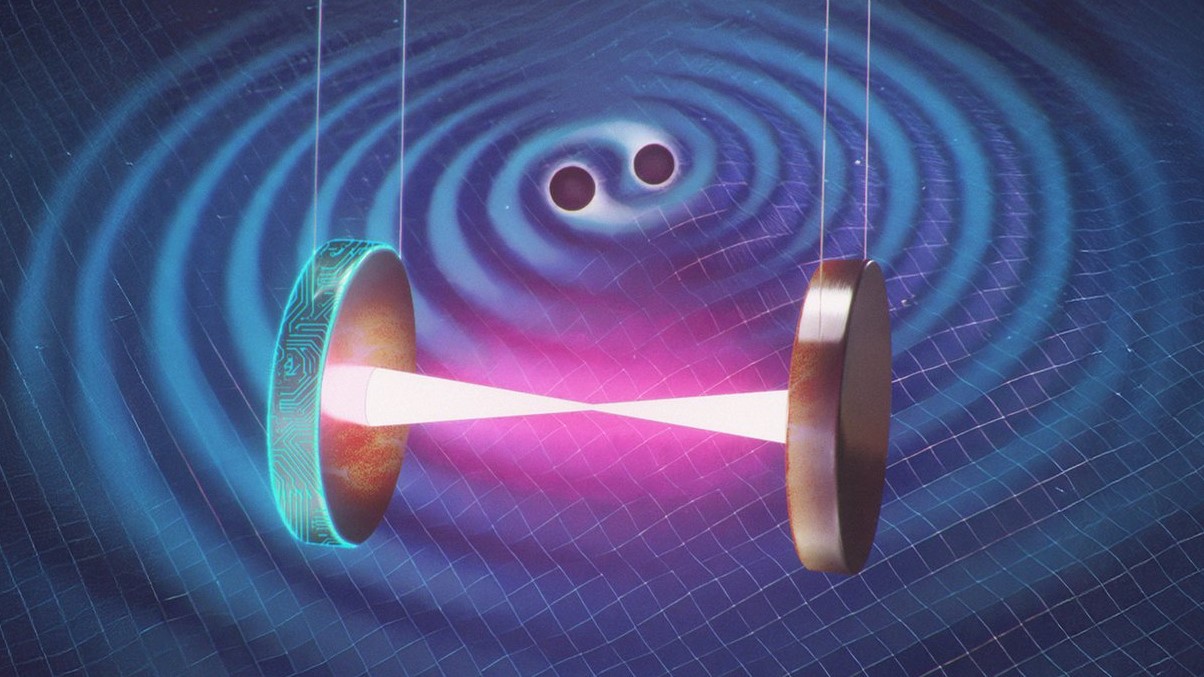
Gravitational waves cause minuscule shifts in the mirrors placed at the ends of LIGO’s 4-kilometer-long arms. Measuring these shifts requires astonishing precision—down to 10⁻¹⁹ meters, or about one ten-thousandth the diameter of a proton. Despite a sophisticated pendulum suspension system and advanced mirror coatings, vibrational noise from seismic activity, thermal fluctuations, and laser radiation pressure has remained a persistent challenge.
“Even the tiniest thermal distortion or seismic tremor can interfere with the mirror alignment,” Adhikari explained. “This noise has limited our sensitivity in the lower frequency ranges for decades.”
Deep Loop Shaping: AI-Powered Noise Reduction
To overcome these limitations, the team turned to deep reinforcement learning, a form of AI where a system improves its performance through a series of trials and feedback. This method was applied to the mirror control systems, allowing them to adapt dynamically and reduce noise in real time.
“Deep loop shaping is a novel AI technique that assists in designing and refining control systems,” said Jonas Buchli from Google DeepMind. “It reduces the need for deep expertise in control engineering and enhances precision in highly sensitive instruments like LIGO.”
Successful Trials and Future Implications
The new AI controllers were rigorously tested at LIGO’s facility in Livingston, Louisiana. According to Buchli, the controllers performed as effectively on actual hardware as they did in simulations. “This validation shows that deep loop shaping can maintain system stability over extended periods,” he stated.
Encouraged by these results, the researchers believe the technique could extend the observational reach of LIGO and similar interferometers. “We are essentially opening an entirely new frequency band,” said Jan Harms of the Gran Sasso Science Institute in Italy. “Just as different bands of electromagnetic radiation—radio, optical, X-ray—reveal different aspects of the universe, this new gravitational wave band could show us phenomena we’ve never seen before.”
Broader Applications of the Technology
Beyond gravitational wave astronomy, the AI-based control techniques developed in this research could have far-reaching applications. Systems requiring high precision and stability—such as quantum computing hardware, particle accelerators, and advanced optical systems—could benefit from similar approaches.
“This isn’t just about LIGO,” said Buchli. “The same AI principles can revolutionize how we control all kinds of complex systems, paving the way for advancements in multiple scientific and industrial fields.”
Looking Ahead
With the successful implementation of deep loop shaping, the future of gravitational wave astronomy looks brighter. The enhanced sensitivity could lead to discoveries of previously undetectable cosmic events, offering deeper insights into the structure and evolution of the universe. Moreover, the technique could provide timely alerts for imminent astrophysical phenomena, allowing astronomers to capture rare events in real time.
“We’re starting a new chapter in our exploration of the cosmos,” Harms concluded. “By pushing the boundaries of what LIGO can detect, we’re not just refining a tool—we’re expanding our window into space and time.”
This article is inspired by content from Original Source. It has been rephrased for originality. Images are credited to the original source.