

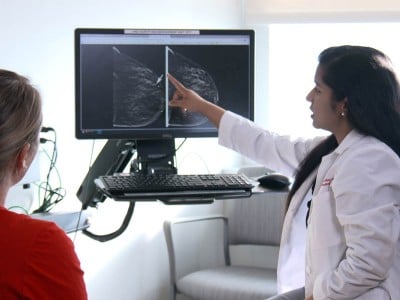
AI Enhances Detection of Elusive Lobular Breast Cancer
Researchers at The Ohio State University Comprehensive Cancer Center – Arthur G. James Cancer Hospital and Richard J. Solove Research Institute (OSUCCC – James) are developing innovative methods to identify and treat a particularly elusive type of breast cancer. This new approach leverages artificial intelligence (AI) to better predict and diagnose invasive lobular carcinoma (ILC), a form of breast cancer that is often missed in traditional screenings.
Lobular breast cancer represents approximately 15% of all breast cancer cases in the United States. Unlike the more common ductal carcinoma, which forms as a defined clump, lobular cancer spreads in a linear pattern, making it harder to detect on mammograms. This subtle growth often appears as a slight thickening of breast tissue, which can be easily overlooked.
Understanding Lobular Breast Cancer’s Challenge
Dr. Arya Roy, a breast medical oncologist specializing in lobular cancer at OSUCCC – James, notes that this type of cancer tends to spread silently and aggressively. “Lobular breast cancer can recur many years after treatment, and when it returns, especially in high-risk patients, the survival rate is generally lower,” she explained.
Despite the biological and clinical differences between lobular carcinoma and invasive ductal carcinoma, current treatment guidelines do not distinguish between the two. This uniformity in treatment protocols can complicate care for patients with lobular cancer, whose disease progression and response to therapy often differ significantly.
“Many patients with lobular cancer present conflicting indicators — clinically high-risk but genomically low-risk based on existing tissue tests,” Roy said. “This discrepancy highlights the need for more precise, tailored tools to determine which patients are genuinely at high risk.”
AI-Powered Innovation in Cancer Detection
To address this gap, Dr. Roy is leading a groundbreaking study that uses AI to analyze digital tumor tissue images alongside patient medical histories. The goal is to discover new visual biomarkers that can signal a higher likelihood of cancer recurrence, including early relapses that may not be caught through conventional diagnostic methods.
By integrating these AI-derived insights into a specialized risk prediction model, researchers hope to improve both early detection and treatment planning for patients with lobular breast cancer. This would mark a significant advancement in personalized oncology, ensuring that each patient receives care based on the unique characteristics of their disease.
Dense Breast Tissue and Diagnostic Challenges
Another complicating factor in breast cancer detection is dense breast tissue, which affects roughly 40% of women over age 40, according to the Society for Breast Imaging. Both dense tissue and cancerous growths appear white on a mammogram, making it harder to distinguish between normal and abnormal structures. This issue is particularly problematic for identifying lobular cancers, which are already difficult to detect due to their subtle presentation.
“Women with dense breast tissue not only have a higher risk of developing breast cancer, but they also face greater challenges in detecting it early,” said Roy. She recommends that women speak with their healthcare providers about whether additional imaging, such as breast ultrasound or MRI scans, might be appropriate, especially if they have a family history of breast cancer.
These advanced imaging techniques can provide different perspectives, potentially revealing tumors that standard mammograms might miss. This is especially beneficial for women with dense breast tissue, where early signs of cancer can be easily obscured.
Improving Patient Outcomes Through Innovation
The use of AI in cancer diagnostics is part of a broader push to improve outcomes for patients with less common or harder-to-detect cancers. By combining machine learning with traditional medical data, researchers can uncover patterns that might not be visible to the human eye, offering hope for earlier and more accurate diagnoses.
“Our objective is to develop a trustworthy, AI-driven tool specifically designed for lobular cancer patients,” said Roy. “The more accurate our predictions, the better we can tailor treatments, ultimately improving survival rates and quality of life.”
As the field of oncology continues to evolve, the integration of artificial intelligence stands to revolutionize how cancer is detected and managed. Through ongoing research and collaboration, institutions like OSUCCC – James are setting the stage for a future where cancer care is more precise, personalized, and effective.
For more information on breast cancer screening, treatment, and research at OSUCCC – James, visit cancer.osu.edu/breast.
This article is inspired by content from Original Source. It has been rephrased for originality. Images are credited to the original source.