

In today’s fintech landscape, leaders are well-versed in predictive analytics from credit scoring to portfolio risk models. But for those of us on the front lines of financial crime, an inflection point is near. The frontier is no longer “What will happen next?” It’s “How can we act in advance?”
To illustrate the shift, consider a recent architectural challenge I faced while optimizing a fraud detection engine. The existing predictive setup was robustt but reactive it flagged anomalies only after the money had moved. The goal was to move left: to engineer a system that could not only forecast the event but understand the mechanism of the fraud, simulate the ripple effects, and respond in real time.
This is the world of Anticipatory Finance where Causal AI, event-driven microservices, and real-time orchestration combine to build systems that are proactive, adaptive, and explainable.
The Limits of Predictive Finance
Predictive models have powered fintech’s first AI revolution. They are valuable but inherently limitedd.
Correlation over causation: Most models can tell us what tends to happen, but not why it happens.
Reactive by design: They learn from the past and flag risks after patterns emerge.
Fragile under change: When attack vectors shift or customer behaviour evolves, these systems degrade quickly.
A clear example of this failure mode occurred in a predictive scoring pipeline I managed during a targeted bot attack. The model relied heavily on device velocity and location mismatch as proxies for risk. However, the fraudsters utilized residential IP proxies and mimicked human typing speeds (drift). Because the predictive model was looking for correlation patterns it had seen before, it missed the attack entirely. Conversely, during legitimate flash sales, the same model would often spike False Positive Rates (FPR) because it couldn’t causally distinguish between “bot volume” and “marketing success.”
Prediction is useful. But for leaders seeking resilience, the architecture must evolve beyond it.
The Anticipatory Finance Paradigm
Anticipatory finance represents a new operating model — systems that sense, simulate, and Anticipatory finance represents a new operating model systems that sense, simulate, and act before fraud signals fully manifest. It rests on three pillars, now bolstered by mature technical frameworks:
Causal Inference: Moving from “If X then Y” to “If we change X, what happens to Y?” enables strategic simulation. In practice, this involves using libraries like DoWhy or EconML to model intervention effects, separating spurious correlations from actual fraud drivers.
Event-Driven Microservices: Financial crime doesn’t happen in tidy batches; it unfolds as continuous streams. Systems must respond in real time through decoupled services. This requires robust message brokers (e.g., Apache Kafka, Apache Pulsar, or AWS Kinesis) to handle high-throughput signal ingestion without bottlenecks.
Continuous Feedback Loops: Systems should learn from their actions. This is orchestrated via Feature Stores and automated retraining triggers (CI/CD for ML) that refine causal models as new ground-truth label data (confirmed fraud vs. false positive) arrives.
Applications are compelling:
Fraud systems: In my investigation work, we built a causal signal detection engine that identified pre-fraud behavioural shifts 30–40 minutes before traditional anomaly models triggered. By identifying causal precursors such as specific navigation loops associated with social engineering or “pre-grooming” activity we could intervene before the transaction was even attempted.
Dynamic portfolios that hedge risk based on policy or sentiment shifts. Liquidity platforms that anticipate funding stress and optimise asset flows in real time. In each case, the goal moves from Predict → Anticipate → Act.
Causal AI: The Brain of Anticipatory Systems
Traditional machine learning stops at correlation: “Customers with traits X and Y tend to default.”
Causal AI asks: “If we intervene on Y, will it reduce fraud risk by Z?”
By modelling cause rather than coincidence, Causal AI unlocks:
Explainability and trust: Regulators and internal audit teams demand to know why a high-value account was frozen. Causal models provide this clarity by tracing the decision path.
Robustness under change: Because they represent underlying mechanisms, causal models generalise better when fraudsters change tactics.
Prescriptive power: We can ask, “What if we introduce a step-up challenge (2FA) here?” and simulate the impact on user friction vs. fraud prevention before deploying.
Engineering the Causal Graph
Implementing this requires constructing a Directed Acyclic Graph (DAG). In my experience, this isn’t purely automated; it requires a “human-in-the-loop” approach where fraud experts validate causal assumptions (e.g., ensuring that “device change” is treated as a cause for “risk score increase,” not just a correlation). We then validate these assumptions using sensitivity analysis to ensure hidden confounders aren’t driving the results.
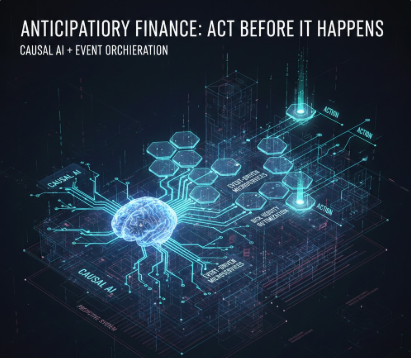
In this architecture, Causal AI is not a peripheral engine. It’s the intelligent core feeding insights and “intervention signals” to an event-driven nervous system.
Event-Driven Microservices: The Nervous System
If Causal AI is the brain, event-driven microservices (EDAs) are the nerves that sense and act. Instead of rigid, batch-oriented pipelines, event-driven systems publish and subscribe to data streams — loosely coupled, asynchronous, and scalable. For finance, this brings:
● Instant responsiveness to transactions, market movements, and regulatory updates. ● Elastic scalability to handle event surges gracefully.
● Decoupled evolution where new services (fraud, underwriting, liquidity) plug in without disruption.
A typical pattern might look like this:
1. Causal AI Core ingests data and generates intervention signals.
2. Event Orchestrator listens for relevant signals and market events.
3. Action Microservices execute decisions — adjusting policies, hedging risk, or rerouting liquidity.
This design offers low latency, resilience, and the ability to evolve as new use cases emerge. Engineering the Anticipatory Architecture
For fintech executives, the question is no longer “Is it possible?” but “How do we build it?” A reference blueprint includes:
1. Data Layer – Unified streaming and historical data fabric combining real-time events with batch analytics.
2. Causal Layer – Structural causal models simulate interventions and estimate outcomes using frameworks like DoWhy or EconML.
3. Decision Layer – Policy engines and reinforcement loops evaluate causal signals and determine optimal actions.
4. Service Layer – Event-driven microservices execute those actions across risk, underwriting, and liquidity domains.
5. Governance Layer – Built-in explainability, audit trails, and compliance monitoring ensure transparency and accountability.
Challenges include latency management, causal model deployment, event schema evolution, and regulatory trust. A pragmatic approach is to pilot the architecture in a “safe pod” — a controlled domain such as credit risk — before scaling enterprise-wide.
From Reactive to Proactive: Implementation Roadmap
A phased path helps balance ambition with execution:
Causal Awareness: Identify domains (e.g., Account Takeover, Synthetic Identity) where causality adds tangible value over simple correlation.
Event-Driven Migration: Decompose monoliths. Implement Schema Registries to ensure data consistency across services.
Causal Integration: Deploy causal models behind an API Gateway to serve operational decision flows.
Autonomous Optimisation: Close the feedback loop. Track metrics like Model Drift, False Positive Rate (FPR), and Decision Latency (p99) to ensure the system adapts without degradation.
Governance, Ethics, and Trust
As systems gain autonomy, trust and accountability become paramount. Leaders must ensure: Transparent causal models: Stakeholders must understand the “why” behind actions.
Audit-ready event trails: Implementing immutable event logs so every decision is traceable from trigger to outcome for regulatory reviews.
Guardrails for autonomy: Deterministic oversight layers that can override probabilistic decisions in critical workflows.
Done right, anticipatory systems become a source of competitive advantage enabling firms to act before risks materialise.
Strategic Outlook: The Fintech Operating Model of 2030
Building anticipatory systems is not just a theoretical exercise; it requires a fundamental shift in engineering practices.
Data Quality is Causal Quality: Unlike correlation models, causal models are highly sensitive to data fidelity. Investing in a robust Data Mesh is a prerequisite.
Latency Matters: The best causal insight is useless if it arrives too late. Optimising the event broker configuration is as critical as tuning the AI model.
Hybrid Teams: Success requires cross-functional squads where data scientists understand event streaming and fraud analysts understand causal inference.
For fintech leaders, investing in causal reasoning and event-driven architecture is not just a tech upgrade it’s a strategic leap toward owning the anticipatory finance platforms of tomorrow.
Conclusion
Prediction has served fintech well. But the next frontier is anticipation. By connecting Causal AI with event-driven microservices, financial institutions can evolve from reactive to proactive, from predictive to pre-emptive.
Those who build the data fabric, the causal layer, and the event orchestration today will define the financial intelligence of tomorrow. The future isn’t just about what will happen next it’s about why it happens and how we act before it does. The time to engineer that future is now.
