

Exploring AI in Rural Contexts
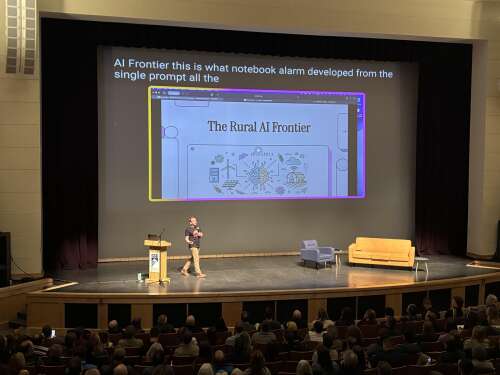
The Four Corners AI Conference returned to Fort Lewis College on Tuesday, drawing a sold-out crowd of 600 attendees eager to learn about the intersection of artificial intelligence and rural development. With the rapid growth of AI technologies, this year’s event placed a spotlight on how communities like Durango can responsibly integrate AI into their economic, educational, and governmental systems.
Tom Miaskiewicz, associate professor of marketing at Fort Lewis College, opened the conference with a presentation on the evolution of AI and its potential benefits for small communities. He emphasized that rural areas have unique opportunities to leverage AI for innovation, though they must also be mindful of the environmental and ethical implications.
A Platform for Open Dialogue
Fort Lewis College Provost and Vice President of Academic Affairs Mario Martinez said the conference was designed to foster community conversations around AI and its growing role in society. This marked the second AI conference hosted by the college, reflecting a significant increase in public interest. According to Martinez, the questions surrounding AI implementation have shifted dramatically over the past year.
“A year ago, people were asking whether they should consider AI,” he said. “Now, they’re asking how they can start using it.”
The conference began with a panel discussion featuring Martinez, Durango City Manager José Madrigal, and Durango School District Superintendent Karen Cheser. Each shared insights on how their respective institutions have already begun incorporating AI into daily operations.
AI in Education and Governance
Cheser highlighted the growing role of AI in classrooms, where it’s helping teachers streamline lesson planning and provide tailored support for students with learning differences, such as ADHD. She noted that AI could be a great equalizer, providing rural students with access to the same tools as those in urban areas.
“We would say it’s making our classrooms more human,” Cheser explained. “AI gives us more time to focus on creative and meaningful learning experiences.”
City Manager Madrigal described how Durango is using AI to boost government efficiency. Tasks like processing open records requests and reviewing building permits can now be automated, freeing up staff to engage more directly with residents. However, he cautioned that ethical considerations and data security—particularly in law enforcement—remain a priority.
“AI can’t replace empathy,” he said. “It can’t replicate a human touch.”
Environmental and Ethical Considerations
Miaskiewicz addressed the environmental footprint of AI, acknowledging its high energy and water demands but also noting that recent innovations have made it 33% more efficient within the past year. He believes AI has the potential to drive advancements in sustainability, such as carbon capture and renewable energy development.
“AI could expand what we are capable of attempting,” he said. “It allows us to tackle problems that once seemed insurmountable.”
The Future of Work and Sovereignty
Luke Norris, co-founder of AI orchestration platform Kamiwaza.ai, delivered a keynote focused on the concept of sovereign AI—giving organizations full control over their data and systems. He described AI-driven automation as both an opportunity and a challenge, particularly in the labor market.
“AI is helping automate, and that is going to be painful,” Norris said. “In the short term, job displacement may be overstated, but in the next two to three years, it will be a massive shift. We’re on the verge of what I call the Fifth Industrial Revolution.”
Norris envisions a transformation where human productivity and innovation increase exponentially, provided that organizations and governments adapt wisely.
Indigenous Perspectives on AI
The day’s second keynote speaker, Angelo Baca, a Diné/Hopi assistant professor at the Rhode Island School of Design, brought a critical voice to the conversation. Baca has been working to raise awareness about the impact of AI on Indigenous communities, particularly in relation to intellectual property and cultural appropriation.
“Native communities are not yet fully equipped to engage with AI in a way that ensures informed consent,” Baca said. “We risk repeating historical patterns of knowledge extraction and exploitation.”
He stressed the importance of including tribal nations in AI discussions and developing frameworks that protect Indigenous knowledge from misuse by tech companies.
This article is inspired by content from Original Source. It has been rephrased for originality. Images are credited to the original source.