

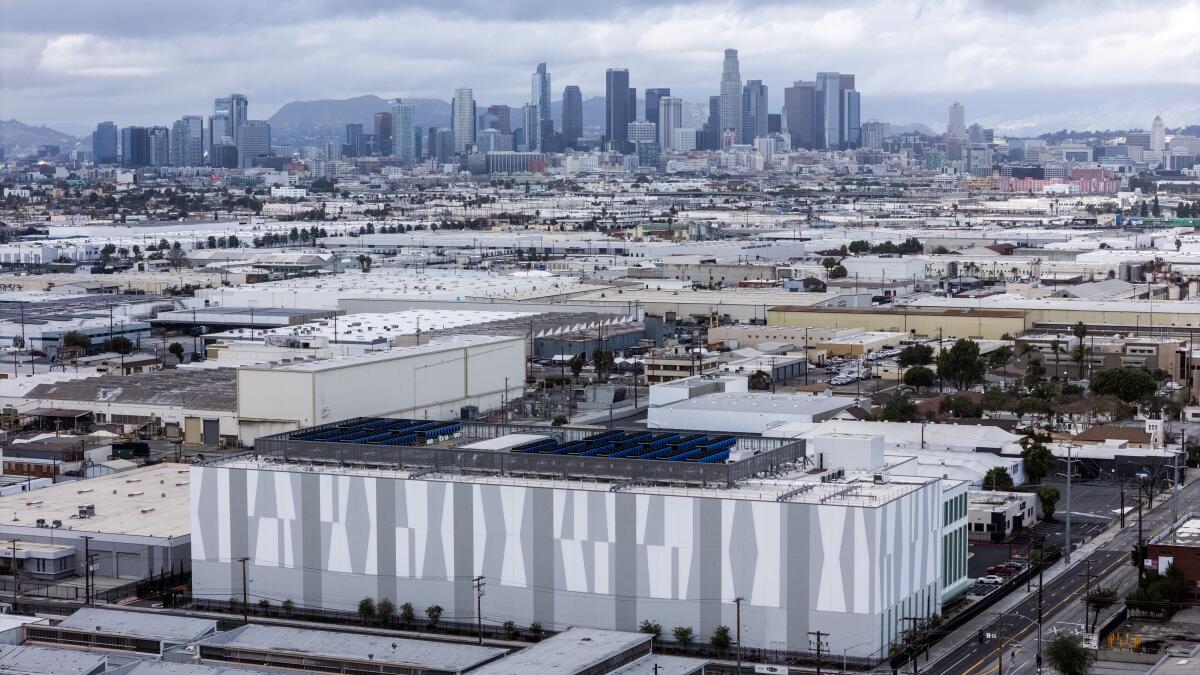
Vernon: An Unexpected Epicenter for AI Infrastructure
Just five miles south of downtown Los Angeles, the small industrial city of Vernon is quietly transforming into a powerhouse of artificial intelligence (AI) infrastructure. Despite having a population of just over 200 residents, Vernon is now home to one of the most power-hungry data centers in Southern California, drawing energy equivalent to that used by more than 26,000 homes annually.
At the center of this transformation lies a massive 242,000-square-foot facility known as LAX01. This three-story complex, operated by Prime Data Centers, houses rows of high-performance AI chips across six buildings. These processors form the backbone of a rapidly expanding network supporting the next generation of AI models and services.
AI Boom Reshapes Southern California Real Estate
The demand for AI and cloud computing capabilities has sparked a new wave of real estate development. Companies are repurposing existing industrial spaces and constructing new data centers to meet the growing need for digital infrastructure. Prime Data Centers is not alone in this movement—other major players like Goodman Group, CoreSite, and Digital Realty are also investing heavily in Vernon.
“The race toward superintelligence is reshaping infrastructure requirements across every industry,” said Michael Wall, executive vice president at Prime Data Centers. “We’re working to give businesses the foundation they need to build and deploy AI models faster, more efficiently, and at scale.”
Why Vernon? Cheap Power and No Resistance
One of Vernon’s major draws for tech companies is its low-cost, independent power supply. The city operates its own publicly owned utility, providing electricity, water, gas, and high-speed fiber-optic internet. This allows Vernon to offer power at rates as low as half of those charged by other providers in Southern California.
Additionally, Vernon’s sparse population means there is virtually no residential opposition—often a significant barrier in other communities. Across the U.S., proposed data center projects have faced delays due to concerns over water usage, noise pollution, and increased electricity rates. In contrast, Vernon has reported no objections from its community, according to city officials.
Nationwide Surge in AI Infrastructure Investment
Vernon’s data center boom is part of a broader national trend. In 2025 alone, Google, Amazon, Microsoft, and Meta collectively invested $465 billion into computing and networking infrastructure for AI. One Harvard economist even noted that without such investments, U.S. GDP growth may have nearly stalled this year.
Los Angeles currently hosts over 70 data centers, with the One Wilshire building historically serving as the central hub. One Wilshire connects the U.S. to Asia via undersea cables and houses nearly every major telecom provider. However, with space in downtown L.A. limited, companies are seeking alternatives like Vernon for expansion.
Environmental and Legislative Challenges Loom
California’s data center growth comes with environmental concerns, particularly regarding water and electricity usage. Although Vernon assures residents that its infrastructure can handle the increased demand without rate hikes, analysts warn that rising power requirements could eventually strain the system.
Some lawmakers have introduced legislation to regulate water usage by data centers. However, a recent bill requiring projected water use disclosures was vetoed by Governor Gavin Newsom, sparking debate over environmental transparency and sustainability in the AI sector.
Managing Growth Within Regulatory Limits
Despite California’s appeal, stringent regulations and high operational costs have historically deterred data center development in the state. To avoid complex licensing requirements, many projects—including those in Vernon—are purposefully kept below 49.9 megawatts of capacity.
Still, the surge in AI-driven activity shows no sign of slowing down. “We didn’t used to speak in megawatts when we talked about data centers; kilowatts were the norm,” said Robert Brooks, vice president of sales at Lambda, a cloud computing firm leasing space in the LAX01 facility. “Now, it’s all about scaling up to meet unprecedented computational demands.”
As Vernon continues to grow as a data center destination, it exemplifies how small industrial towns can reinvent themselves in the era of artificial intelligence. With its unique blend of infrastructure, affordability, and minimal resistance, Vernon may well become a national model for future AI development hubs.
This article is inspired by content from Original Source. It has been rephrased for originality. Images are credited to the original source.