

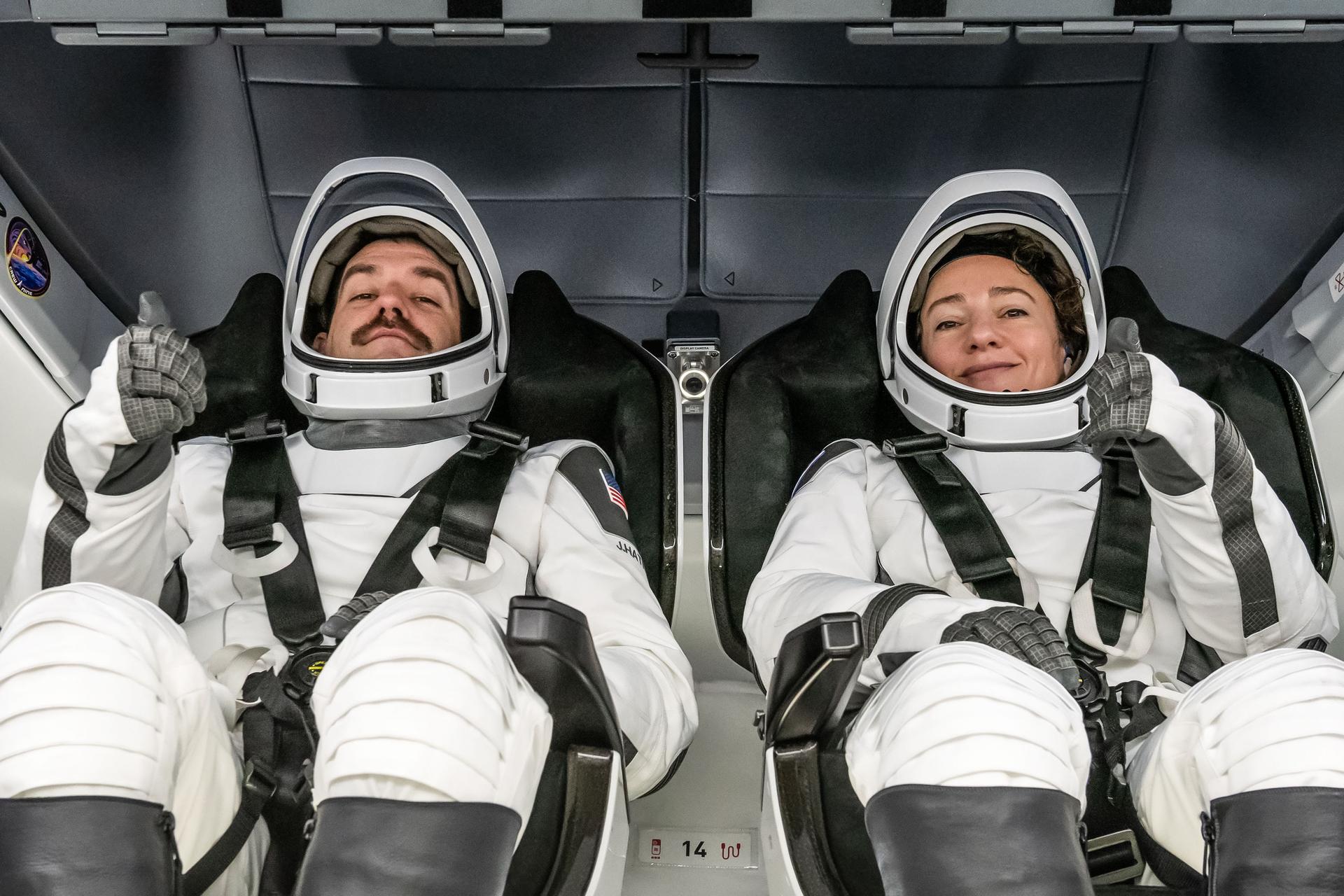
Dragon Spacecraft Arrival Preparations Underway
The International Space Station (ISS) is buzzing with activity as the Expedition 74 crew continues to prepare for the highly anticipated arrival of NASA’s SpaceX Crew-12 mission. Scheduled for launch no earlier than 6:01 a.m. EST on February 11, 2026, from Space Launch Complex 40 at Cape Canaveral Space Force Station, the mission marks another milestone in crewed space exploration.
The four-member Crew-12 team includes NASA astronauts Jessica Meir and Jack Hathaway, European Space Agency (ESA) astronaut Sophie Adenot, and Roscosmos cosmonaut Andrey Fedyaev. The team will dock with the space-facing port of the Harmony module on the ISS the day after launch. They are set to spend nine months conducting a wide range of microgravity research aimed at benefiting life both on Earth and beyond.
Training and Equipment Checks in Full Swing
NASA astronaut Chris Williams has been diligently working to ensure a seamless arrival for the Crew-12 team. Williams spent significant time reviewing procedures for monitoring Dragon’s automated approach and docking. These simulations are critical to ensure that the spacecraft connects safely and efficiently with the Harmony module.
Following his training, Williams organized standard emergency equipment that will be transferred into the Dragon capsule upon its arrival. This equipment is essential for maintaining preparedness in case of an onboard emergency.
New Ultrasound Technology Tested
In addition to Dragon-related tasks, Williams also evaluated the newly arrived Ultrasound 3 biomedical scanner, which will replace the older Ultrasound 2 system. Installed in the Columbus laboratory module, Ultrasound 3 is designed to perform advanced imaging of cardiovascular, abdominal, and musculoskeletal systems in microgravity. The device offers real-time guidance from Earth-based medical professionals, enhancing in-space diagnostics and treatment capabilities.
Delivered on September 18, 2025, by Northrop Grumman’s Cygnus XL spacecraft, the Ultrasound 3 system enhances the ISS’s ability to monitor and manage crew health during long-duration missions.
Artificial Intelligence Enhances Crew Efficiency
Roscosmos cosmonauts Sergey Kud-Sverchkov and Sergei Mikaev have been exploring the use of artificial intelligence (AI) to streamline operations aboard the ISS. The duo tested speech-to-text AI tools designed to speed up documentation and facilitate more efficient communication between the station and mission control on Earth.
These AI-assisted systems aim to reduce manual workload and improve data handling, ultimately boosting crew productivity and operational effectiveness. As missions become longer and more complex, such technologies are expected to play a crucial role in space exploration.
Medical Training and Plasma Research Continue
Station Commander Kud-Sverchkov also engaged in medical officer training, familiarizing himself with essential emergency medical hardware, including an automated external defibrillator and a respiratory support pack. These tools are vital for addressing medical emergencies in the isolated environment of space.
In parallel, Kud-Sverchkov continued his work on the Plasma Kristall-4 experiment, which investigates complex plasma behaviors to inform spacecraft design, planetary formation theories, and fundamental physics research.
Maintaining Life Support Systems
Flight Engineer Sergei Mikaev, on his first mission to the ISS, focused on ensuring the functionality of critical life support systems. He tested space-to-ground communication hardware in coordination with Russian mission controllers and inspected the Elektron oxygen generator’s water tanks for air bubbles. These checks are essential to guarantee continuous life support aboard the station.
The Elektron system plays a pivotal role in maintaining breathable air for the crew, and regular inspections are necessary to ensure its reliability throughout the mission duration.
Looking Ahead
As the launch date for Crew-12 draws near, the current ISS crew remains focused on preparing the station for a smooth handover and integration of the new arrivals. The combination of advanced medical equipment, artificial intelligence tools, and rigorous training underscores the complexity and precision required to operate the orbital laboratory.
These preparations not only support immediate mission goals but also contribute to the long-term vision of sustained human presence in space. With each mission, the ISS continues to serve as a testbed for innovations that will pave the way for future deep space exploration.
This article is inspired by content from Original Source. It has been rephrased for originality. Images are credited to the original source.