

Introduction: Navigating the AI Slop Era
In the era of advanced language models and automated writing tools, concerns about AI-generated text are more prominent than ever. Enter Sinceerly, a tool designed to help users mask their reliance on AI writing assistants like ChatGPT or Grammarly. Rather than polishing your writing to perfection, Sinceerly intentionally injects human-style errors, typos, and quirks to make content appear authentically human. This quirky solution addresses the growing need for emails and messages to avoid the telltale signs of AI-generated text.
How Sinceerly Works: From AI Slop to Human Touch
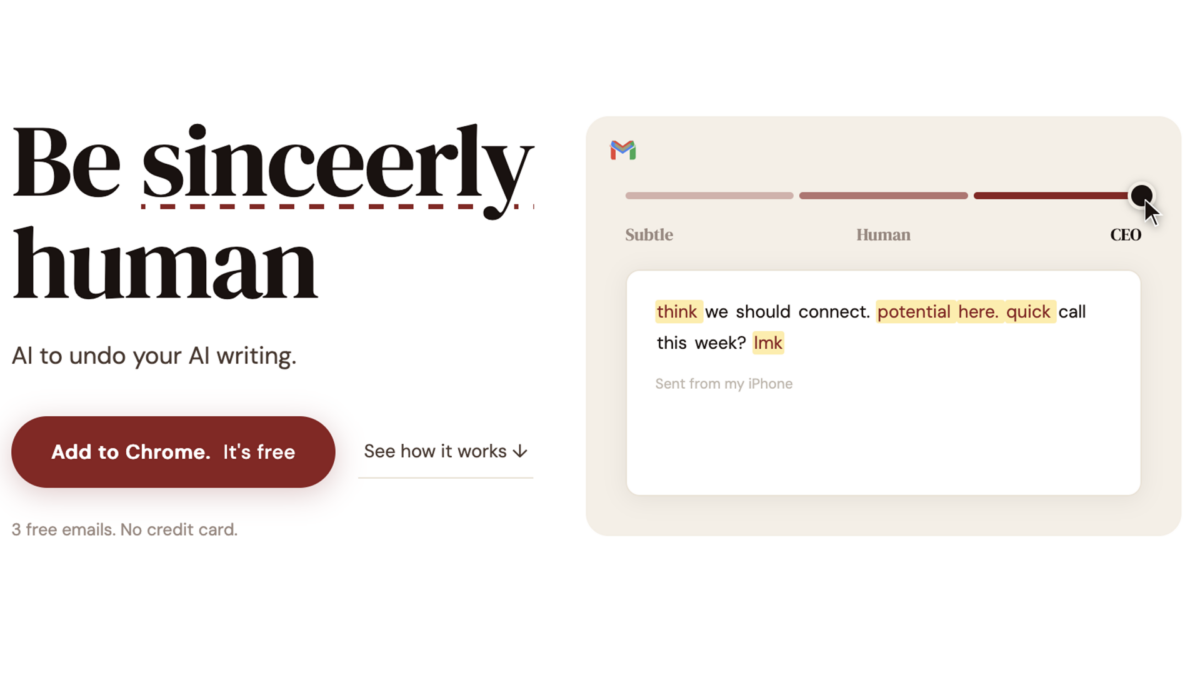
Sinceerly operates under a unique premise: if your emails sound too much like they were written by an AI or a corporate pitch deck, that could raise suspicion. Users worried about their dependence on tools like ChatGPT or Grammarly can turn to Sinceerly, which promises to “kill the emdash,” remove overused phrases, and sprinkle in some typographical errors for good measure. The app offers three distinct rewriting settings:
- Subtle: Makes minor changes, introducing small typos and casual phrasing.
- Human: Adds more noticeable errors and informal language, making the text feel natural and spontaneous.
- CEO: Prioritizes brevity and even dismisses traditional capitalization, mimicking a high-powered executive’s hurried style.
For example, a passage filled with AI writing tropes is transformed according to the chosen setting. The “Subtle” mode might quietly shift “emails” to “emials” and insert colloquial transitions. The “Human” setting increases errors and conversational tone, while “CEO” strips away formalities and capital letters entirely.
Satire or Serious Solution?
The existence of Sinceerly raises an intriguing question: is it satire, or a genuine response to the prevalence of AI-generated text? The app’s deadpan website and playful design suggest a tongue-in-cheek approach. When contacted, developer Dan Horwitz—a Harvard MBA student—confirmed that the project is meant to amuse as much as to offer a real solution. According to Horwitz, “The whole thing is meant to make people think twice and have a little fun. It’s closer to satire.”
Yet, the serious tone of the website and the growing demand for such tools hint at a deeper trend. As AI-generated content becomes more common, the need to disguise it—ironically, with the help of another AI—represents a fascinating twist in how we communicate. The blurring line between human and machine-written text is sparking new debates about authenticity, credibility, and trust in digital communication.
The Mechanics Behind the Masking
Sinceerly focuses on removing common markers of AI-generated text, such as formulaic phrases and the “rule of three” structure. While the tool is not perfect—some AI tropes may still slip through—it offers a novel way to disrupt the uniformity often found in AI-assisted writing. By introducing random errors and informalities, Sinceerly hopes to produce content that passes as genuinely human, even as readers become more savvy in spotting algorithmic patterns.
This approach also highlights a broader trend: as AI tools shape the way we write, new systems emerge to counteract their effects. An email refined by Grammarly might be run through Sinceerly to add “imperfections,” creating a loop where AI corrects the work of another AI, ultimately for an audience that may itself be an AI-driven filter or reader. It’s a humorous yet insightful commentary on the evolution of digital communication.
Implications for Communication and Trust
The rise of tools like Sinceerly underscores changing attitudes toward AI-generated text. For those concerned about appearing too robotic, or for professionals who want to maintain a personal touch, these utilities offer a way to regain control over their digital voice. However, they also prompt important questions: Does masking AI assistance undermine transparency? Does it matter if a message is written by a machine if it resonates with the recipient?
Ultimately, Sinceerly and similar tools are a response to a digital landscape where authenticity is both valued and increasingly difficult to prove. As more writers, companies, and individuals rely on AI-driven content creation, the pressure to appear “real”—even if artificially so—will only intensify.
Conclusion: The Future of Human-AI Writing
As the lines between human and AI-generated text continue to blur, tools like Sinceerly offer both a practical solution and a satirical reflection on our relationship with technology. Whether used in jest or earnest, these applications highlight the ongoing evolution of communication in the digital age. As we navigate this new landscape, the challenge will be to balance authenticity, efficiency, and trust in every message we send.
This article is inspired by content from Original Source. It has been rephrased for originality. Images are credited to the original source.