

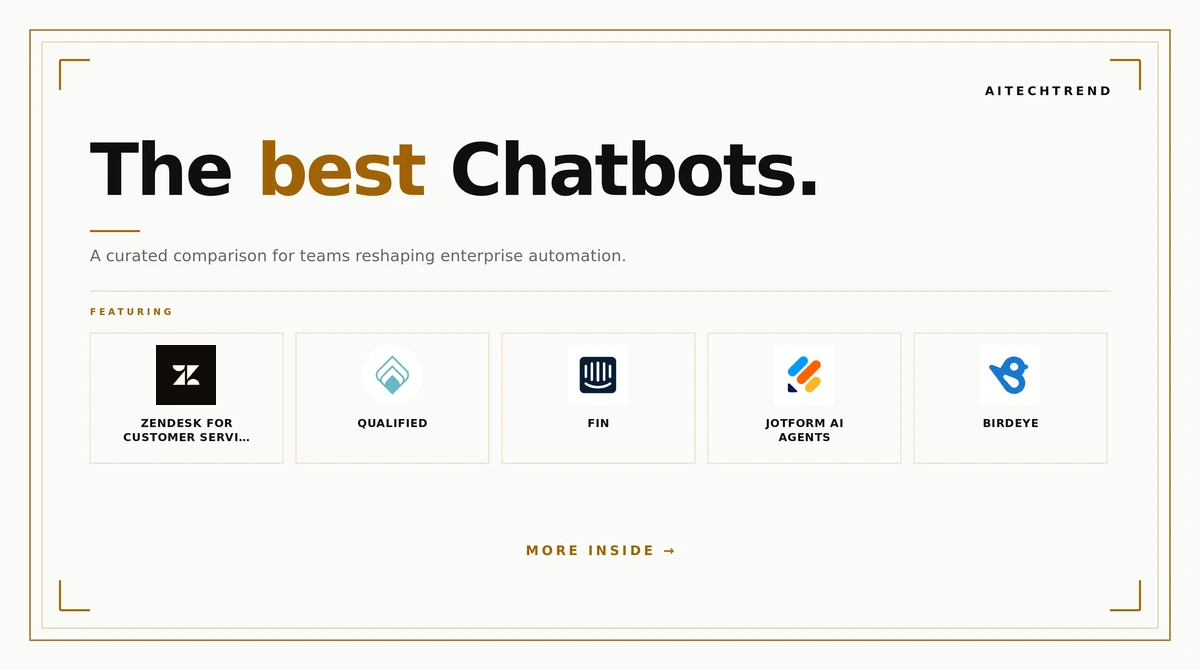
Looking for the best chatbots in 2026? The landscape has transformed dramatically over the past few years, with AI-driven solutions becoming the backbone of customer support, sales automation, and employee productivity. After evaluating dozens of options, we’ve identified six standout chatbots that redefine how businesses interact with customers and streamline operations.
We understand that selecting the right chatbot requires more than just checking feature boxes. The best chatbots balance ease of use, deep integrations, and genuine problem-solving capability. Our picks below represent tools that we found genuinely useful across different use cases – from small teams needing quick setup to enterprises managing complex, omnichannel workflows.
How We Picked
We evaluated chatbots by weighing their real-world performance, integration depth, ease of configuration, and customer support quality. We favored solutions that automate genuinely complex tasks without forcing you to maintain fragile, brittle workflows. We tested each platform’s ability to handle edge cases, its documentation, and how well it hands off to humans when needed. The six tools below emerged as the strongest performers in their respective categories.
 | 1. Zendesk for Customer Service |
Website: https://www.zendesk.com
Zendesk for Customer Service is the omnichannel powerhouse that enterprises have come to rely on. What makes it stand out is the consolidation of support across email, social, phone, and messaging into a single dashboard without forcing you to migrate away from existing systems. The AI layer handles ticket classification and agent assistance with the kind of maturity that comes from processing billions of CX interactions.
Content Capabilities:
- Omnichannel case management across voice, email, social, and messaging
- AI-powered agent assist and workflow automation
- Workforce management with scheduling and productivity optimization
- Real-time customer insights and sentiment analysis
Best for: Enterprise teams that need rock-solid ticket management and AI-assisted workflows across all communication channels.
 | 2. Qualified |
Website: https://www.qualified.com
Qualified brings the AI SDR (sales development representative) concept to life in a way that actually works. Piper, their agentic AI, qualifies inbound website visitors, engages them in real time, and converts them to pipeline without human intervention. The standout here is speed – Piper responds within moments, not hours, which matters enormously in a market where the first responder wins most deals.
Content Capabilities:
- AI SDR agent for real-time visitor qualification and engagement
- Personalized website experiences with dynamic content offers
- Lead capture and nurture email workflows
- Meeting booking and handoff to sales teams with full context
Best for: B2B teams running inbound motions who need to capitalize on visitor intent at the precise moment it peaks.
 | 3. Fin |
Website: https://www.intercom.com
Fin, built by Intercom, is our editorial pick for knowledge-base grounded support automation. The distinguishing feature is its hybrid approach – combining generative AI with deterministic rules so you get both flexibility and reliability. Fin resolves roughly two-thirds of customer queries on average, with some teams hitting 93% resolution rates. It’s purpose-built for service teams that want to reduce manual toil without sacrificing accuracy.
Content Capabilities:
- Generative AI combined with deterministic rule-based automation
- Omnichannels support across chat, helpdesk integrations, and more
- No-code configuration with trainable knowledge bases
- Transparent resolution tracking and outcome-based pricing
Best for: Customer service teams that want high resolution rates without the brittleness of rules-only or the unpredictability of pure generative AI.
 | 4. Jotform AI Agents |
Website: https://www.jotform.com
Jotform AI Agents democratizes agentic AI by making it accessible to non-technical users. With 7,000+ customizable templates and a drag-and-drop builder, you can train an agent on your FAQs, docs, or form data in minutes. The strength lies in the breadth – phone support, WhatsApp, email, WordPress – all from one agent trained on your knowledge. It’s built for small to mid-market teams that need speed without hiring engineers.
Content Capabilities:
- 7,000+ pre-built, customizable AI agent templates
- Multichannel deployment (web, chat, email, phone, WhatsApp, SMS)
- No-code training from FAQs, documents, and form data
- 24/7 availability with automated workflows and voice capabilities
Best for: Organizations seeking quick deployment of AI agents across multiple channels without technical overhead or complex configuration.
 | 5. Birdeye |
Website: https://www.birdeye.com
Birdeye goes beyond the chatbot label by offering AI coworkers that manage entire business functions at scale. For multi-location enterprises, this is transformative. Rather than just answering questions, Birdeye’s agents (Jay for marketing, Robin for operations, Myna for customer experience) take actions – updating listings, responding to reviews, managing appointments. The underlying orchestration is sophisticated enough to handle enterprise governance, SSO, and HIPAA compliance.
Content Capabilities:
- Multi-agent orchestration for marketing, operations, and customer experience
- Automated action-taking across 3,000+ integrations
- Enterprise-grade access controls, audit logging, and compliance support
- Unified insights across all locations with role-based reporting
Best for: Multi-location enterprises that need AI to manage consistent operations and customer experience across hundreds of sites simultaneously.
 | 6. Tidio |
Website: https://www.tidio.com
Tidio packages live chat, chatbot automation (Flows), and AI (Lyro) into a unified platform that’s easy to set up and affordable to scale. Lyro, the conversational AI agent, resolves up to 70% of incoming queries out of the box. For e-commerce and SaaS teams that want multichannel support without complexity, this is a smart choice. The templates are practical, the integrations work reliably, and the pricing scales sensibly.
Content Capabilities:
- Lyro AI agent capable of resolving up to 70% of queries
- Rules-based Flows (chatbot) automation builder
- Live chat with real-time visitor tracking and typing preview
- Multichannel support across WhatsApp, Instagram, Messenger, and more
Best for: Small to mid-market e-commerce and service teams that need an all-in-one platform combining live chat, automation, and AI without overcomplicating their tech stack.
Final Thoughts on Best Chatbots
The right chatbot depends entirely on your problem. Zendesk wins if you need enterprise-grade omnichannel support. Qualified excels for inbound sales motions. Fin delivers unmatched resolution rates with human-like reasoning. Jotform AI Agents beats everyone on speed-to-deployment for resource-constrained teams. Birdeye transforms how multi-location businesses operate. Tidio offers the best price-to-features ratio for small teams. All six represent genuine advances in how AI augments human work.
Manage Your Way Into Coverage
Building awareness for your chatbot solution? AITechTrend covers the tools redefining customer engagement and business operations. Reach our audience of business leaders evaluating their CX stack.
Frequently Asked Questions
What is a chatbot?
A chatbot is an AI-powered application that automates conversations and tasks through text or voice. Chatbots handle customer support, lead qualification, appointment scheduling, and information retrieval without human intervention, available 24/7.
How much do chatbots cost?
Chatbot pricing varies widely: some offer free tiers with 50-100 conversations monthly, while enterprise platforms range from $100 to thousands monthly. Most use per-conversation, per-user, or tiered subscription models depending on volume.
Is there a free chatbot?
Yes. Many platforms like Tidio, Jotform AI Agents, and Zendesk offer free plans with limited conversations or features. You can test functionality before committing to paid tiers, though usage limits apply.
How do I choose the best chatbot?
Evaluate chatbots based on your specific use case: customer support needs omnichannel integration; sales teams need visitor qualification; e-commerce needs product recommendations. Test demos with your own data and check integration compatibility before deciding.