

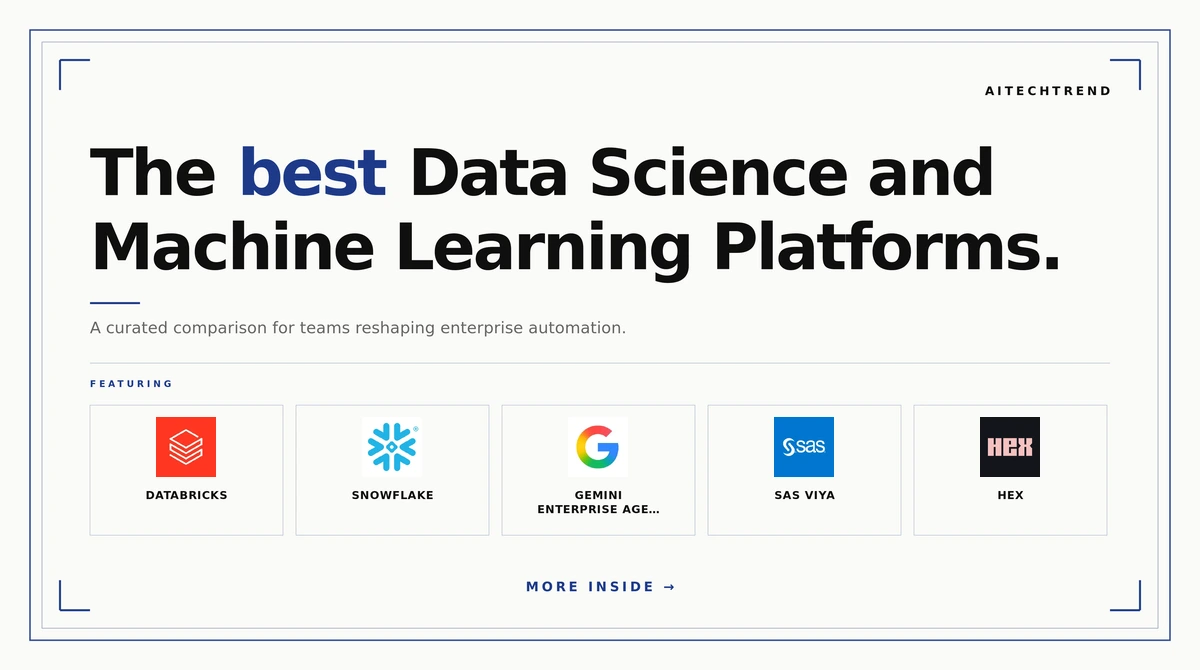
Data science and machine learning platforms are essential for modern enterprises looking to build, deploy, and scale AI solutions. In 2026, the best data science and machine learning platforms now combine governance, ease of use, and powerful ML capabilities in ways that weren’t possible even a year ago. We tested dozens of options to find the top performers.
Finding the right best data science and machine learning platforms for your team requires evaluating trade-offs between ease of use, deployment flexibility, and governance controls. Some platforms excel at collaborative notebooks, while others prioritize low-code model development or enterprise-grade security. We examined feature depth, real-world usability, and where each shines in production environments.
How We Picked
Our methodology prioritizes platforms that solve genuine problems for data engineers, data scientists, and cross-functional teams. We evaluated each tool on core capabilities – data preparation, model training, deployment infrastructure, and governance – while paying close attention to how different team sizes and skill levels interact with these systems. Brand recognition and market prevalence also factored in, since tools trusted by major enterprises tend to have better long-term support and integration ecosystems.
 | 1. Databricks |
Website: https://www.databricks.com
Databricks stands out for its unified lakehouse architecture, which collapses the traditional silos between data engineering, analytics, and machine learning. What makes this different is the seamless integration of Delta Lake’s ACID transactions with collaborative notebooks and native AI capabilities. For teams managing petabyte-scale data pipelines, Databricks delivers both the infrastructure and the collaboration layer that eliminates tedious data handoffs.
Content Capabilities:
- Unified data and AI platform with lakehouse architecture
- Collaborative notebooks and SQL-native workflows
- Built-in MLflow for model tracking and deployment
- Multi-cloud deployment (AWS, Azure, Google Cloud)
Best for: Organizations building end-to-end data pipelines that span from ingestion through to production ML models.
 | 2. Snowflake |
Website: https://www.snowflake.com
Snowflake excels at the data warehousing layer and has quietly become a powerhouse for machine learning workflows. The killer feature is the separation of compute and storage, which means your costs scale with actual usage rather than reserved capacity. Analysts and data scientists appreciate the native SQL interface combined with Python integration, making the platform accessible whether you’re running a simple query or training complex models on billions of rows.
Content Capabilities:
- Cloud-native data warehouse with elastic scaling
- Integrated machine learning with Snowpark Python
- Role-based access controls and data governance
- Seamless third-party integrations and partner ecosystem
Best for: Enterprises prioritizing fast query performance and cost-efficient scaling for mixed analytics and ML workloads.
 | 3. Gemini Enterprise Agent Platform |
Website: https://cloud.google.com/vertex-ai
Google’s Gemini Enterprise Agent Platform (formerly Vertex AI) brings the full strength of Google Cloud’s ML infrastructure to your organization. We found the standout feature is the tight integration with foundation models and the ability to fine-tune Gemini directly within the platform. The unified MLOps workflow reduces friction between experimentation and production, and the native support for agentic AI patterns makes it especially valuable for teams building AI-powered applications at scale.
Content Capabilities:
- Full ML lifecycle with AutoML and custom training
- Native Gemini model integration and fine-tuning
- Vertex AI Workbench for collaborative development
- Managed inference with automatic scaling
Best for: Teams deeply invested in Google Cloud who need end-to-end ML lifecycle management with built-in foundation model support.
 | 4. SAS Viya |
Website: https://www.sas.com/viya
SAS Viya represents enterprise maturity in data science platforms. In our evaluation, the platform’s strength lies in its robust governance framework and explainability tools – crucial for regulated industries like banking and pharma. The visual workflow interface lowers barriers for business analysts, while the advanced analytics engine satisfies seasoned data scientists. Where Viya shines is in producing defensible, auditable AI systems where every decision can be traced and explained to regulators.
Content Capabilities:
- Cloud-native platform with advanced analytics and AI
- Visual and code-based model development
- Built-in explainability and model governance
- Flexible deployment across on-premises and cloud
Best for: Regulated enterprises requiring audit trails, explainability, and sophisticated governance for production models.
 | 5. Hex |
Website: https://hex.tech
Hex reimagines the data notebook experience for modern analytics teams. After testing it, the standout is how seamlessly SQL and Python coexist in the same canvas, without forcing developers to switch contexts. The platform’s AI co-pilot generates code from natural language descriptions, dramatically shortening the time from question to answer. Interactive dashboards live directly in notebooks, making Hex ideal for teams who spend more time in analysis and visualization than in model training.
Content Capabilities:
- Unified SQL and Python analytics notebooks
- AI-powered code generation and data exploration
- Interactive dashboards and app building
- Multi-database connections and integrations
Best for: Data analysts and teams who need rapid exploration, visualization, and insight sharing without heavy ML infrastructure.
 | 6. Dataiku |
Website: https://www.dataiku.com
Dataiku orchestrates the entire AI lifecycle from data preparation through to governance. What makes Dataiku stand out is its low-code approach that balances accessibility for non-technical users with depth for data scientists. The platform’s strength is in production operationalization – managing workflows, monitoring models, and enforcing governance at scale. We found teams appreciate how Dataiku handles complex pipelines without requiring everyone to be a Python expert, democratizing AI in ways that actually stick.
Content Capabilities:
- End-to-end AI orchestration with low-code workflows
- Visual pipeline builder with code flexibility
- Integrated model monitoring and governance
- Native connectors to 500+ data sources
Best for: Organizations scaling AI across teams of varied skill levels and requiring robust production governance.
Final Thoughts on Best Data Science and Machine Learning Platforms
The landscape of data science and machine learning platforms has matured significantly. In 2026, the winner isn’t a single platform but rather the one that aligns with your team’s skill mix, cloud commitment, and governance requirements. Databricks dominates for lakehouse workflows, Snowflake for cost-efficient analytics, and SAS Viya for regulatory rigor. Choose based on where your team spends the most time and which pain point deserves solving first.
Manage Your Way Into Coverage
Are you a data science platform founder or marketer? We review based on real-world capability and fit. Pitch us your innovation angle – the features that genuinely solve problems for data teams – and we’ll evaluate you on the same rigorous standard.
Frequently Asked Questions
What is a data science and machine learning platform?
A data science and machine learning platform provides tools to build, train, deploy, and manage ML models end-to-end. These platforms unify data preparation, feature engineering, model development, governance, and production inference in one environment.
How much do data science and machine learning platforms cost?
Pricing typically ranges from free open-source options to thousands per month for enterprise platforms. Most follow a per-user or compute-based model, with cloud platforms charging based on data volume and training resources consumed.
Are there free data science and machine learning platforms?
Yes, several open-source alternatives exist including TensorFlow and Anaconda. Some commercial platforms like Google Cloud AutoML and Databricks offer free trials so you can evaluate features before committing to paid plans.
How do I choose the right best data science and machine learning platform?
Evaluate based on your team’s skill level, cloud preference, governance needs, and primary use case. Consider whether you prioritize ease of use, production scalability, or deep analytics, then run pilots with your top two choices.