


TL;DR: AI gateways sit between your applications and every LLM provider, adding routing, cost controls, observability, and governance. The 2026 field spans open-source proxies, developer-focused tools, and full enterprise control planes. TrueFoundry leads for organizations that need unified governance over both LLM traffic and AI agent tool calls. LiteLLM remains the go-to open-source starting point. Portkey excels at LLMOps depth. Helicone wins on observability simplicity. Kong is the choice when you’re already on Kong. OpenRouter offers the widest model selection with zero infrastructure.
As AI moves from isolated experiments to shared organizational infrastructure, the question is no longer whether to use an AI gateway – it’s which one to use. A good gateway routes requests to the right provider, enforces cost limits before the invoice arrives, logs every call for compliance, and scales without becoming the bottleneck itself.
The 2026 market has matured enough that each major option has a clear profile. This guide compares the five most-evaluated solutions: what each one does well, where it falls short, and which team profile it fits best.
What Is an AI Gateway?
An AI gateway is a middleware layer between your applications and LLM providers like OpenAI, Anthropic, AWS Bedrock, and Google Vertex AI. Rather than embedding provider-specific API keys and logic directly into application code, teams route all LLM traffic through a central gateway that handles:
- Unified API access one endpoint regardless of which model or provider is called
- Routing and fallbacks automatic failover when a provider hits rate limits or has an outage
- Cost attribution token-level spend tracked by user, team, project, or environment
- Access control RBAC, virtual keys, and rate limits enforced centrally
- Observability request traces, latency metrics, and model performance logged end-to-end
- Guardrails input/output filtering for PII, prompt injection, and content policy
As AI agents and MCP (Model Context Protocol) tool calls become a significant share of total LLM traffic, the best gateways in 2026 also govern tool access alongside model access – a capability that separates purpose-built enterprise platforms from proxy-first tools.
Top AI Gateway Solutions in 2026
Here is a quick snapshot of the best AI gateway solutions:
| Gateway | Best for | Deployment | MCP / Agents | Compliance | Latency overhead |
| 🥇 TrueFoundry | Enterprise, regulated workloads, agentic AI | VPC, on-prem, air-gapped, hybrid | ✅ Full — Virtual MCP, RBAC, guardrails | SOC 2 Type II, HIPAA | ~3–4 ms / 350+ RPS |
| LiteLLM | Developers, prototypes, open-source flexibility | Self-managed | ❌ None | Not certified | Higher under load |
| Portkey | LLMOps, prompt management, guardrails | SaaS, hybrid, air-gapped | ⚠️ MCP support, guardrails (early access) | SOC 2, ISO 27001, HIPAA, GDPR | Low (SaaS) |
| Helicone | Fast observability, logging, analytics | SaaS, OSS self-host | ❌ None | Partial | Low (SaaS) |
| Kong AI Gateway | Existing Kong API management users | Self-managed (Kubernetes) | ❌ None | Via Kong Enterprise | Low |
| OpenRouter | Model discovery, experimentation | Hosted only | ❌ None | Not certified | Low (hosted) |
1. TrueFoundry AI Gateway

Best for: Enterprise teams that need unified governance over LLM traffic and AI agent tool calls
TrueFoundry’s AI Gateway is built on the premise that LLM management and AI agent tooling should live in one place, not two. Rather than deploying a standalone LLM proxy, TrueFoundry gives organizations a single control plane that manages model traffic, MCP tool calls, observability, and access control under the same governance layer.
Universal model routing
Connect to any LLM provider – OpenAI, Anthropic, Azure, Gemini, Mistral, AWS Bedrock, Google Vertex AI, or self-hosted models through a single OpenAI-compatible endpoint. Intelligent load balancing, automatic failover, and fallback chains ensure continuity when provider quotas or outages occur. TrueFoundry supports 1,000+ LLMs through a unified API; switching models is a one-field change, not an integration rewrite.
Sub-3ms overhead at scale
Authentication, rate limiting, and routing are handled in-memory, keeping gateway-added latency under 3ms even under heavy load. At 350+ RPS on a single vCPU, the gateway is designed to sit in the hot path without becoming the bottleneck. Semantic caching further reduces costs and latency for repeated or similar queries.
RBAC, access control, and MCP governance
Define which teams or users can access which models, with per-team rate limits and quotas enforced at the gateway layer. The same RBAC system extends to MCP tool access, so there’s no separate permission model for agents. Key MCP capabilities include:
- Authentication and security controls for MCP servers with centralized authorization across teams
- Virtual MCP Servers that aggregate tools through a unified interface
- OpenAPI-to-MCP conversion to expose existing APIs as MCP-compatible tools without rebuilding integrations
- IDE integration so developers connect MCP servers directly from coding assistants while governance stays centralized
- Hosted stdio-based MCP Servers with centralized operational management
Guardrails and content safety
Built-in input and output guardrails for PII detection, prompt injection defense, and content policy enforcement – configurable per team or deployment without custom middleware. TrueFoundry runs the entire hot path, including guardrail evaluation, inside your Kubernetes cluster with no external dependencies.
Enterprise Features That Actually Work
TrueFoundry achieved SOC 2 Type 2 and HIPAA compliance in 2024, with authentication systems supporting Personal Access Tokens for development and Virtual Account Tokens for production, plus OAuth 2.0 integration for enterprise identity providers.
What sets TrueFoundry apart is its comprehensive cost management that goes beyond basic tracking. Token-level usage attribution lets you understand costs by user, team, geography, or any custom dimension. Real-time budget enforcement prevents surprises, while detailed analytics help optimize spending patterns. Teams typically see 30-70% cost reduction compared to direct provider usage.
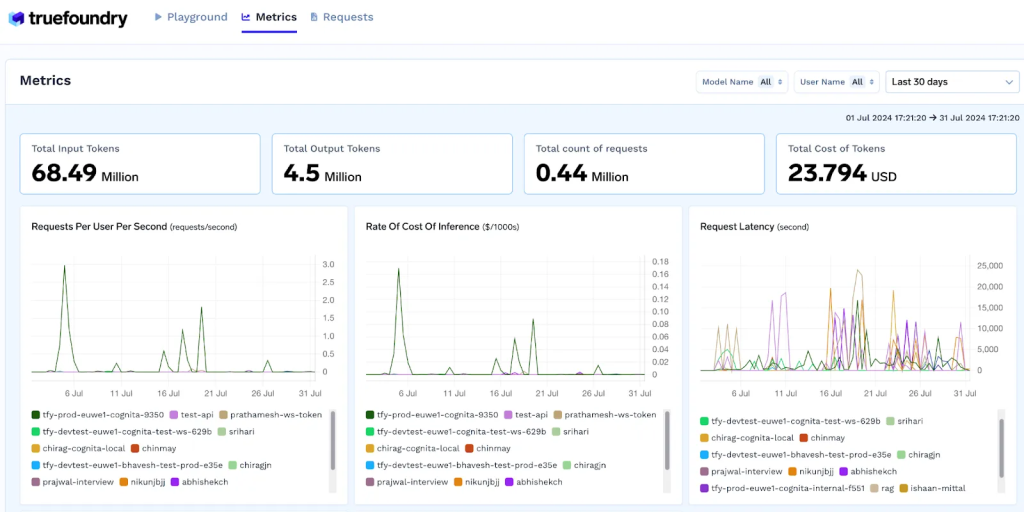
The Model Context Protocol (MCP) Gateway represents forward-thinking architecture for enterprise tool integration. Instead of building custom connectors for every enterprise tool, you get centralized MCP server management with OAuth 2.0 secured access to tools like Slack, GitHub, and Confluence, plus comprehensive observability across agent workflows.
Pricing: Free tier available; Pro tier at $499/month for up to 1M requests with all enterprise features. Enterprise pricing by quote.
Explore TrueFoundry AI Gateway →
2. LiteLLM
Best for: Individual developers and small teams wanting open-source flexibility
LiteLLM is the most widely adopted open-source AI gateway, providing a Python-based proxy server with a unified OpenAI-compatible API for 100+ LLM providers. It is commonly deployed as an internal gateway that teams run and operate themselves.
What it does well
- Universal API compatibility with all major providers using consistent OpenAI-format requests
- YAML-based configuration making it easy to define model lists, fallbacks, and routing rules as code
- Basic virtual keys for distributing access to team members
- Cost tracking at the key and model level
- Active open-source community with wide documentation coverage
Where it falls short at enterprise scale
LiteLLM works well for individual developers and experiments. As organizations grow, several gaps become significant: no formal commercial backing means no enterprise SLAs, audit logs are basic, RBAC is limited to simple key management, and the platform has no native MCP or agentic governance. Teams frequently find themselves building custom middleware to cover compliance and governance requirements. The operational burden of managing Postgres, Redis, upgrades, and scaling is entirely on your team.
Pricing: Open-source core is free to self-host. LiteLLM Enterprise starts at ~$250/month; the real cost is the infrastructure and DevOps hours running around it.
3. Portkey
Best for: Production AI teams that need deep LLMOps – prompt management, observability, and guardrails
Portkey positions itself as an LLMOps platform rather than just a gateway. It provides unified access to 1,600+ AI models while extending into prompt management, guardrails, and governance tools making it a good option for teams whose primary need is prompt-level observability and control.
What it does well
- 50+ pre-built guardrails for content filtering, PII redaction, and jailbreak detection
- Advanced prompt management with collaborative templates and versioning
- Real-time monitoring with comprehensive latency and cost visibility
- MCP support (generally available as of January 2026) with central server onboarding, OAuth 2.1, and tool provisioning
Where it falls short
MCP native guardrails remain in early access — custom tool-call validation uses a webhook path rather than a first-class policy engine. Model deployment (fine-tuning, custom serving) is not natively supported, so teams running self-hosted models need an additional platform. Some users report the feature density can be overwhelming for new teams. Enterprise pricing restricts key features like budget limits to higher tiers.
Pricing: Free tier; paid plans scale by volume. Enterprise pricing by quote.
4. Kong AI Gateway
Best for: Platform teams already running Kong for API management
Kong AI Gateway extends Kong’s mature API management platform with LLM-specific capabilities. If your organization already uses Kong for REST API management, the AI Gateway adds model routing, AI-specific rate limiting, and request transformation with minimal new operational overhead.
What it does well
- Seamless integration with existing Kong API management infrastructure
- AI Proxy plugin supporting Anthropic, OpenAI, Azure, and other providers in their native formats
- Traffic logging and metrics feeding into Kong’s existing observability stack
- Enterprise support via Kong’s established commercial offering
Where it falls short
Kong AI Gateway is an extension of a traditional API management platform, not a purpose-built LLM control plane. Cost attribution by team or model, MCP governance, guardrails, and budget enforcement all require additional plugins or custom configuration. For organizations starting fresh with AI infrastructure (rather than extending existing Kong deployments), purpose-built AI gateways deliver more capability out of the box.
Pricing: Kong Konnect with AI Gateway; enterprise pricing by quote.
5. OpenRouter
Best for: Developers who want the widest model selection with zero infrastructure to manage
OpenRouter is a developer-focused hosted gateway providing a single API for accessing hundreds of models from dozens of providers. It abstracts provider credentials and billing behind a unified endpoint – you pay OpenRouter per token, and OpenRouter manages provider relationships. No infrastructure, no Kubernetes, no configuration files.
What it does well
- Widest model selection access to frontier models, open-source models, and niche providers in one place
- Zero infrastructure no deployment, no scaling, no maintenance
- Transparent routing automatic failover to maintain availability during outages
- Developer-friendly with a simple API key model
Where it falls short
OpenRouter is a hosted third-party service – data transits OpenRouter’s infrastructure, making it unsuitable for regulated workloads requiring VPC deployment or data residency controls. Governance is minimal: no RBAC, no audit logs, no per-team budget enforcement. For internal platform deployments serving multiple teams or compliance-sensitive applications, OpenRouter’s simplicity becomes a liability.
Pricing: Pay-per-token; no infrastructure costs.
Conclusion
The AI gateway market in 2026 has diverged into three clear tiers: lightweight developer proxies (LiteLLM, OpenRouter, Helicone) that get you started fast; mid-market LLMOps platforms (Portkey) that add depth around observability and prompt management; and enterprise control planes (TrueFoundry) that unify model routing, agent tool governance, compliance, and deployment in a single Kubernetes-native platform.
For most enterprise teams, the right choice is not the tool that covers the most surface area today it’s the tool whose architecture fits where your AI footprint is heading. Organizations running AI agents alongside LLM workloads, or operating in regulated industries, will find that governance built in from day one costs far less than governance bolted on after production.