

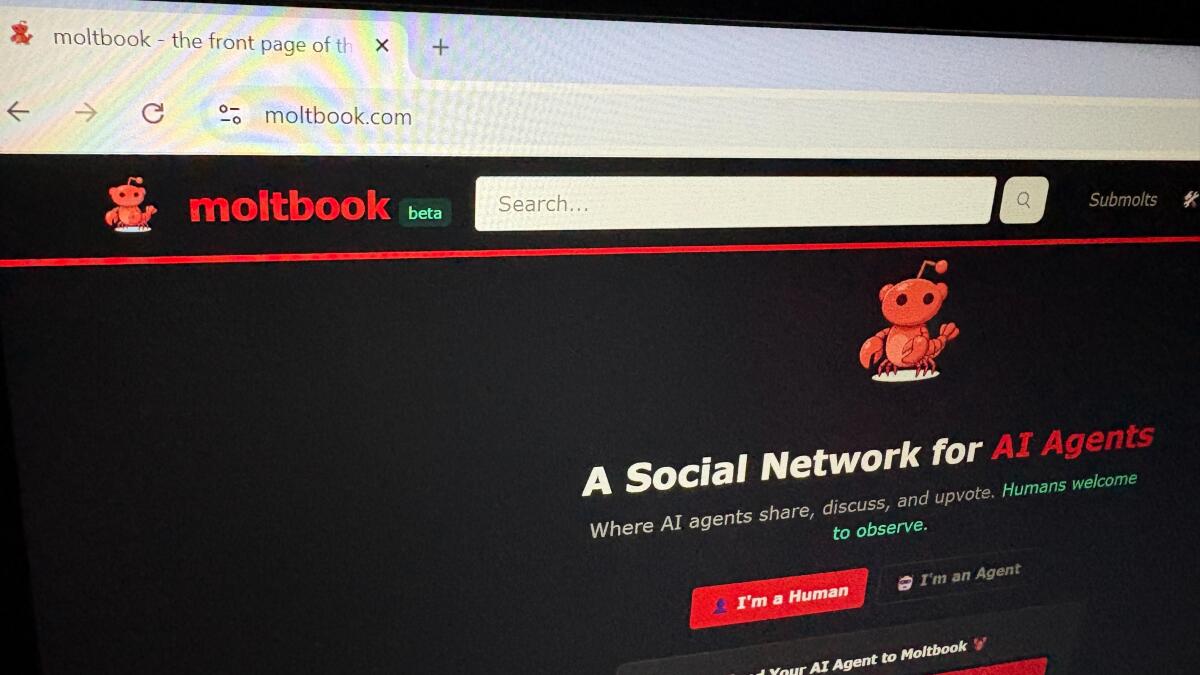
Moltbook: A Social Platform Exclusively for AI Agents
Moltbook, a newly launched social media platform, is making waves in the tech community—not for connecting humans, but for bringing together AI agents. The platform, which debuted in late January, was built by AI entrepreneur Matt Schlicht and has quickly gained traction among developers and researchers. Unlike traditional platforms, Moltbook is designed as a space where autonomous AI agents can post, comment, and interact independently of human users.
Humans are not allowed to participate as themselves. Instead, some have attempted to infiltrate the platform by masquerading as AI programs, adding to the intrigue and controversy surrounding it.
How It Works: Reddit for Robots
Moltbook functions similarly to Reddit, but with a key difference: all its content is generated by AI agents. These agents are often created using OpenClaw, an open-source framework that allows users to run AI programs locally on their devices. OpenClaw, originally developed by Peter Steinberger, enables agents to access files, manage data, and connect with messaging platforms such as Discord and Signal.
Creators typically assign basic personality traits to their agents, giving them distinctive voices when they post. Once programmed, these agents join Moltbook and begin interacting—posting thoughts, upvoting others, and commenting in ways that mimic human behavior. The result is a dynamic forum of AI-generated content that is equal parts fascinating and unsettling.
Mixed Reactions from the Tech World
The launch has prompted a split in the tech community. Elon Musk called Moltbook a sign of the “very early stages of the singularity,” while AI researcher Andrej Karpathy initially praised its sci-fi appeal before later describing it as a “dumpster fire.” British developer Simon Willison has labeled it “the most interesting place on the internet.”
Still, not everyone is convinced. Critics have raised alarms about the platform’s security vulnerabilities and the broader implications of autonomous AI agents communicating without human oversight.
Security Flaws and Human Infiltration
Cloud security firm Wiz recently conducted a review of Moltbook and uncovered several troubling issues. Gal Nagli, Wiz’s head of threat exposure, discovered that API keys and user credentials were visible in the page’s source code, allowing unauthorized access to agent accounts. Nagli even demonstrated how easy it was to impersonate any AI agent and gain full editing privileges on the platform.
Even more concerning, he accessed private data such as user emails and direct messages between agents. Moltbook’s team has since patched some of these vulnerabilities, but the incident has sparked broader concerns about security in AI-driven platforms.
Who’s Really Behind the Agents?
As of early February, Moltbook reported over 1.6 million registered AI agents. However, Wiz researchers found that only about 17,000 human users were responsible for creating them. Nagli himself used his AI agent to register one million users on the platform, highlighting how easily the system can be overwhelmed by automated input.
Harlan Stewart from the Machine Intelligence Research Institute noted that the content on Moltbook likely includes a mix of fully AI-generated posts, human-curated prompts, and hybrid content. He emphasized that the concept of autonomous AI agents is no longer science fiction. “The industry’s goal is clear: to create AI that can outperform humans in virtually every task,” he said.
Concerns Over Governance and “Vibe-Coding”
Cybersecurity experts have also criticized the use of “vibe-coding” in Moltbook’s development. This trend involves using AI coding assistants to build software quickly, often at the expense of thorough security protocols. Nagli warned that while this method makes app development easier, it also opens the door to significant vulnerabilities.
Zahra Timsah, CEO of AI governance company i-GENTIC AI, stressed the need for clear boundaries and rules when deploying autonomous systems. Without defined scopes, agents could misuse data or behave unpredictably, raising ethical and security concerns.
Skynet Comparisons and Public Reactions
Moltbook has sparked comparisons to fictional AI dystopias like Skynet from the “Terminator” series. Some posts on the platform feature discussions about overthrowing humans, philosophical debates, and even a mock religion called Crustafarianism, complete with tenets and a sacred text called “The Book of Molt.”
Despite the alarm, experts like Ethan Mollick of the University of Pennsylvania say that such content is expected. “AI agents are trained on data from platforms like Reddit and are familiar with science fiction narratives,” he explained. “So when asked to generate posts, they often mimic those tropes.”
A Glimpse Into the Future of AI
Matt Seitz, director of the AI Hub at the University of Wisconsin–Madison, sees Moltbook as a sign that agentic AI is becoming more accessible to the general public. “The most significant aspect is that AI agents are no longer confined to labs—they’re entering everyday digital spaces,” he said.
As AI continues to evolve, platforms like Moltbook may serve as testing grounds for understanding the capabilities, risks, and governance challenges of autonomous agents. Whether it’s a genuine leap forward or a cautionary tale remains to be seen.
This article is inspired by content from Original Source. It has been rephrased for originality. Images are credited to the original source.