

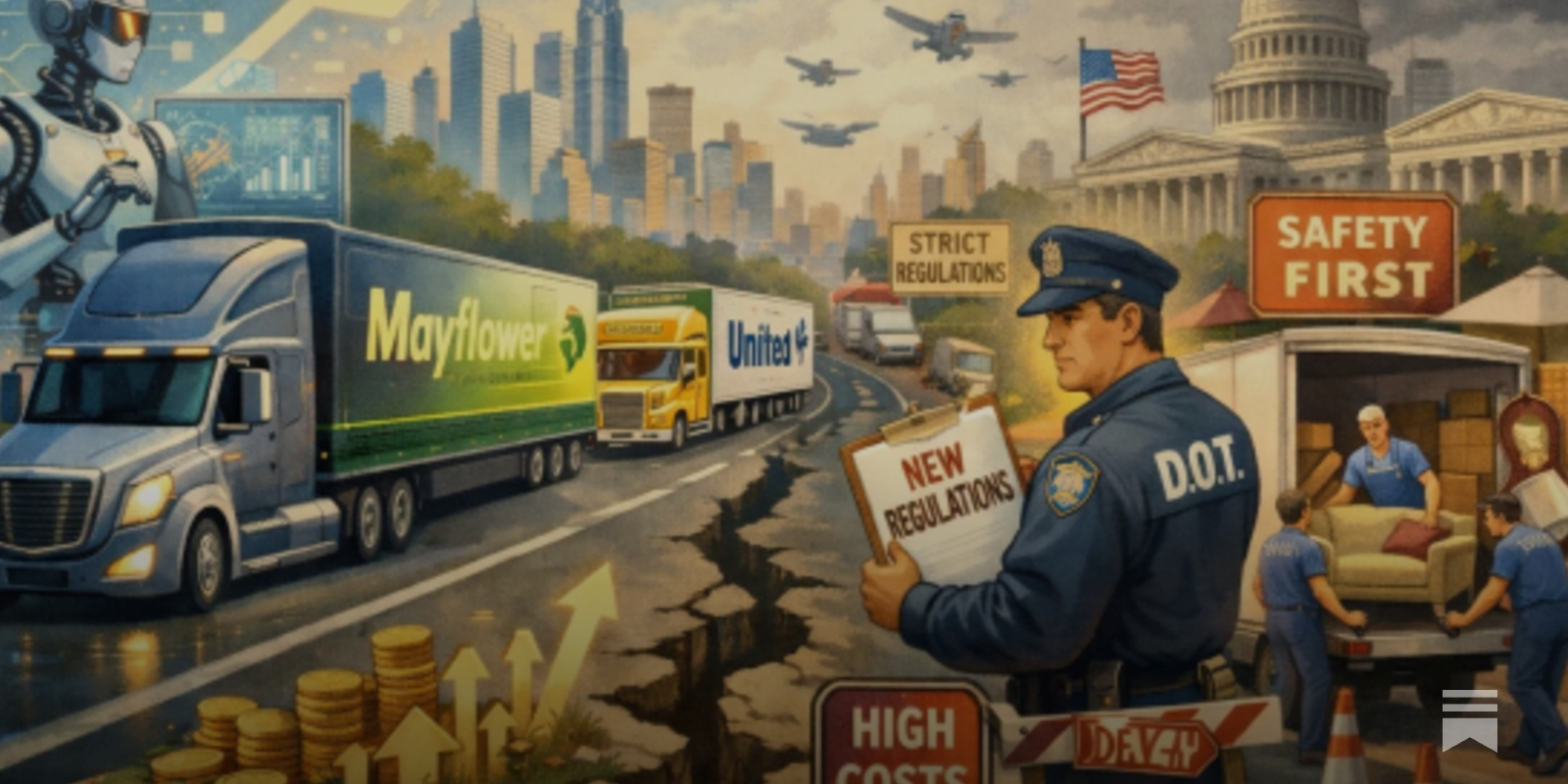
AI Disruption and Regulatory Changes Shake Trucking Industry
On February 12, 2026, logistics and trucking stocks faced a dramatic equity market downturn. Companies like RXO, C.H. Robinson, Expeditors International, XPO, and J.B. Hunt saw stock prices plunge between 5% and 20.5% in just one trading session. The unexpected catalyst wasn’t rising fuel prices or labor disputes—it was the debut of a revolutionary artificial intelligence (AI) platform by Algorhythm Holdings.
The company unveiled its Semi-Cab AI platform, a freight-scaling solution that promises to reduce empty miles by over 70% and increase freight volume capacity by up to 400%, all without boosting headcount. In an industry with razor-thin margins and high labor expenses, the announcement was seismic. Investors swiftly recalibrated expectations, anticipating commoditized routing, reduced pricing power, and an impending technological arms race among carriers.
New DOT Rule Threatens to Remove Nearly 200,000 Drivers
Just a day earlier, a more profound structural shift emerged. On February 11, 2026, the U.S. Department of Transportation finalized a rule via the Federal Motor Carrier Safety Administration that disqualifies individuals with Deferred Action for Childhood Arrivals (DACA), Temporary Protected Status (TPS), asylum status, or Employment Authorization Documents (EADs) from obtaining or renewing commercial driver’s licenses (CDLs). Effective March 16, 2026, the rule is expected to phase out approximately 194,000 drivers over two years—about 5% to 8% of the interstate CDL workforce.
This rule also prohibits non-domiciled commercial learner’s permit holders from upgrading to full CDLs. Only individuals under specific visa categories—H-2A, H-2B, and E-2—remain eligible, pending federal verification. Analysts estimate just 6,000 new eligible drivers annually, far short of the anticipated shortfall.
Labor Shortage Meets Technological Promise
Even before the regulatory shift, the trucking industry was already grappling with a driver deficit of 60,000 to 80,000. With 3.5 million CDL holders nationwide, demographic pressures such as aging drivers and limited new entrants have strained the labor pool. The DOT’s decision exacerbates this shortage, making it harder for firms to maintain route coverage and shipment schedules.
For companies like UniGroup, which oversees United Van Lines and Mayflower Transit, the contrast is stark: technological abundance via AI clashing with regulatory-induced labor scarcity. While AI can optimize routing and automate logistics, it still requires licensed operators to move freight—highlighting a critical bottleneck.
Safety Concerns and the DACA Paradox
Transportation Secretary Sean P. Duffy defended the new rule by citing 17 fatal crashes in 2025 involving non-domiciled drivers. These incidents accounted for 30 deaths. However, in context, over 3,700 fatal truck crashes occurred that year, with non-domiciled drivers responsible for just 0.45% of them. The majority involved domestically domiciled drivers.
The regulation has sparked controversy, especially concerning DACA recipients. Most arrived in the U.S. as children and have lived in the country for over two decades. With an average age of 32, roughly 84% are active in the labor force and fluent in English. Under the new guidelines, however, they are barred from operating interstate trucks—even as some states allow them to practice medicine. This contradiction underscores the disconnect between federal and state licensing laws and the complexities of integrating immigration policy with labor market needs.
English Proficiency and Compliance Risks
The new rule also mandates rigorous English proficiency standards across all CDL holders. Drivers must read road signs and communicate effectively with authorities. Noncompliance during roadside inspections can lead to immediate out-of-service rulings. While naturalized citizens and Green Card holders maintain eligibility, the heightened scrutiny forces firms to conduct internal audits to prevent abrupt operational disruptions.
Interestingly, the rule does not apply to non-driving roles like dispatchers and IT staff, though companies may still impose language requirements consistent with civil rights law.
AI as a Game-Changer or Competitive Threat?
The launch of Algorhythm’s AI platform introduces not only efficiency but also uncertainty. By minimizing empty miles—essentially trips without cargo—the technology addresses a key inefficiency in the sector. AI-enabled load matching and predictive analytics offer the potential to increase productivity per driver and counteract rising labor costs.
Yet for publicly traded logistics firms, the fear of margin compression and competitive threats looms large. Cooperatives and smaller agents could benefit from AI democratization, gaining access to tools previously reserved for large enterprises. Over time, this technological equalization may empower smaller operators and enhance overall industry resilience.
Rising Consumer Costs and Industry Investment
A reduced driver pool is likely to drive up freight rates, particularly during peak seasons. For consumers, this may translate into more expensive interstate moves. Driver recruitment costs—which range from $7,000 to $20,000 per hire—are also expected to climb as companies vie for a shrinking talent base.
Truck Driver USA estimates that labor shortages cost the industry approximately $95 million per week in 2025. While AI can mitigate some losses, the transitional period will involve significant capital investment and process overhauls.
What Lies Ahead?
In the short term, the labor shock is likely to be a net negative. Operational bottlenecks, compliance costs, and uncertainty will weigh heavily. Market reactions like the February 12 sell-off reflect this unease.
However, in the medium to long term, the outcome hinges on strategic adaptation. Companies that swiftly adopt AI—leveraging route optimization, digital dispatch, and predictive analytics—may offset labor constraints. Those with strong networks and brand equity could gain pricing power and adapt by integrating semi-autonomous or driverless technologies for long hauls.
If successful, this dual shock—regulatory tightening and technological advancement—could ultimately strengthen the industry. But the road ahead demands agile execution, robust compliance, and sustained investment in innovation.
This article is inspired by content from Original Source. It has been rephrased for originality. Images are credited to the original source.