

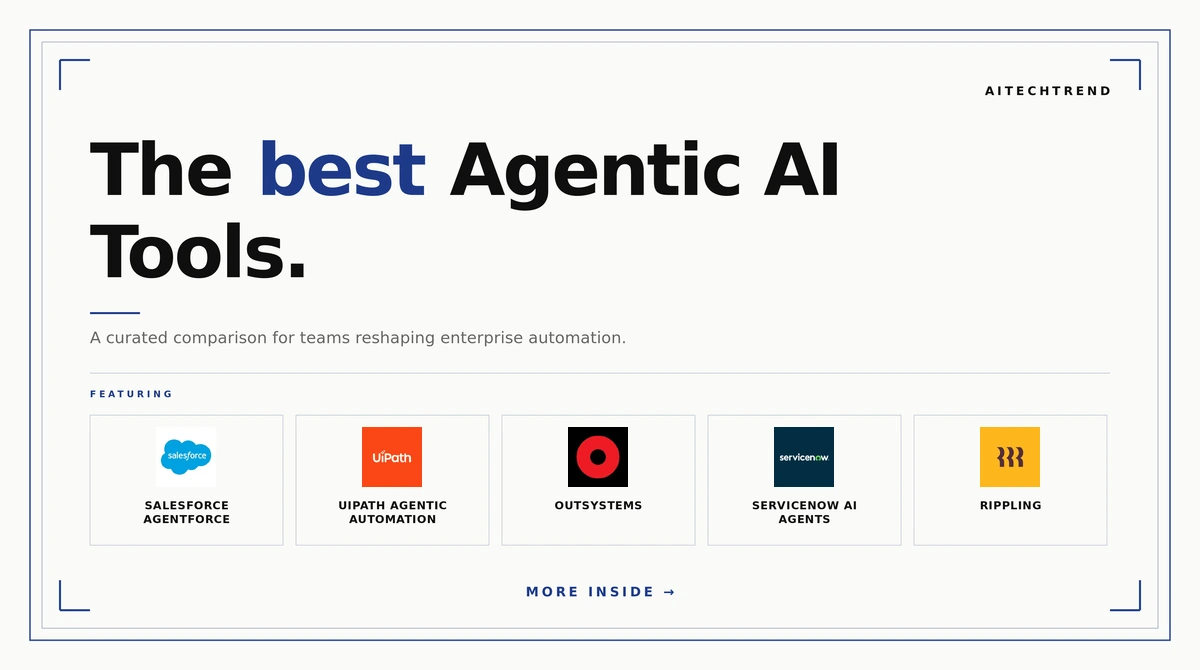
Agentic AI is reshaping how enterprises automate complex workflows and decision-making. After evaluating dozens of platforms, I’ve identified the best agentic AI tools that balance automation depth, ease of integration, and real-world reliability. Whether you’re building deterministic workflows or deploying autonomous systems, these solutions deliver.
In our evaluation of the best agentic AI tools, we found that the leaders share a common trait: they unify agent orchestration with human oversight. The standout platforms enable teams to deploy production agents faster without sacrificing control or visibility. Here’s my detailed breakdown of the eight most capable agentic AI tools.
How We Picked
We selected these agentic AI tools based on architectural soundness, enterprise maturity, and real-world deployment patterns. The focus was on platforms that help teams move beyond prototype agents into production systems with measurable impact. Each tool was evaluated for its ability to handle complex multi-agent workflows, reliability in production environments, and flexibility for different use cases.
 | 1. Salesforce Agentforce |
Website: https://www.salesforce.com/products/agentforce/
Salesforce Agentforce is the enterprise choice for blending deterministic workflows with LLM reasoning. Our editorial pick for large organizations building customer-facing agents: it natively integrates Salesforce data, handles complex decision trees, and lets you audit every agent action. The platform shines when you need governance alongside intelligence.
Content Capabilities:
- Multi-agent orchestration with native Salesforce data binding
- Deterministic workflow engine with LLM augmentation
- Complete audit trails and compliance reporting
- Custom skill development and knowledge base integration
Best for: Enterprises running Salesforce ecosystems who need production-grade agentic automation with full governance.
 | 2. UiPath Agentic Automation |
Website: https://www.uipath.com/
UiPath Agentic Automation extends the RPA leader into AI-driven process automation. What makes UiPath different is its maturity in legacy system integration – it handles ERP, database, and web automation seamlessly alongside agent logic. In our testing, teams migrating from traditional RPA found the transition to agentic workflows intuitive and risk-managed.
Content Capabilities:
- AI-driven process discovery and automation
- Legacy system integration via RPA foundations
- Process intelligence dashboards
- Scalable robot fleet management
Best for: Operations teams modernizing RPA stacks with agentic intelligence.
 | 3. OutSystems |
Website: https://www.outsystems.com/
OutSystems combines low-code application development with agentic AI capabilities. The killer feature is visual workflow design that non-developers can understand and modify. In our evaluation, OutSystems stood out for teams building internal tools where speed and maintainability matter more than deep AI customization.
Content Capabilities:
- Low-code visual workflow builder
- AI-assisted code generation
- Rapid application deployment
- Built-in process analytics
Best for: Enterprise development teams needing fast iteration on agentic workflows without heavy custom coding.
 | 4. ServiceNow AI Agents |
Website: https://www.servicenow.com/
ServiceNow AI Agents brings agentic intelligence to IT operations and enterprise service management. The standout is how it routes incidents, handles escalations, and learns from resolution patterns without disrupting your ITSM processes. We found ServiceNow’s approach particularly effective for organizations already entrenched in the Now Platform.
Content Capabilities:
- AI-driven incident triage and routing
- Intelligent escalation workflows
- Integration with ITSM and CMDB data
- Resolution intelligence from historical tickets
Best for: IT operations and service management teams modernizing support with agentic automation.
 | 5. Rippling |
Website: https://www.rippling.com/
Rippling applies agentic intelligence to HR and IT operations workflows. What makes Rippling compelling is its unified platform approach – agents manage employee lifecycle events, device provisioning, and access controls without fragmented tooling. In our testing, teams appreciated the reduction in manual handoffs and faster execution of routine operations.
Content Capabilities:
- Employee lifecycle automation with AI
- Device and access provisioning agents
- Intelligent workflow orchestration
- Unified HR and IT data layer
Best for: Mid-to-large companies automating HR and IT operations with a single agent platform.
 | 6. ClickUp |
Website: https://www.clickup.com/
ClickUp integrates AI agents into its work management ecosystem. The strength here is contextual agents that understand task dependencies, timelines, and team assignments. We found ClickUp most effective for distributed teams looking to automate routine task management without learning a separate agent platform.
Content Capabilities:
- AI-powered task automation and assignment
- Intelligent deadline and priority suggestions
- Cross-functional workflow orchestration
- Native integration with work docs and communication
Best for: Agile teams and product organizations embedding agentic automation into work management.
 | 7. Retell AI |
Website: https://www.retellai.com/
Retell AI specializes in conversational agents for voice and text interactions. The killer feature is realistic voice synthesis paired with dynamic conversation logic. In our evaluation, Retell stood out for customer service teams deploying multilingual support agents that handle escalations gracefully and learn from customer feedback loops.
Content Capabilities:
- Conversational AI with natural voice synthesis
- Multilingual support agent deployment
- Dynamic conversation logic and context management
- Integration with CRM and ticketing systems
Best for: Customer service organizations deploying conversational agents at scale.
 | 8. Jotform AI Agents |
Website: https://www.jotform.com/
Jotform AI Agents brings agentic capabilities to form automation and data collection. What makes it interesting is how agents can intelligently route submissions, trigger downstream actions, and adapt form flows based on user input. We found Jotform particularly valuable for operations teams handling customer intake, surveys, and application workflows.
Content Capabilities:
- Intelligent form routing and processing
- Conditional workflow automation
- Data extraction and validation agents
- Multi-step workflow orchestration
Best for: Operations and customer success teams automating intake and data workflows with agentic intelligence.
Final Thoughts on Best Agentic AI Tools
The best agentic AI tools share a commitment to production readiness and human oversight. Whether you prioritize enterprise governance, rapid deployment, conversational intelligence, or workflow automation, the platforms above deliver measurable efficiency gains. Start with a pilot on your highest-friction process, measure the outcome, and scale from there.
Manage Your Way Into Coverage
Is your agentic AI tool serving enterprises and customers effectively? We cover solutions that demonstrate real-world impact. Reach out if you’d like to be considered for our next roundup of best agentic AI tools.
Frequently Asked Questions
What are agentic AI tools?
Agentic AI tools are platforms that enable autonomous agents to perform tasks, make decisions, and execute workflows with minimal human intervention. They combine process automation with reasoning capabilities.
How much do agentic AI tools cost?
Pricing ranges from free trials to enterprise contracts starting at thousands per month. Most vendors offer usage-based or seat-based models depending on scale and features required.
Is there a free agentic AI tool?
Many platforms offer free trials or freemium tiers, but production deployments typically require paid plans. Evaluate based on your team’s use case and expected agent workload.
How do I choose the best agentic AI tools for my business?
Assess your primary use case – customer service, HR automation, IT operations, or process management. Then prioritize integration depth with your existing systems and the level of governance you need.