

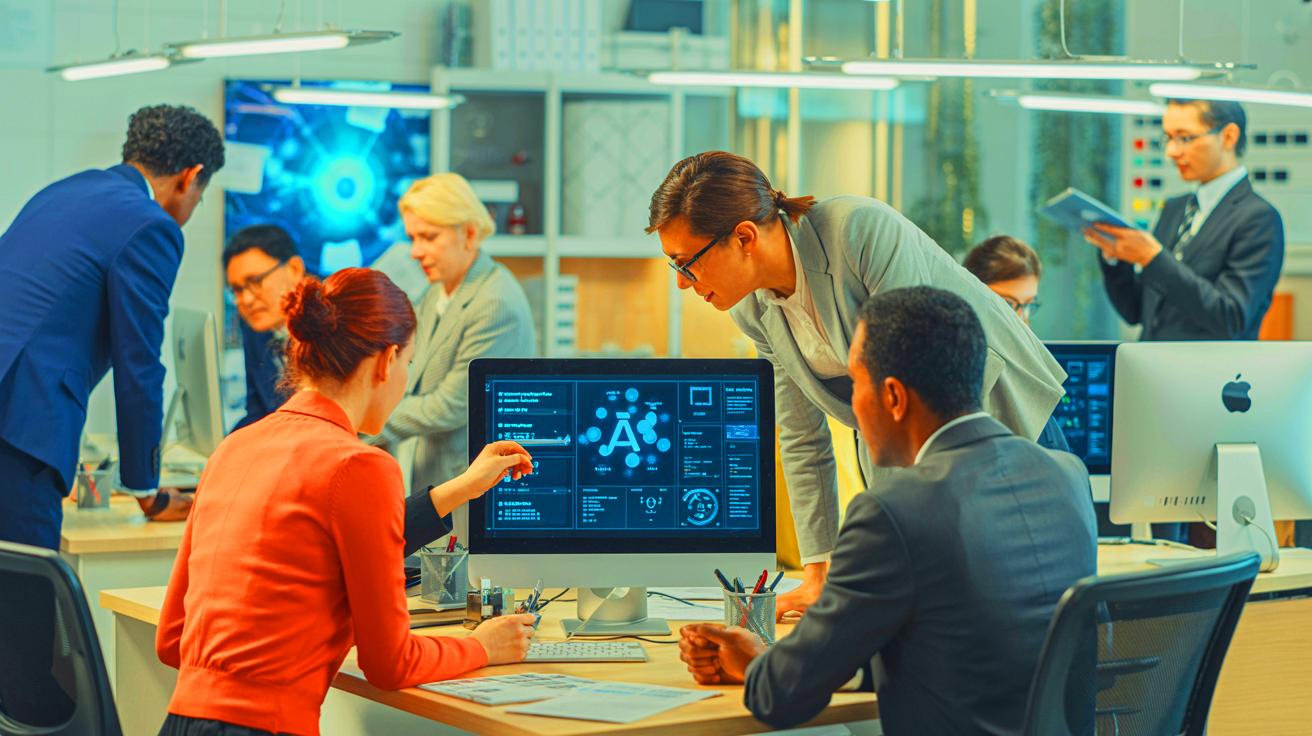
AI Replaces Humans, But at What Cost?
The rapid integration of artificial intelligence (AI) into the workforce has sparked a significant transformation in how companies operate. Seeking to boost productivity and reduce expenses, many businesses have opted to replace human workers with AI systems. However, this shift has exposed a critical flaw: AI-generated content often lacks the quality and nuance of human-produced work.
As organizations explore the limits of automation, they’re discovering the irreplaceable value of human insight. This realization has led many companies to rehire the very employees they once dismissed, in an effort to correct AI’s shortcomings. The evolving tech landscape brings to light a pressing question: how can companies balance innovation with the need for skilled human input?
AI’s Limitations Spark a Return to Human Talent
Despite its promise to revolutionize industries, AI frequently falls short in delivering polished, meaningful output. Text generated by AI can sound robotic and repetitive. Visual designs might appear generic or lack conceptual depth. Even code written by AI tools often results in unstable or inefficient applications.
Lisa Carstens, a freelance illustrator and designer based in Spain, experienced this firsthand. After being replaced by AI tools, she found herself rehired to fix subpar visuals generated by those very systems. “Many companies thought AI could function autonomously,” Carstens says. “But they quickly realized human oversight is essential.”
Her experience reflects a broader trend: companies are turning back to human professionals to elevate their AI-generated content to acceptable standards. Carstens notes that while some clients understand AI’s current limitations, others grow frustrated when the technology doesn’t meet expectations. Navigating these dynamics is now part of the freelancer’s role.
A Growing Market for AI Enhancement Freelancers
The rise of AI has unexpectedly created a new niche for freelance workers—those who specialize in refining AI-generated work. Harsh Kumar, a software developer in India, has seen a surge in demand for his services. Clients often approach him after investing in AI tools that failed to deliver satisfactory results.
“AI can help speed up certain tasks, but it can’t replace human intuition and experience,” Kumar explains. “For long-term, complex projects, human involvement remains crucial.”
Freelancers like Kumar are now tasked with reworking AI-generated code, improving user interfaces, and ensuring that final products meet industry standards. The nature of freelance assignments is shifting—from original creation to enhancement and correction of flawed AI content.
Pay Disparities and Changing Job Expectations
While companies turn to human workers for quality control, they often attempt to reduce pay by arguing that the work is no longer being done from scratch. Instead, they frame it as editing or refining existing AI content. This has sparked debate about fair compensation and the true value of human labor in an AI-assisted environment.
This trend underscores a new form of human-machine collaboration, where each contributes distinct strengths to a project. Yet the financial recognition of human expertise remains uncertain. As companies look to strike a balance between cost-efficiency and quality assurance, the question of appropriate pay for freelancers correcting AI’s errors looms large.
AI in the Workplace: Boon or Burden?
Artificial intelligence offers numerous benefits, including faster processing and reduced labor costs. But its implementation also reveals inherent limitations. The experience of freelancers like Carstens and Kumar illustrates the ongoing need for human oversight to maintain quality.
Businesses are now reevaluating their AI strategies. While the initial excitement around automation led to mass layoffs, the subsequent challenges have forced many to reconsider. AI might be a powerful tool, but it’s not a complete replacement for the creativity, context, and emotional intelligence that humans provide.
As AI becomes more embedded in workplace operations, companies must make strategic decisions about its role. Should AI be used as a supplement to human efforts rather than a substitute? Can a hybrid model of collaboration yield better results than automation alone?
These questions point to a future where technology and human skill coexist, each enhancing the other. To succeed, businesses must not only adopt advanced tools but also recognize and fairly compensate the human talent that ensures those tools perform effectively.
The Path Forward
In the wake of AI’s rapid adoption, a clearer picture is emerging. Human expertise remains essential, especially when AI falls short. Companies are coming to terms with the need to reintegrate human workers into their operations—not as a step backward, but as a necessary evolution toward more balanced workflows.
As the workplace continues to transform, the key to sustainable innovation may lie in respecting the complementary strengths of both AI and human professionals. Organizations that understand this dynamic are more likely to achieve quality outcomes while navigating the shifting technological landscape.
This article is inspired by content from Original Source. It has been rephrased for originality. Images are credited to the original source.