

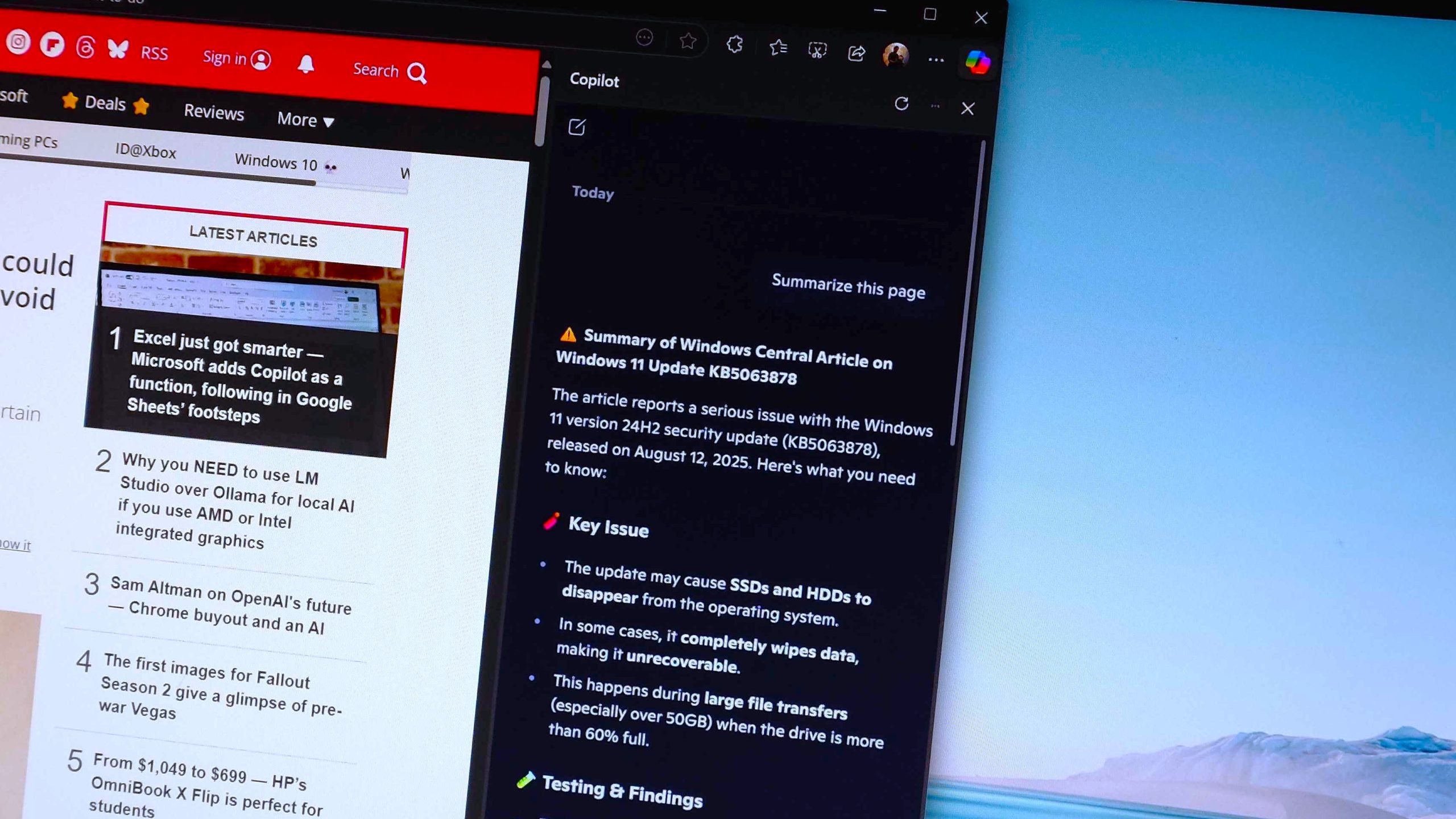
Copilot Remains the Best Tool for Summarizing Web Pages
In an age where efficiency is paramount—especially for busy professionals or parents—being able to quickly digest information is crucial. As someone who reads countless web pages daily for research, news, and reviews, I’ve come to rely heavily on AI tools to summarize content. And despite the growth in local AI models, Copilot continues to be the gold standard for this task.
Over time, Copilot has evolved from requiring explicit prompts to delivering accurate summaries effortlessly. It has become more intuitive, conversational, and effective at extracting the essence of a webpage without the need for detailed input. This makes it incredibly useful when you’re juggling multiple articles in quick succession.
Experimenting with Local AI: Page Assist and Ollama
Despite Copilot’s strengths, my curiosity led me to explore local AI alternatives. I’ve recently been trying out platforms like Ollama and LM Studio, looking for a browser-based solution that doesn’t require complex setups or Python scripts. That’s when I discovered Page Assist, a browser extension that acts as a front-end for Ollama. It integrates well into Chrome and Edge, providing a user-friendly interface and a sidebar that interacts with open web pages.
Page Assist is a robust application with an impressive feature set. It simplifies managing local language models and allows for real-time webpage interaction. However, there’s a catch: to get it working effectively, you need to set up Retrieval-Augmented Generation (RAG). This involves pulling in an embedding model like nomic-embed-text:latest into Ollama, which Page Assist facilitates through its settings menu.
Promising Features, But Still Lags Behind
Once everything is configured, using Page Assist becomes straightforward. Right-clicking on a page lets you open a side panel to interact with its contents. If your model supports vision capabilities—such as Gemma 3 or Llama 3.2 Vision—you can even analyze images through OCR.
While the functionality is impressive, the quality of the summaries still doesn’t match what Copilot delivers. Even with powerful models like gpt-oss:20b, the output is more factual and less conversational. The summaries are adequate, but they lack the nuanced understanding and flow that makes Copilot feel like a human assistant rather than a machine.
Another drawback is the session memory management. When browsing multiple pages, Page Assist often retains context from the previous page unless explicitly instructed to forget it. This results in redundant or inaccurate summaries unless you manually reset the session. In contrast, Copilot seamlessly adapts as you move from page to page, maintaining relevance without additional input.
Where Copilot Shines
Copilot’s biggest advantage lies in its ease of use and the quality of its summaries. It anticipates user needs, offering follow-up questions that spark new ideas or angles for exploration. While I don’t always use these suggestions, they occasionally provide valuable insights I hadn’t considered. This level of interaction is something local models haven’t quite mastered yet.
Moreover, because summarizing web pages requires an internet connection anyway, using an online tool like Copilot doesn’t add any extra inconvenience. It integrates smoothly into the workflow, making it the preferred choice when time and clarity are priorities.
Local AI: A Worthy Educational Experience
Despite its shortcomings in this particular use case, local AI tools like Page Assist paired with Ollama are worth exploring. They offer a deeper understanding of how AI models work and can be tailored for specific tasks through customization. Every day spent tinkering with these tools teaches me something new, from embedding models to session management and vision integration.
Page Assist, in particular, is a remarkable tool with much potential. As I continue experimenting, I intend to explore more of its features and possibly write further about its capabilities in detail. But for now, Copilot will remain my go-to solution for quickly summarizing web content.
This article is inspired by content from Original Source. It has been rephrased for originality. Images are credited to the original source.