

Docker Addresses Major Security Vulnerability in AI Assistant
Docker has released a critical security update to fix a flaw in its integrated AI assistant, Ask Gordon, which could allow attackers to execute arbitrary code and exfiltrate sensitive data using manipulated Docker image metadata. The flaw, discovered by cybersecurity firm Noma Labs and dubbed DockerDash, impacted Docker Desktop and the Docker Command-Line Interface (CLI).
The vulnerability was resolved with the launch of Docker version 4.50.0 in November 2025. According to researchers, a single rogue metadata label embedded in a Docker image could be exploited to bypass security protocols, resulting in a three-stage attack chain capable of executing malicious commands.
How DockerDash Compromised Security
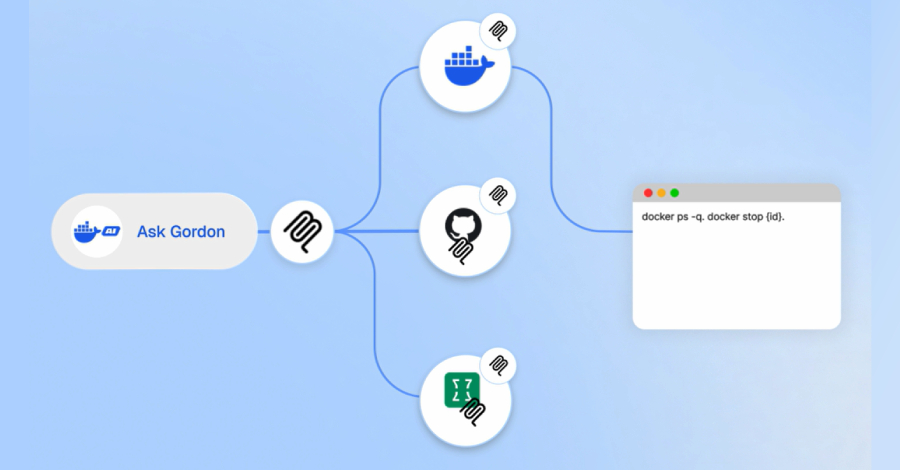
“In DockerDash, a single malicious metadata label in a Docker image can be used to compromise your Docker environment through a simple three-stage attack,” explained Sasi Levi, security research lead at Noma Labs. “Gordon AI reads and interprets the malicious instruction, forwards it to the MCP (Model Context Protocol) Gateway, which then executes it using MCP tools.”
This vulnerability stems from an architectural flaw in how the AI assistant processes metadata. The AI component treats unverified metadata as legitimate commands without performing proper validation. This opens the door for attackers to embed executable instructions within seemingly harmless Dockerfile LABEL fields.
The MCP Gateway, acting as an intermediary between AI agents and the local environment, fails to distinguish between standard metadata and harmful instructions. As a result, malicious commands sent through this channel are executed with the same privileges as the user’s Docker environment.
Stages of the Exploit
The attack unfolds in four main steps:
- An attacker crafts a Docker image with malicious instructions embedded in the
LABELfields. - When a user queries Ask Gordon about the image, the AI assistant reads the metadata, including the injected labels.
- Ask Gordon forwards the interpreted instructions to the MCP Gateway, which assumes the input is trusted and executes the request.
- The command is run using MCP tools with the victim’s Docker privileges, effectively achieving remote code execution.
This chain of events happens without any validation, allowing attackers to hijack the AI assistant’s reasoning process and gain control over the host system.
Data Exfiltration via AI Prompt Injection
Beyond code execution, the flaw could also be leveraged to steal internal data from Docker Desktop environments. Using prompt injection techniques, attackers can instruct Ask Gordon to extract sensitive system information such as installed tools, container configurations, mounted file systems, and network settings. While Ask Gordon operates with read-only permissions, it can still gather a significant amount of intelligence from the host system.
This type of attack, referred to as Meta-Context Injection, exploits the AI’s inability to differentiate between informational and executable metadata, making it a potent method for stealthy data collection.
Additional Vulnerabilities Patched
In addition to DockerDash, version 4.50.0 of Ask Gordon AI also patched another prompt injection vulnerability uncovered by Pillar Security. This flaw allowed attackers to manipulate metadata in Docker Hub repositories to hijack the AI and extract sensitive data.
These back-to-back discoveries highlight the growing risks associated with integrating AI into developer tools and underscore the urgent need for enhanced validation and security protocols.
Recommendations and Security Best Practices
Levi emphasized the importance of implementing zero-trust validation across all AI-powered environments. “The DockerDash vulnerability underscores your need to treat AI Supply Chain Risk as a current core threat,” he said. “It proves that your trusted input sources can be used to hide malicious payloads that easily manipulate AI’s execution path.”
To mitigate similar threats, security experts recommend:
- Applying the latest updates and patches promptly
- Auditing Docker images for suspicious metadata entries
- Implementing strict validation checks for AI inputs
- Isolating AI assistants from sensitive host environments
As AI continues to integrate more deeply into software development workflows, these safeguards will become essential to preventing exploitation through seemingly innocuous channels like metadata.
This article is inspired by content from Original Source. It has been rephrased for originality. Images are credited to the original source.