

Widespread AI Adoption in the American Workforce
Artificial intelligence (AI) is rapidly becoming a staple in the daily routines of many American workers. According to a recent Gallup Workforce survey conducted in the fall of 2025, about 12% of employed adults in the United States use AI on a daily basis. Nearly one-quarter of respondents report using AI at least a few times a week. This marks a significant increase from the 21% who reported occasional use in 2023, highlighting the growing integration of AI technologies in the workplace.
The rise in AI usage aligns with the commercial success of generative AI tools, such as ChatGPT, which can perform a variety of tasks including writing emails and code, summarizing documents, creating images, and answering questions. These tools are reshaping job functions across numerous industries.
AI in Action: Real-Life Workplace Examples
Gene Walinski, a 70-year-old employee at a Home Depot in New Smyrna Beach, Florida, exemplifies how AI is helping workers across different sectors. Walinski uses an AI assistant on his personal smartphone about once every hour while working in the store’s electrical department. The tool helps him quickly answer customer questions, especially when he isn’t fully familiar with a product. “I think my job would suffer if I couldn’t because there would be a lot of shrugged shoulders and ‘I don’t know,’ and customers don’t want to hear that,” he said.
In finance, 28-year-old investment banker Andrea Tanzi from Bank of America in New York uses AI daily to process documents and data sets. The technology significantly reduces the time required to analyze complex information. Tanzi also utilizes the bank’s internal AI chatbot, Erica, to manage administrative duties, further enhancing productivity.
Sector-Specific AI Adoption Trends
Technology-related fields have shown the highest levels of AI adoption. Approximately 60% of tech workers report using AI frequently, with about 30% using it daily. The finance sector also demonstrates strong adoption rates. In contrast, while AI is making inroads in education and professional services, its use is less frequent in service-based industries like retail, healthcare, and manufacturing.
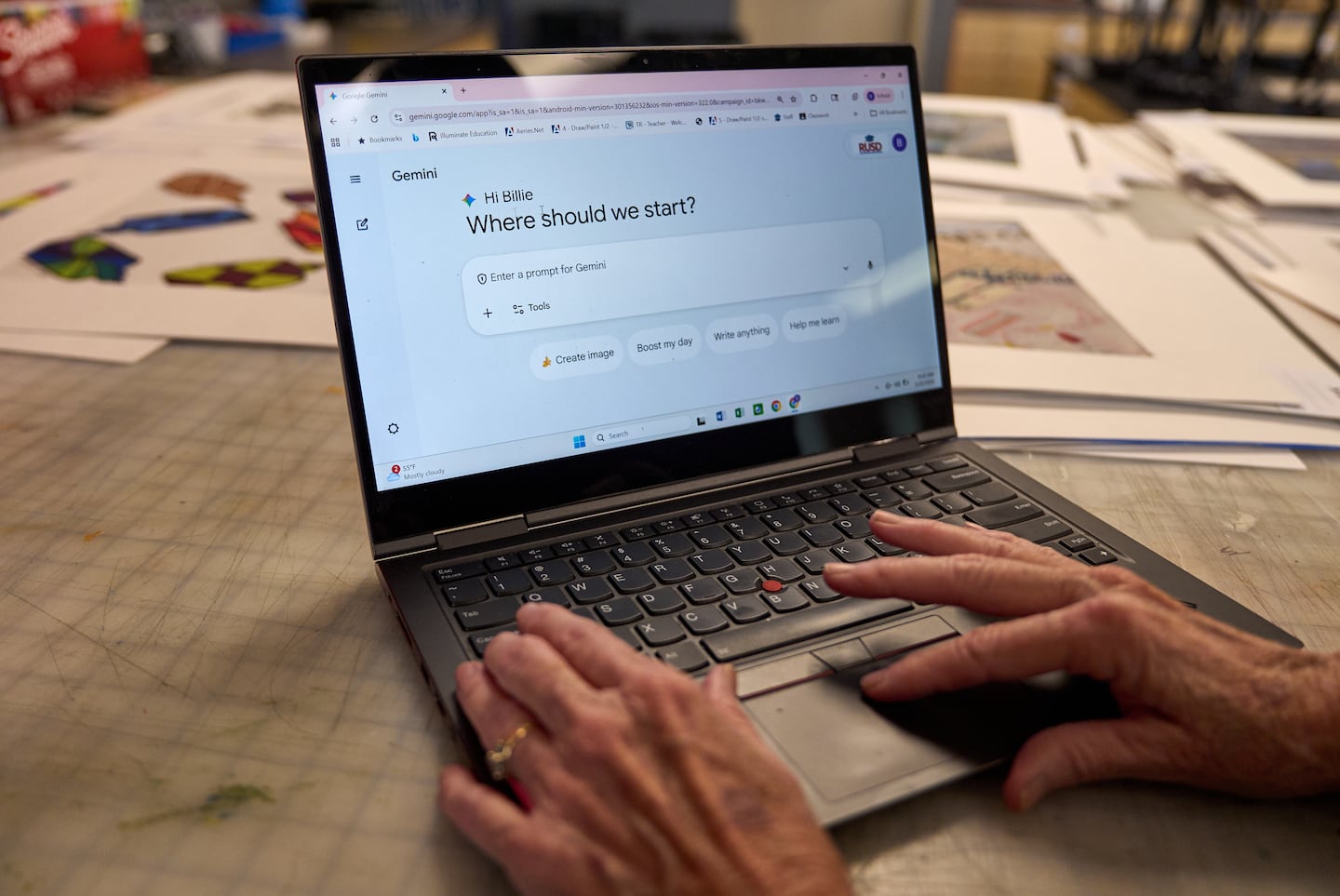
Joyce Hatzidakis, a 60-year-old high school art teacher in Riverside, California, started using AI chatbots to improve her communication with parents. “I can scribble out a note and not worry about what I say and then tell it what tone I want,” she explained. Hatzidakis began with ChatGPT and later switched to Google’s Gemini, the tool officially adopted by her school district. She even uses AI to assist in writing recommendation letters, noting, “There’s only so many ways to say a kid is really creative.”
How Workers Are Using AI
Another Gallup survey from the previous year revealed that around 60% of employees using AI rely on chatbots or virtual assistants. About 40% use it to consolidate information, generate ideas, or learn new skills. These findings suggest that AI is not just automating tasks but also enhancing the way people approach problem-solving and creativity in their roles.
The Broader Implications of AI Integration
As AI becomes more embedded in the workplace, questions about its long-term impact on employment and productivity continue to emerge. Sam Manning, a fellow at the Centre for the Governance of AI, highlights that workers most exposed to AI disruption typically possess higher education levels and diverse skill sets. “They also have higher savings, which is helpful for weathering an income shock if you lose your job,” Manning noted.
However, Manning’s research also identifies vulnerabilities. An estimated 6.1 million American workers are both heavily exposed to AI and less equipped to adapt. These individuals, often older women in administrative roles in smaller cities, may struggle to transition to new careers if their jobs are automated. “An income shock could be much more harmful or difficult to manage,” Manning added.
Job Security and Human Connection
Despite the rise in AI use, most workers are not overly concerned about job loss. A 2025 Gallup survey found that only a small percentage of employees believe AI or automation will eliminate their jobs within the next five years. While the percentage of workers who consider job loss “not at all likely” has decreased from 60% in 2023 to 50%, a majority still feel relatively secure.
The Rev. Michael Bingham, pastor of Faith Community Methodist Church in Jacksonville, Florida, shared his skepticism about AI’s role in certain professions. He recounted a time when a chatbot gave him “gibberish” in response to a theological question. “You don’t want a machine, you want a human being, to hold your hand if you’re dying,” Bingham said. “And you want to know that your loved one was able to hold the hand of a loving human being who cared for them.”
Retail worker Walinski echoes this sentiment. Although Home Depot didn’t require or discourage AI use, he embraced the technology on his own terms. “The human interface part is really what a store like mine works on,” he said. “It’s all about the people.”
This article is inspired by content from Original Source. It has been rephrased for originality. Images are credited to the original source.