

Artificial Intelligence Becomes a Central Focus in Higher Education
Artificial intelligence (AI) is no longer limited to science fiction or high-tech companies—it’s now a central part of higher education. Over 100 colleges and universities across the United States are now offering dedicated degrees in AI or computer science programs with a strong AI emphasis. This surge reflects the growing influence of AI across industries and its increasing relevance in preparing students for future careers.
At the forefront of this academic shift is the University of Southern California’s (USC) Viterbi School of Engineering, which recently announced a new bachelor’s degree in artificial intelligence set to launch in fall 2026. The degree program will be a collaboration between computer science, electrical and computer engineering, and industrial and systems engineering departments.
“There is so much going on in the world right now that we felt we had to develop a new degree focused solely on AI,” said Erik Johnson, vice dean for academic programs at USC’s Viterbi School.
An Interdisciplinary Approach to AI Education
The new Bachelor of Science in Artificial Intelligence (BSAI) program aims to provide students with in-depth knowledge in areas such as computer vision, natural language processing, and emerging AI applications. Johnson emphasized that the program goes beyond basic AI theory, preparing students to solve complex, real-world problems across multiple disciplines.
USC has also been exploring AI’s intersection with other fields. Two years ago, the university introduced an innovative degree titled “Artificial Intelligence for Business”. This interdisciplinary program combines engineering principles with entrepreneurship and business acumen.
“You have really, really smart technical folks that speak the language of business and are oriented towards business problems,” said Charlie Hannigan, the academic director of the AI-for-business program.
Students Gaining Real-World Experience
Francesa Kubica, a junior in the AI-for-business program and a member of its inaugural class, recently completed a summer internship at Google. She believes the degree has given her a competitive edge and a broader understanding of how AI applies in various sectors.
“AI is not just finance. It’s not just bio. It’s not just tech. You really can apply it to everything,” Kubica said. She added that her upcoming academic year includes building AI systems and participating in a capstone project with real-world companies.
As AI technology rapidly evolves, keeping course content current presents a constant challenge for educators. “This morning, I was having to change some lectures because they’re outdated,” Hannigan admitted, highlighting the pace at which AI advances.
Innovative Research and Applications in AI
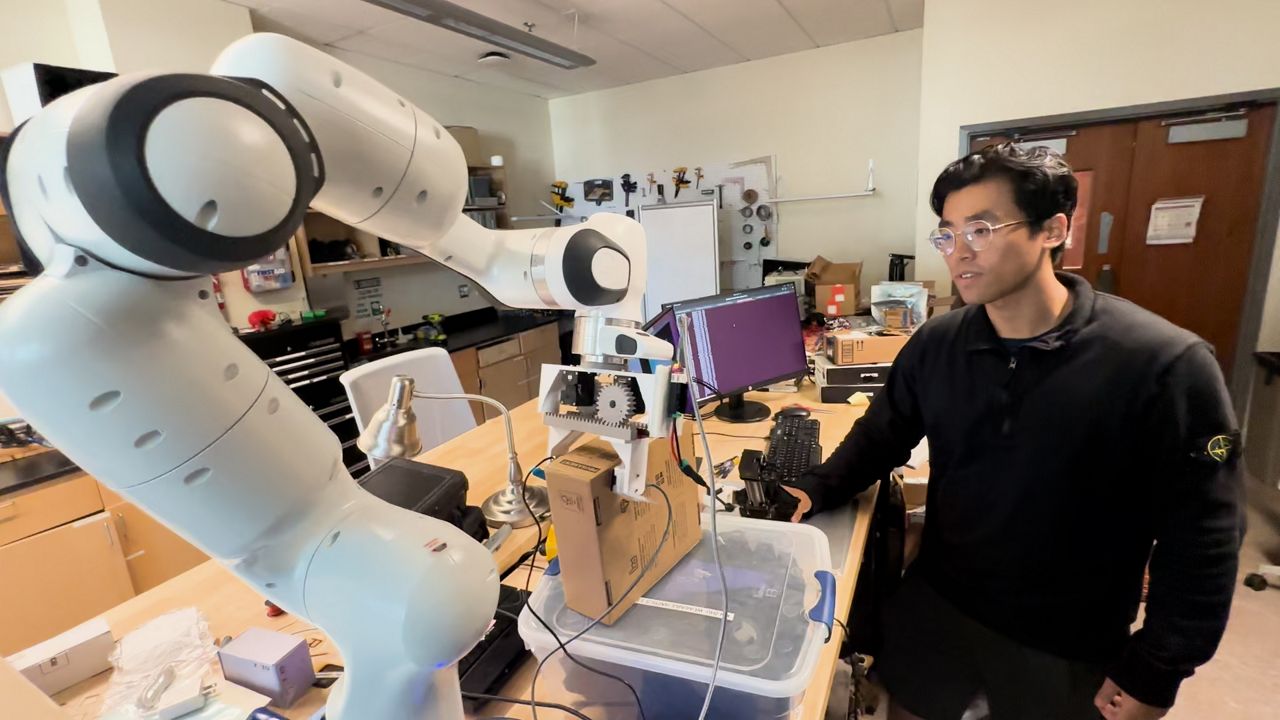
USC is also making strides in AI research. One notable project is underway in the university’s haptics lab, which focuses on the science of touch. Researchers are developing robotic systems capable of identifying various surfaces and textures using AI algorithms. These efforts aim to build a database that can be shared with scientists and engineers globally, helping to train robots in tactile recognition.
These developments have potential applications in a wide range of fields—from graphic design, where designers can feel digital surfaces, to remote surgery, where doctors receive tactile feedback through robotic instruments.
“I’m not worried about AI taking over the world, but at the same time, we also have to do things responsibly and make sure that we are developing models that are fair and are helpful,” Johnson noted.
Preparing Students for the Future Workforce
The expansion of AI degree programs is not just about keeping up with technological trends—it’s about preparing students for jobs that may not yet exist. According to a recent report by Goldman Sachs, AI could replace up to 25% of work tasks in the U.S. and Europe. However, this shift could also lead to a significant boost in productivity and the creation of new job categories.
“It is definitely scary, but in terms of students, it’s exciting,” Kubica said, reflecting on the dual nature of AI’s impact on the workforce.
With more institutions embracing AI in their curricula, students are gaining opportunities to develop technical skills, business insights, and ethical awareness—all essential for navigating a world increasingly shaped by artificial intelligence.
This article is inspired by content from Original Source. It has been rephrased for originality. Images are credited to the original source.