

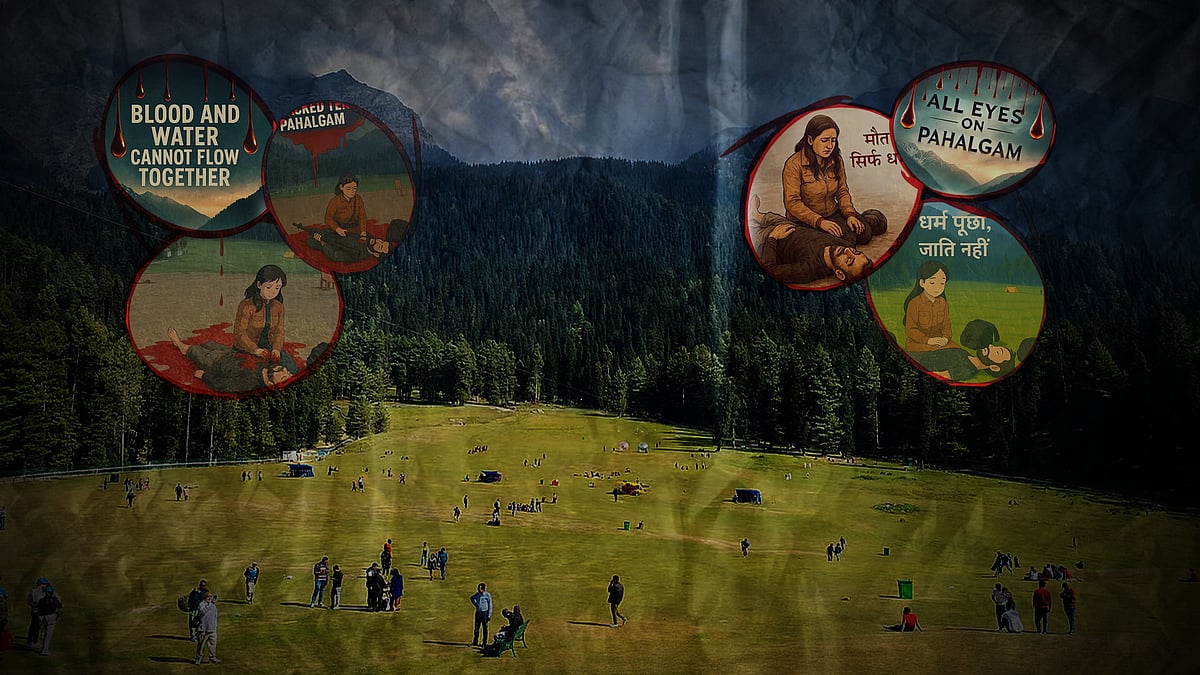
A recent study in neuroscience has uncovered a startling revelation: AI-regenerated images have the potential to alter our actual memories by replacing them with manipulated visuals. This finding raises profound concerns about the future, suggesting that if such practices become widespread, it could prove to be one of the greatest challenges facing our generation.
The Tragedy and Its Digital Aftermath
The terrorist attack on tourists in the Baisaran Valley near Pahalgam, Kashmir, shocked the nation. Yet, alongside the tragedy, a new phenomenon emerged on social media — the dissemination of AI-regenerated, visually enhanced images of the crime scene. These altered images depicted a woman sitting beside her deceased husband, transforming a raw and distressing moment into something visually pleasing.
The Preference for Altered Realities
One might ask, why do people prefer these beautified versions of distressing scenes when original images exist? The answer may lie in a shift in how we process information and emotion on social media. In this parallel universe, morality is measured by the number of likes a post garners. In this new normal, morality becomes synonymous with likability, a trend we can term as ‘more L(ikes)’.
The Impact on Digital Communities
This regeneration of grief into visually appealing content reflects a growing moral dissonance within our digital communities. Rather than communities bound by shared values, what we witness are networks of individuals connected by content. The moral weight of an event is no longer tied to its emotional or human depth but to its visual appeal and potential to go viral.
The Hyperreal World
In our hyperreal world, we struggle to connect with anything raw or unfiltered. Our empathy is dulled by the normalization of violence, voyeurism, and visual manipulation encountered with every swipe and scroll. Platforms like Instagram and YouTube, where much of our time is spent, offer an unfiltered world devoid of accountability. The distortion of reality is evident when individual selfies are more heavily filtered than content depicting real-world tragedies.
The Political Exploitation
It was no surprise when a social media handle from the Bharatiya Janata Party (BJP) posted a Ghibli-styled picture of the mourning woman with a provocative caption. This move illustrates how political entities can exploit fleeting cultural moments to propagate their agendas. Even those with genuine empathy for the victims feel compelled to share more appealing images to gain attention and express solidarity.
The Broader Trend
The Pahalgam tragedy is part of a broader trend. In 2024, AI-generated images of children in Gaza went viral during the Israeli attacks on Palestine. Initially believed to be real, these images were later exposed as fakes. Similarly, a photograph from Syria in 2014 was mischaracterized as fabricated, only to be confirmed as authentic by the United Nations.
Alternative Uses of AI
Amidst this, there is also a different kind of AI usage. In the ongoing Palestine-Israel conflict, artists have used AI to generate images expressing political dissent and grief. These images are imaginative compositions meant to evoke solidarity or resistance, rather than replace reality.
The Risk of Aesthetic Trends
A recent neuroscience study reveals that AI-regenerated images can alter memories by replacing them with manipulated visuals. Even genuine acts of empathy risk being absorbed into the aesthetic trends that dominate digital platforms, overshadowing facts and emotional depth.
Note: This article is inspired by content from https://www.thenewsminute.com/news/the-ai-filtered-horror-of-pahalgam-why-are-we-beautifying-tragedy. It has been rephrased for originality. Images are credited to the original source.