

Limited Adoption of AI Among Home Builders
Despite the growing influence of Artificial Intelligence (AI) in many industries, most single-family home builders have yet to integrate AI into their operations. According to the July 2025 survey conducted by the NAHB/Wells Fargo Housing Market Index (HMI), a majority of builders are still not utilizing AI in their businesses. However, certain functions are seeing a gradual increase in adoption.
Main Uses of AI in the Building Industry
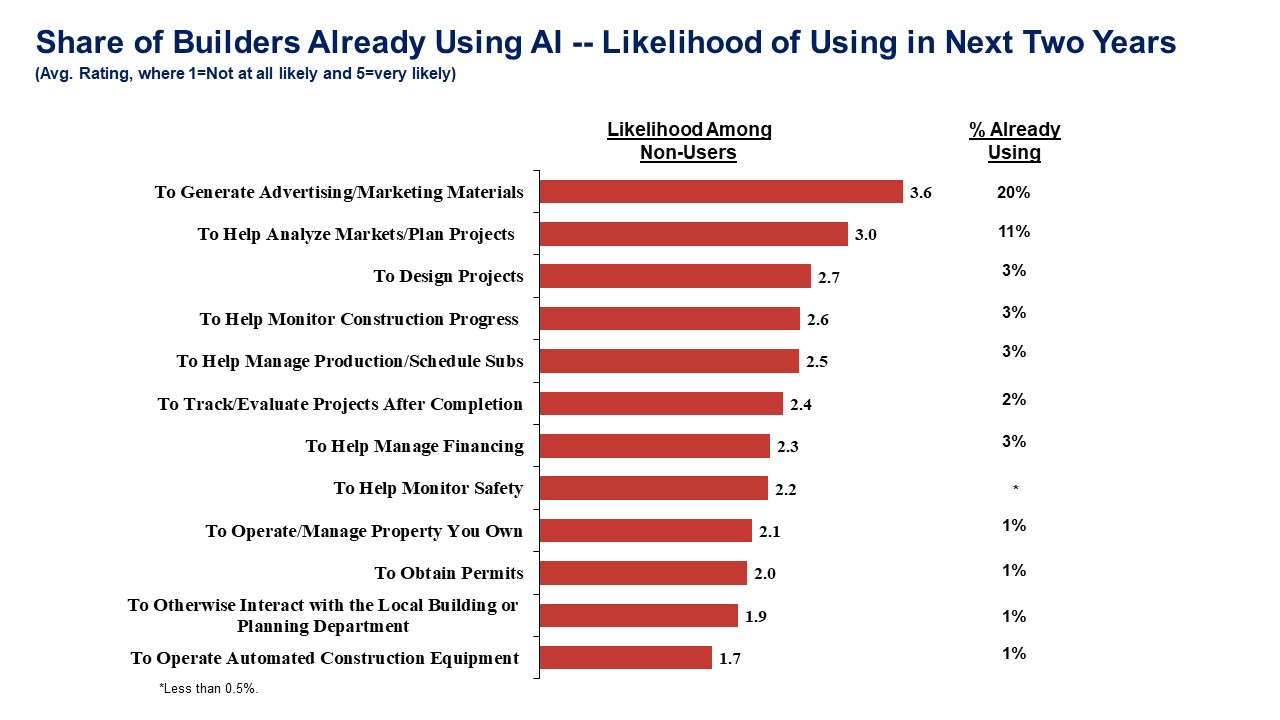
Among the builders who have adopted AI, the most common usage is in generating advertising and marketing materials, with 20% of respondents indicating they use AI for this purpose. Coming in second, 11% of builders reported leveraging AI to analyze markets and plan projects. These two functions stand out as the primary areas where AI is currently making a tangible impact in the homebuilding sector.
Other applications of AI, such as project design, budgeting, customer communication, and even operating automated construction equipment, are far less common. In fact, less than 5% of builders use AI in any of these additional areas, highlighting that AI adoption remains in its very early stages across the broader scope of construction activities.
Looking Ahead: Builders’ Plans for AI Adoption
To assess future trends, the survey also asked builders who have not yet adopted AI how likely they are to do so in the next two years. Respondents rated the likelihood on a scale from 1 (not at all likely) to 5 (very likely).
Not surprisingly, the two functions already showing the most AI usage—ad creation and market analysis—also received the highest average likelihood ratings for future adoption. The average rating for using AI in advertising/marketing was 3.6, while market analysis/planning came in at 3.0. These figures suggest that more builders are considering AI for these strategic functions in the near future.
However, the likelihood of adopting AI for other business functions remains relatively low. All 10 other surveyed functions received average likelihood ratings below 3.0. This indicates that most builders are hesitant to expand AI use beyond marketing and planning tasks, at least in the short term.
Low Interest in AI for Construction Operations
The survey found particularly low enthusiasm for AI in construction-related operations. The two areas with the lowest likelihood of future AI adoption were:
- Operating automated construction equipment – average rating: 1.7
- Interacting with local building or planning departments – average rating: 1.9
These figures suggest that while AI-driven automation is making strides in other industries, construction professionals remain cautious about using AI for hands-on tasks or regulatory processes.
Why Builders Are Slow to Embrace AI
Several factors may contribute to the slow adoption of AI in homebuilding. Unlike industries such as finance or retail, where digital tools are easily integrated, construction involves physical labor, complex logistics, and strict regulatory compliance. Integrating AI into such a multifaceted environment requires significant investment, training, and a shift in workflow.
Additionally, the small or medium size of many homebuilding firms might limit their technological capabilities. For these companies, investing in AI might not yet seem cost-effective or necessary, especially if traditional methods still yield satisfactory results.
Industry Outlook: An Evolving Landscape
Despite the current limitations, the construction industry is not immune to technological change. As AI tools become more accessible and their benefits more apparent, more builders may begin to explore how AI can streamline operations, improve efficiency, and enhance customer experience.
Industry experts suggest that over time, AI will likely move beyond marketing and planning to play a more integral role in construction management, design optimization, and even jobsite safety. Early adopters may gain a competitive edge, encouraging broader implementation across the sector in the years ahead.
In conclusion, while AI has yet to become a standard part of homebuilding operations, signs point to a gradual shift. Marketing and planning are paving the way for AI integration, and as more builders recognize its value, adoption may accelerate across other functions.
This article is inspired by content from Original Source. It has been rephrased for originality. Images are credited to the original source.