

AI’s Growing Influence in Classrooms
The integration of artificial intelligence (AI) tools in education is reshaping how teachers instruct and how students learn. As AI becomes more accessible and sophisticated, schools across the United States are struggling to define and enforce academic integrity. Educators are reevaluating traditional teaching methods and assessment strategies amid concerns about widespread AI use and cheating.
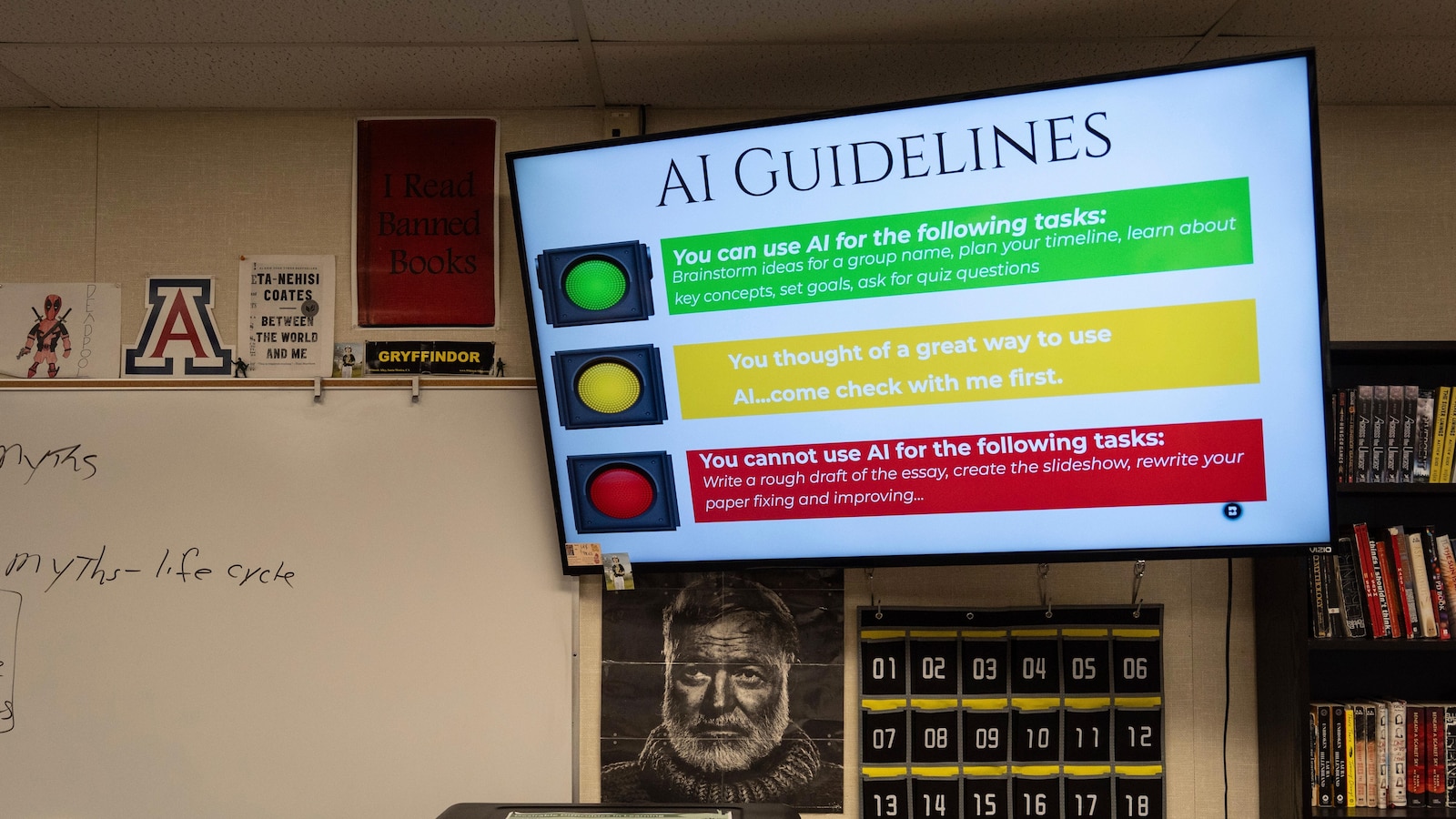
“The cheating is off the charts. It’s the worst I’ve seen in my entire career,” said Casey Cuny, an English teacher with over two decades of experience. He emphasizes that sending assignments home now often results in students relying heavily on AI to complete them. Cuny, honored as California’s 2024 Teacher of the Year, has transitioned to administering most writing exercises during class time, closely monitoring student activity with screen-locking software. He also incorporates AI tools into his curriculum to teach students how to use them ethically for studying rather than cheating.
Changing the Way Teachers Assign Work
The traditional take-home essay or book report is quickly becoming obsolete. Teachers like Kelly Gibson in rural Oregon have replaced these assignments with in-class essays and verbal assessments. “I used to give a writing prompt and say, ‘In two weeks I want a five-paragraph essay,’” Gibson explained. “These days, I can’t do that. That’s almost begging teenagers to cheat.”
Students have become accustomed to relying on AI tools like ChatGPT for brainstorming, structuring, and even writing entire essays. A simple prompt about the relevance of social class in The Great Gatsby can yield a comprehensive outline, complete with supporting quotes, in seconds. While many students start with good intentions—using AI to clarify complex texts or improve grammar—the line between assistance and academic dishonesty is increasingly blurred.
Students Navigate Ethical Ambiguities
College sophomore Lily Brown, a psychology major, frequently uses AI to help organize her thoughts and understand difficult material. “Sometimes I feel bad using ChatGPT to summarize reading, because I wonder is this cheating?” she said. Her course syllabi prohibit using AI to write essays or generate original thoughts, but they don’t clearly define the limits of acceptable use, leaving students uncertain and reluctant to seek clarification for fear of being labeled cheaters.
“Whether you can use AI or not depends on each classroom. That can get confusing,” said Jolie Lahey, a high school junior in California. While some of her teachers embrace AI and teach students how to use it responsibly, others enforce strict bans, creating inconsistency and frustration among students who see AI as a valuable resource.
Schools Struggle to Set Clear Guidelines
Initially, many schools responded to the rise of tools like ChatGPT by banning their use. However, the narrative has shifted toward embracing “AI literacy,” acknowledging that students must learn to use these tools appropriately. Over the summer, universities including the University of California, Berkeley took steps to formalize AI guidelines. Berkeley encouraged faculty to clearly articulate their AI policies in course syllabi, providing sample language for various levels of AI integration.
At Carnegie Mellon University, faculty have reported a spike in academic violations tied to unintentional misuse of AI tools. Rebekah Fitzsimmons, who heads the university’s AI faculty committee, noted that many students don’t even realize they’ve crossed ethical boundaries. She described a case where a student used an AI translator that subtly rewrote his essay, triggering plagiarism detection.
“Enforcing academic integrity policies has become more complex,” said Fitzsimmons. Faculty are increasingly cautious about accusing students of cheating, worried about fairness and the difficulty of proving intent. In response, she helped draft new, detailed guidelines this summer to provide clarity for both instructors and students. These guidelines recommend that blanket AI bans are only viable if instructors adjust their teaching and assessment methods accordingly.
Adapting Teaching to the AI Era
To address these challenges, many educators are rethinking their instructional design. Some are eliminating take-home exams entirely. Others have returned to in-person, pen-and-paper testing or adopted “flipped classroom” models, where students engage with homework during class time. Carnegie Mellon communication professor Emily DeJeu has replaced traditional writing assignments with in-class quizzes using a secure browser that prevents students from accessing other websites.
“To expect an 18-year-old to exercise great discipline is unreasonable,” DeJeu said. “That’s why it’s up to instructors to put up guardrails.”
As the academic world continues to grapple with these evolving challenges, the conversation around AI in education is shifting from prohibition to adaptation. Schools are beginning to understand that the key lies in teaching students how to use AI responsibly, rather than banning it outright.
This article is inspired by content from Original Source. It has been rephrased for originality. Images are credited to the original source.