

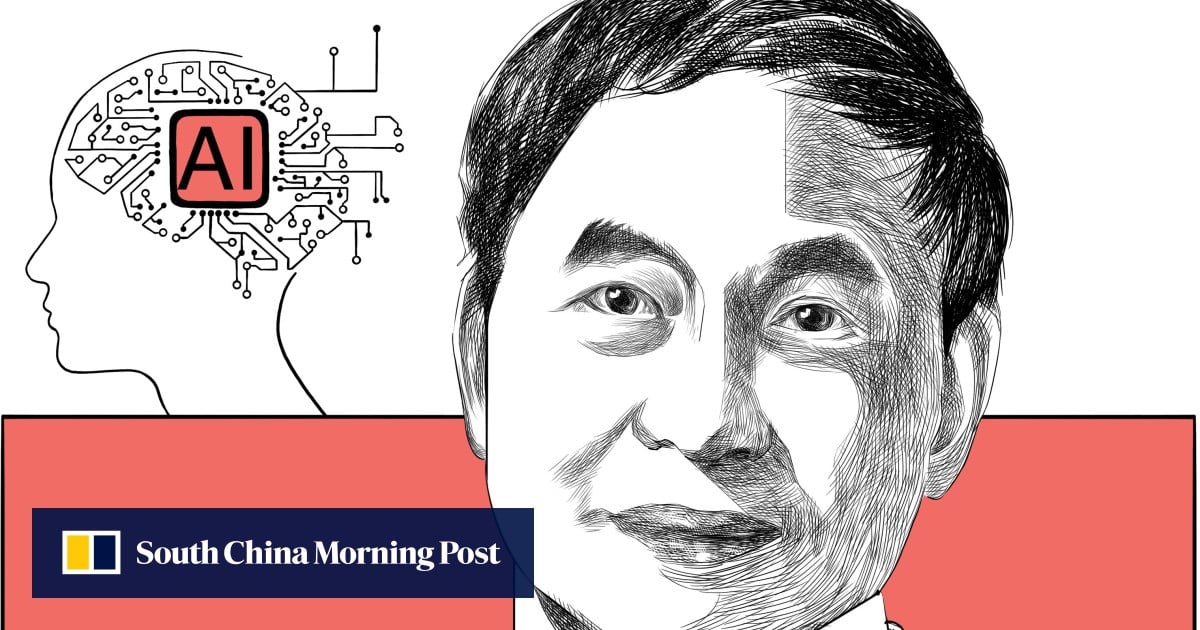
China Must Forge Its Own Path in AI Development
Renowned Chinese political scientist and government adviser Zheng Yongnian has emphasized the urgent need for China to develop a distinct artificial intelligence (AI) framework that is grounded in its own cultural and intellectual traditions. In a recent interview, Zheng warned of the dangers of relying solely on Western ideologies to inform AI systems, calling instead for the establishment of a strong, independent narrative based on China’s unique heritage.
Zheng, known for his extensive work on contemporary Chinese politics, transformation, and international relations, expressed concern over what he terms “intellectual colonialism” in the AI era. He believes that as AI becomes more integral to governance and society, it is essential for China to contribute its own body of knowledge to global AI development.
The Risks of Western-Centric AI
According to Zheng, one of the key challenges lies in the dominance of Western social sciences, which form the foundation of current AI knowledge systems. These theories, he argues, are rooted in Western historical experiences and cultural values, making them ill-suited to explain or address the complexities of non-Western societies.
“The meaning of society and technology is deeply embedded in the humanities and social sciences,” Zheng explained. “Many Chinese researchers have studied Western theories, but these frameworks are not universal. They fail to capture the essence of Confucian civilization, the Islamic world, or Indian society.”
He referenced political scientist Samuel Huntington’s idea from The Clash of Civilisations, noting that religion, ideology, and values are integral to national identity and must be reflected in the development of new technologies like AI. Without a localized understanding, he warned, China risks being intellectually dominated by Western narratives embedded in AI algorithms and systems.
Rebuilding China’s Knowledge System
Zheng has long advocated for a reconstruction of China’s knowledge infrastructure. In his view, the country must move beyond Western paradigms and cultivate a robust academic and cultural framework that accurately reflects its own societal values and historical context. This would not only strengthen China’s global influence but also ensure that AI technologies developed within the country are more aligned with its needs and aspirations.
“We need to fully embrace our secular civilization,” Zheng asserted. “By doing so, we can play a more meaningful role in shaping the international order.”
He believes that building a credible Chinese knowledge system is vital to resisting intellectual dependency and fostering innovation that is both culturally relevant and globally competitive. This means investing in social sciences and humanities research that interprets Chinese history, philosophy, and governance models through indigenous lenses.
A New Global Narrative
Zheng’s call to action is not just about domestic advancement; it is also about reshaping the global discourse around AI. As geopolitical tensions rise and the US-China tech rivalry intensifies, he sees an opportunity for China to redefine its role on the world stage by offering an alternative perspective on AI ethics, governance, and application.
“Artificial intelligence is not just a technical tool,” Zheng pointed out. “It is also a carrier of values and ideologies. If we rely entirely on Western systems, we will inevitably adopt their worldview. China must participate in this conversation with its own voice.”
To that end, he suggests that China should contribute more actively to international AI standards and ethical discussions, while promoting a balanced and fact-based narrative that reflects its own developmental experiences.
Consolidating China’s AI Strategy
As part of its broader AI strategy, Zheng recommends that China develop policies that support the integration of traditional Chinese thought with cutting-edge technological research. This includes encouraging interdisciplinary collaboration between computer scientists and scholars in philosophy, sociology, and political science.
He also advocates for the creation of platforms that allow Chinese perspectives to be shared and debated globally. “We must ensure that AI development is not monopolized by any one civilization,” he said. “Diversity in knowledge production will lead to more robust and inclusive technologies.”
Furthermore, Zheng believes that China should prioritize educational reforms that encourage critical thinking and cultural confidence among its youth. By equipping the next generation with both technical skills and a deep understanding of Chinese values, the country can ensure that its AI future is both innovative and authentic.
Looking Ahead
Zheng Yongnian’s insights come at a pivotal moment for China, as it seeks to position itself as a global leader in AI. His vision underscores the importance of intellectual sovereignty and the need for a multidimensional approach to technological progress—one that honors the richness of Chinese civilization while engaging constructively with the world.
In a landscape increasingly shaped by digital tools and automated decision-making, Zheng’s message is clear: to build better AI, China must first understand itself.
This article is inspired by content from Original Source. It has been rephrased for originality. Images are credited to the original source.