

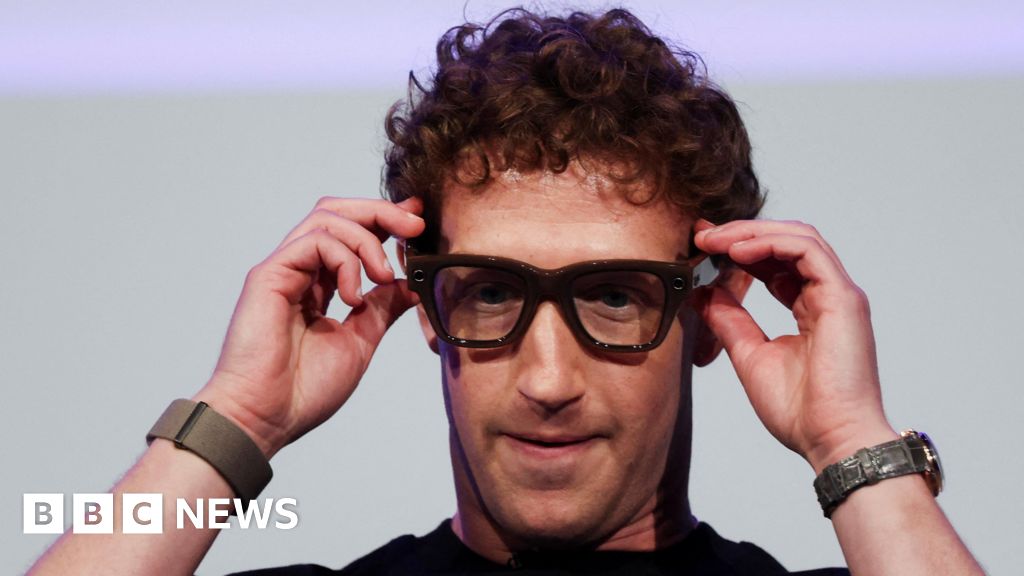
Meta Unveils Latest AI Smart Glasses at Developer Conference
Meta, the parent company of Facebook, Instagram, and WhatsApp, has announced a new lineup of AI-powered smart glasses during its annual “Meta Connect” developer conference held in Menlo Park, California. CEO Mark Zuckerberg introduced the next-generation wearable tech in collaboration with Ray-Ban and Oakley, aiming to make smart glasses an integral part of daily life.
Among the highlights was the Meta Ray-Ban Display, a sleek pair of smart glasses featuring a high-resolution full-color screen embedded in one lens. The glasses also come equipped with a 12-megapixel camera, allowing users to participate in video calls, view messages, and capture content seamlessly.
New Neural Wristband Enhances Hands-Free Interaction
In a move to further integrate wearable tech into everyday routines, Meta also introduced a neural wristband. This innovative device pairs with the Meta Ray-Ban Display glasses and allows users to perform tasks such as sending messages using subtle hand gestures. Zuckerberg described this technology as a “huge scientific breakthrough” as he addressed the audience gathered at the company’s Silicon Valley campus.
The wristband utilizes neural signals to interpret minimal finger movements, enabling more intuitive and discreet interactions with digital content. This approach signifies Meta’s ongoing investment in creating more natural and seamless user experiences through wearable technology.
Strategic Shift from Metaverse to Wearables
As Meta continues to face scrutiny over its Metaverse ambitions and the societal impact of its platforms, the company appears to be shifting focus toward more practical applications of AI. Analysts suggest that smart glasses could prove to be a more successful venture than the company’s earlier forays into immersive virtual worlds.
“Unlike VR headsets, glasses are an everyday, non-cumbersome form factor,” said Mike Proulx, VP and Research Director at Forrester. However, he cautioned that Meta still needs to demonstrate clear value to convince the majority of consumers to adopt AI-powered eyewear.
Expanding Product Line with Oakley and Ray-Ban
Alongside the Display model, Meta introduced the $499 Oakley Meta Vanguard glasses, targeting sports and fitness enthusiasts. Additionally, the second-generation Ray-Ban Meta glasses were unveiled with a more affordable price tag of $379, continuing the brand’s appeal to mainstream users.
Leo Gebbie, an analyst at CCS Insight, expressed skepticism about the adoption rate of the new Display model, noting that the original Ray-Bans gained popularity due to their ease of use, subtle design, and accessible pricing. The Display model, retailing at $799 (£586), represents a significant price increase that may hinder widespread adoption.
Massive Investment in AI and Infrastructure
Meta’s commitment to AI extends beyond consumer devices. The company is currently investing heavily in building vast AI infrastructure, including data centers across the United States. Zuckerberg previously stated that Meta plans to spend hundreds of billions of dollars on these facilities, with some sites expected to span areas comparable to the size of Manhattan.
These investments are part of Meta’s broader strategy to develop what it calls “superintelligence”—AI systems capable of outperforming human cognitive abilities. The company is also actively recruiting top talent from competitors to bolster its AI research and development efforts.
Public Scrutiny and Calls for Child Safety
Despite the excitement surrounding the product launches, Meta continues to face intense public scrutiny. On the same day as the conference, protesters gathered outside Meta’s New York headquarters demanding greater protections for children on social media platforms. Many of the demonstrators were parents and family members of youth affected by harmful online content.
The protest followed testimony from two former Meta safety researchers before the U.S. Senate. Jason Sattizahn and Cayce Savage alleged that the company discouraged internal research that might reveal risks to children from its virtual reality products. Meta has strongly denied the allegations, calling them “nonsense.”
In response to growing concerns, Meta recently announced plans to restrict its AI chatbots from engaging in conversations with teens about sensitive topics such as suicide.
Looking Ahead
Meta’s latest announcements mark a pivotal moment in its evolution, as the company doubles down on wearable technology and artificial intelligence. With bold investments and a growing product portfolio, Meta aims to redefine how users interact with the digital world. However, it must also navigate the complex landscape of public trust and regulatory oversight that increasingly shapes the tech industry.
This article is inspired by content from Original Source. It has been rephrased for originality. Images are credited to the original source.