

Exploring the Human Impact on Artificial Intelligence
In a world rapidly shaped by automation and algorithms, three alumni from St. Olaf College are making meaningful contributions at the forefront of artificial intelligence (AI). Their experiences underscore the importance of critical thinking, ethical responsibility, and multidisciplinary perspectives in an evolving tech landscape.
Cianna Bedford-Petersen: Designing Identity in the Metaverse
Cianna Bedford-Petersen ’14 works at Meta as a user experience researcher, contributing to the development of the Metaverse across virtual reality and mobile platforms. Her role involves creating tools that empower users to express their identities through digital avatars and pets.
“My job often involves researching ideas or needs of people for a product that doesn’t even exist tangibly yet,” she explains. Her journey began in a psychology class at St. Olaf, where she discovered a love for exploring human self-expression. This interest grew into a Ph.D. in personality psychology from the University of Oregon and now informs her work at Meta.
Bedford-Petersen is involved in projects like generative AI tools that allow users to customize clothing for avatars using text-based prompts. “We’re making creativity more accessible,” she says. “AI is integral to this development.”
She also highlights the ethical dimensions of her work. “Technology evolves quickly, often outpacing legislation,” she notes. “Researchers must ensure we build safe, inclusive spaces.”
Somang Han: Harnessing AI for Social Good
Somang Han ’18 is a data scientist at Amazon, where she creates AI-powered tools to streamline operations and enhance customer experiences. She’s currently focused on using machine learning to prioritize Amazon Web Services clients.
Han credits her liberal arts education, particularly a course on algorithms, for developing her problem-solving skills. “St. Olaf taught me to think critically and adapt — essential skills in data science,” she shares.
She remains committed to lifelong learning amid the fast-paced tech world. “I read scientific publications, attend conferences, and stay updated through podcasts and industry news,” she says.
Han is especially intrigued by multimodal AI and neuromorphic computing, but she warns of the dangers of unregulated AI. “We need safety standards, much like what emerged in the early automobile industry,” she cautions, pointing to the risks of disinformation and misuse.
Despite these concerns, Han remains optimistic. “My goal is to use AI to benefit society, especially marginalized groups with limited access to education. AI can empower, but it must be guided ethically.”
Charles Fyfe: Optimizing Infrastructure and Education
Charles Fyfe ’09 is a software engineer at Meta, focusing on infrastructure optimization between Facebook and Instagram. Simultaneously, he teaches hardware design at St. Olaf as a visiting physics professor.
“I’m currently running a job that deletes 400 terabytes of data,” Fyfe notes. “That saves about half a million dollars in electricity annually.” His work emphasizes efficiency and resource management.
AI plays a supportive role in his daily tasks. “It’s another layer in tech evolution,” he explains. “Like how Python made coding more accessible, AI could be the next interface layer.”
Fyfe is cautious, however, about over-reliance on AI. “AI can fail in unpredictable ways. It’s essential to scrutinize these tools continuously,” he says. He also draws parallels between AI’s impact on education and the arrival of pocket calculators. “We’ll need to rethink what skills are essential for the future.”
The Role of Liberal Arts in Tech Innovation
All three alumni agree: the liberal arts equip students with the adaptability needed in the tech industry. “A liberal arts education teaches you how to learn,” says Bedford-Petersen. “That’s critical in a field where new challenges emerge daily.”
Han adds that interdisciplinary thinking fosters innovation. “We collaborate across departments — something I practiced at St. Olaf.”
Fyfe believes that diversity in education will shape AI’s future. “Students bring multifaceted identities and interests. That diversity is our strength.”
Ethics, Oversight, and the Future of AI
From fostering creativity to improving infrastructure, these Oles are redefining what it means to work in tech. But they stress that AI is a tool — not a replacement for human insight. “We must always maintain human oversight,” Han says. “Ethics should be built into every system.”
Bedford-Petersen emphasizes discernment. “Not every tech advancement is perfect at first. But they can be stepping stones to transformative change.”
Fyfe concludes with a hopeful outlook. “We’re not heading for a dystopia. If we integrate AI thoughtfully, maybe we can aim for a 32-hour work week and a more balanced life.”
Visualizing AI Through Human Creativity
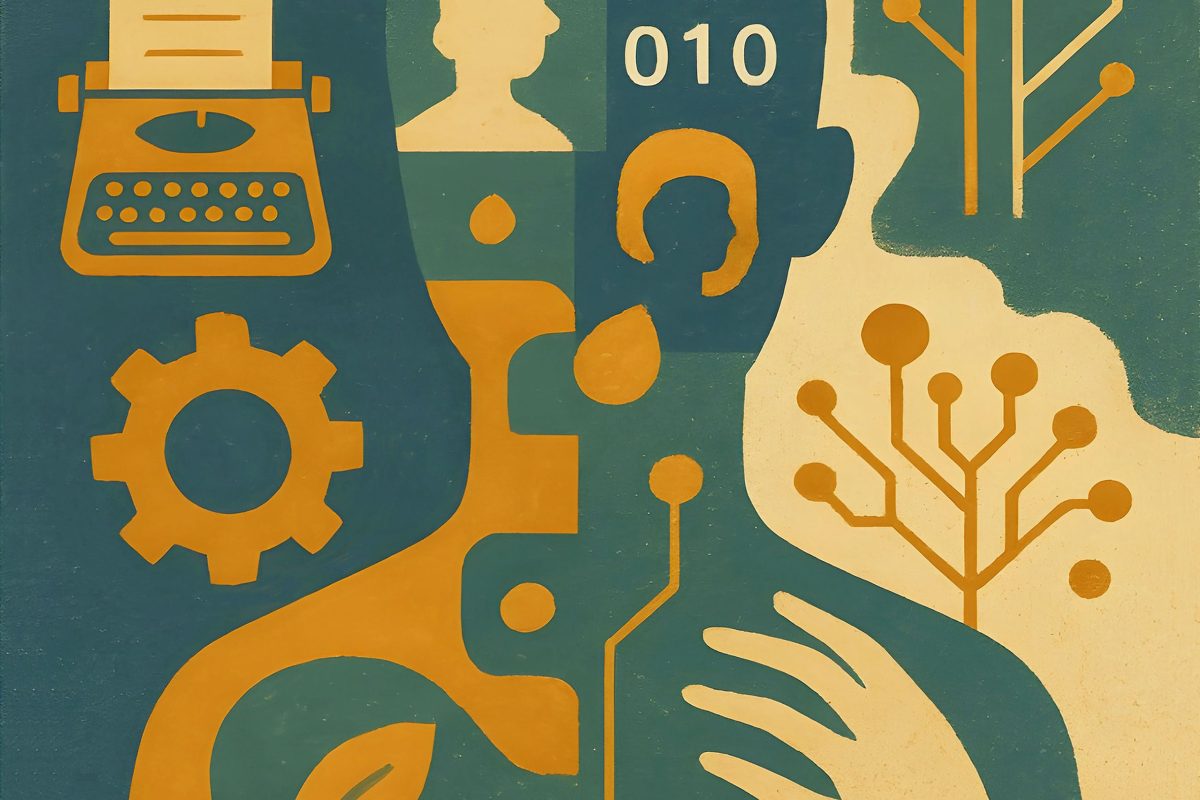
To reflect the themes of this story, St. Olaf Magazine’s Creative Director Fernando Sevilla collaborated with AI to create original illustrations. By feeding the article’s text into image-generation tools like ChatGPT, Google Gemini, and Adobe Firefly, he engaged in a creative dialogue that balanced machine interpretation with human intention.
From surrealist collages to minimalist symbolic designs, the visual process mirrored the article’s central question: How do humans shape technology, and how does it shape us?
This article is inspired by content from Original Source. It has been rephrased for originality. Images are credited to the original source.