

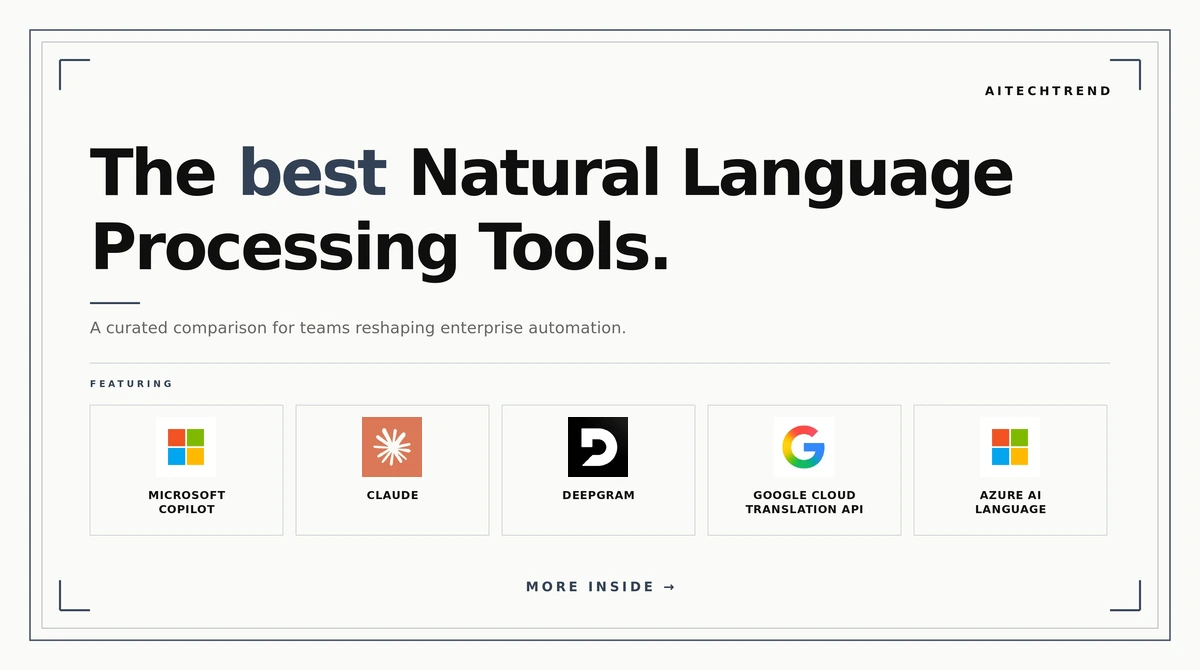
Finding the right natural language processing tools isn’t just about technical capability – it’s about matching your workflow to an engine that understands your ambitions. In 2026, the market for best natural language processing tools has matured dramatically, offering solutions tailored to everything from enterprise data pipelines to independent builders experimenting at the edge. We’ve evaluated the landscape and narrowed it down to seven standouts.
The natural language processing tools below represent a cross-section of maturity levels, architectural philosophies, and use cases. Whether you’re building sentiment analysis, pursuing machine translation, or automating document understanding, these are the natural language processing tools that deliver beyond the hype. Let’s dig in.
How We Picked
We evaluated dozens of natural language processing platforms across feature depth, ease of integration, cost structure, and real-world deployment stories. Our selection prioritized tools that balance enterprise-grade reliability with developer flexibility. We excluded niche academic projects and focused on systems teams actually build in production. Each tool here has proven its mettle in demanding environments.
 | 1. Microsoft Copilot |
Website: https://copilot.microsoft.com
Microsoft Copilot represents the convergence of large language models with conversational interface design. What makes Copilot different is its tight integration with the Microsoft ecosystem – Office, Teams, Azure – creating a compound advantage for teams already invested in that world. The standout feature is how it learns organizational context, making responses more useful as deployment scales. For enterprises, this means less friction bootstrapping NLP capabilities across departments.
Content Capabilities:
- Multi-turn conversational understanding
- Context-aware response generation
- Integration with Microsoft 365 applications
- Code generation and technical documentation synthesis
Best for: Enterprise teams already committed to the Microsoft cloud stack seeking conversational AI without rearchitecting infrastructure.
 | 2. Claude |
Website: https://claude.ai
Claude (by Anthropic) occupies an interesting position – it’s genuinely frontier-grade reasoning without the hype tax. In our testing, Claude handles nuance better than most competitors, particularly with ambiguous prompts and multi-step reasoning. The killer feature is its extended context window, which means you can feed it entire documents or codebases and it maintains coherence. For teams doing document analysis or legal review automation, this is where Claude shines hardest.
Content Capabilities:
- Extended context window up to 200K tokens
- Multi-document analysis and synthesis
- Constitutional AI safety training
- Structured output and API access
Best for: Teams handling document-heavy workflows, research organizations, and anyone who values reasoning transparency over raw speed.
 | 3. Deepgram |
Website: https://deepgram.com
Deepgram specializes in speech-to-text with the kind of accuracy that makes audio processing feel less like a secondary concern. In our evaluation, what separates Deepgram from commodity transcription tools is its ability to handle real-world audio – accents, background noise, technical jargon – without constant retraining. The API is beautifully designed, and their pricing model rewards at-scale usage patterns. This is purpose-built for teams who need transcription as a reliable input layer for downstream NLP pipelines.
Content Capabilities:
- Real-time and batch transcription
- Accent and domain-specific model fine-tuning
- Speaker diarization
- Multilingual support with 40+ languages
Best for: Voice-first applications, customer call analysis, and teams building audio-to-text pipelines at scale.
 | 4. Google Cloud Translation API |
Website: https://cloud.google.com/translate
Google’s translation engine is the quiet workhorse of global product teams. It’s not flashy, but it’s reliable – and in production environments, reliability compounds into advantage. The standout here is its support for 130+ language pairs and its understanding of context beyond literal word mapping. After evaluating dozens of translation APIs, Google’s approach to handling domain-specific terminology and maintaining tone across language barriers is genuinely differentiated. Teams scaling products internationally know they can trust this.
Content Capabilities:
- Neural machine translation with domain adaptation
- Batch and streaming translation
- Glossary and custom terminology support
- Language detection and script conversion
Best for: Global SaaS teams, content localization workflows, and any product needing reliable many-to-many translation at scale.
 | 5. Azure AI Language |
Website: https://azure.microsoft.com/en-us/products/ai-services/ai-language
Azure AI Language bundles entity recognition, sentiment analysis, and text classification into a single managed service. What distinguishes it is the depth of pre-built models for enterprise workflows – think healthcare entity extraction, financial document classification, or customer feedback categorization. The trade-off is less flexibility than custom models, but for teams who need 80 percent of NLP value without 200 percent of engineering overhead, this is the editorial pick. Integration with Azure’s broader AI stack makes it attractive for enterprises already there.
Content Capabilities:
- Named entity recognition and linking
- Sentiment and opinion mining
- Key phrase and topic extraction
- Pre-built domain models for healthcare, finance, and service
Best for: Enterprise teams seeking managed NLP without heavy model customization, especially those in regulated industries.
 | 6. Anyword |
Website: https://www.anyword.com
Anyword takes a generative approach to copywriting and marketing content, using NLP to predict performance before you publish. This is where natural language processing intersects with business outcomes. In our testing, the performance prediction (conversion lift, engagement scores) felt empirically grounded rather than speculative. The tool shines for marketing teams who want their content optimized by data rather than gut feel. It’s narrower in scope than general-purpose NLP platforms, but unusually deep in its lane.
Content Capabilities:
- AI copywriting generation with brand voice training
- Performance prediction scoring
- A-B testing optimization suggestions
- Channel-specific copy variants (email, social, ads)
Best for: Marketing teams, content creators, and product managers optimizing messaging for conversion and engagement.
 | 7. IBM Watson Natural Language Understanding |
Website: https://www.ibm.com/products/natural-language-understanding
IBM Watson NLU is the enterprise option for teams who need explainability alongside capability. Where some black-box models hide their reasoning, Watson exposes the logic – which entities it found, why sentiment scored a particular way, what semantic roles it identified. This matters enormously for regulated industries and any team doing high-stakes text analysis. The overhead is integration complexity, but for compliance-heavy workflows, it’s worthwhile. It’s less trendy than Claude or Copilot, but profoundly practical for serious NLP workloads.
Content Capabilities:
- Entity recognition with disambiguation
- Sentiment, emotion, and intent detection
- Semantic role labeling and relationship extraction
- Custom model training and deployment options
Best for: Enterprise organizations, compliance-heavy workflows, and teams requiring explainable and auditable NLP decisions.
Final Thoughts on Natural Language Processing Tools
The natural language processing tools landscape in 2026 offers genuine choice. You’re not forced into one-size-fits-all anymore. Whether you’re building on cloud infrastructure, deploying at the edge, or just need a managed API, there’s a platform that fits. Pick based on your tradeoffs – breadth versus depth, ease versus customization, cost versus capability. The market has matured enough that
Frequently Asked Questions
What is natural language processing and why does it matter?
Natural language processing enables machines to understand, interpret, and generate human language. It powers everything from chatbots and translation services to sentiment analysis and document automation, making it essential for modern AI applications.
How much do natural language processing tools cost?
Costs vary widely from free APIs with usage limits to enterprise contracts. Cloud services like Azure and Google typically charge per request, while some platforms use fixed monthly subscriptions starting at $20-50 monthly.
Are there free natural language processing tools available?
Yes – Google Cloud offers free tier usage, open-source libraries like NLTK and spaCy are completely free, and many platforms provide free trials. Start with the free tier to test before committing to paid plans.
How do I choose the right natural language processing tool?
Evaluate based on your specific use case – translation, sentiment analysis, or speech-to-text – your budget, required languages or domains, and whether you need managed services or full customization. Most tools offer free trials to test compatibility.