

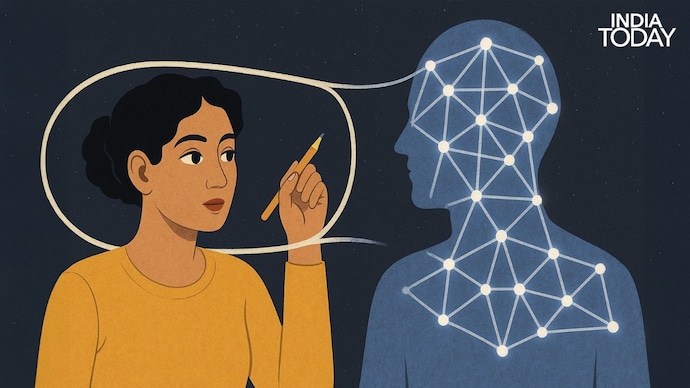
How do we discern if an article was crafted by a human or generated by artificial intelligence? The question probes deeper than mere structure or language; it challenges the essence of creativity itself. Historically, technology has augmented human capabilities, with inventions like calculators enhancing productivity by handling rote calculations, thus freeing time for intellectual pursuits. However, recent advancements in AI disrupt this tradition, not just assisting but beginning to replace human creators.
The Creative Process and AI Disruption
Every artist, writer, or philosopher grapples with ideas, investing time and emotion in multiple drafts and revisions. This process has been central to the human experience of creativity, involving struggles with form, structure, and meaning. AI, however, bypasses this intricate journey, producing essays, artworks, and solutions within seconds. This rapid output, though polished, lacks the depth arising from human struggle and emotional investment.
The Redefinition of Creativity
Language models have popularized a new definition of creation. Traditionally, creativity involved a relationship between effort and outcome, marked by late-night frustrations and serendipitous breakthroughs. Immanuel Kant’s insights in the “Critique of Judgement” highlight that true artistic creation is driven by internal necessity, a spontaneity that AI’s statistical patterning cannot replicate. While AI’s outputs may be sophisticated, they lack the originality grounded in subjective intuition.
The Challenge of Authorship
The evolution of AI also challenges the notion of authorship. Roland Barthes’ concept of the “death of the author” argued that meaning lies in the reader’s interpretation rather than the creator’s intent. However, AI-generated content raises the question of whether creation is taking place at all, as these texts emerge without an originator’s experience or emotional investment. Walter Benjamin warned that mechanical reproduction dissolves the artwork’s aura, a risk magnified by generative AI.
Technology’s Role in Creative Evolution
Previous technological tools complemented human creativity without challenging authorship. Calculators didn’t write theorems, and word processors didn’t create novels. They extended human capabilities without assuming the role of the creator. In contrast, generative AI produces creative products through simple prompts, blurring the line between human and machine authorship.
The Impact on Artistic Expression
The recent trend of converting images into Studio Ghibli-style animations underscores AI’s capability to mimic existing styles. This trend highlights how AI reduces meticulously developed styles to filters, devoid of their socio-cultural and historical contexts. A novelist spending years crafting a story contrasts starkly with someone generating storylines through prompts, a process lacking the depth of human involvement and creative agency.
The Categorical Shift in Creativity
Generative AI represents a categorical shift rather than a mere technological evolution. Unlike previous tools, it can replace human creativity, collapsing the creative process into mere prompting. This transformation challenges our understanding of creativity, authorship, and human presence in a world increasingly dominated by AI-generated content.
As AI becomes more pervasive, it becomes essential to recognize that we are not merely adapting to a new tool. We are negotiating the meaning of creativity and authorship in a world where machines increasingly speak in our voice and think in our place.
Note: This article is inspired by content from https://www.indiatoday.in/technology/talking-points/story/artificial-intelligence-chat-gpt-replace-humans-here-is-how-computer-technology-new-machine-different-2716896-2025-04-30. It has been rephrased for originality. Images are credited to the original source.