

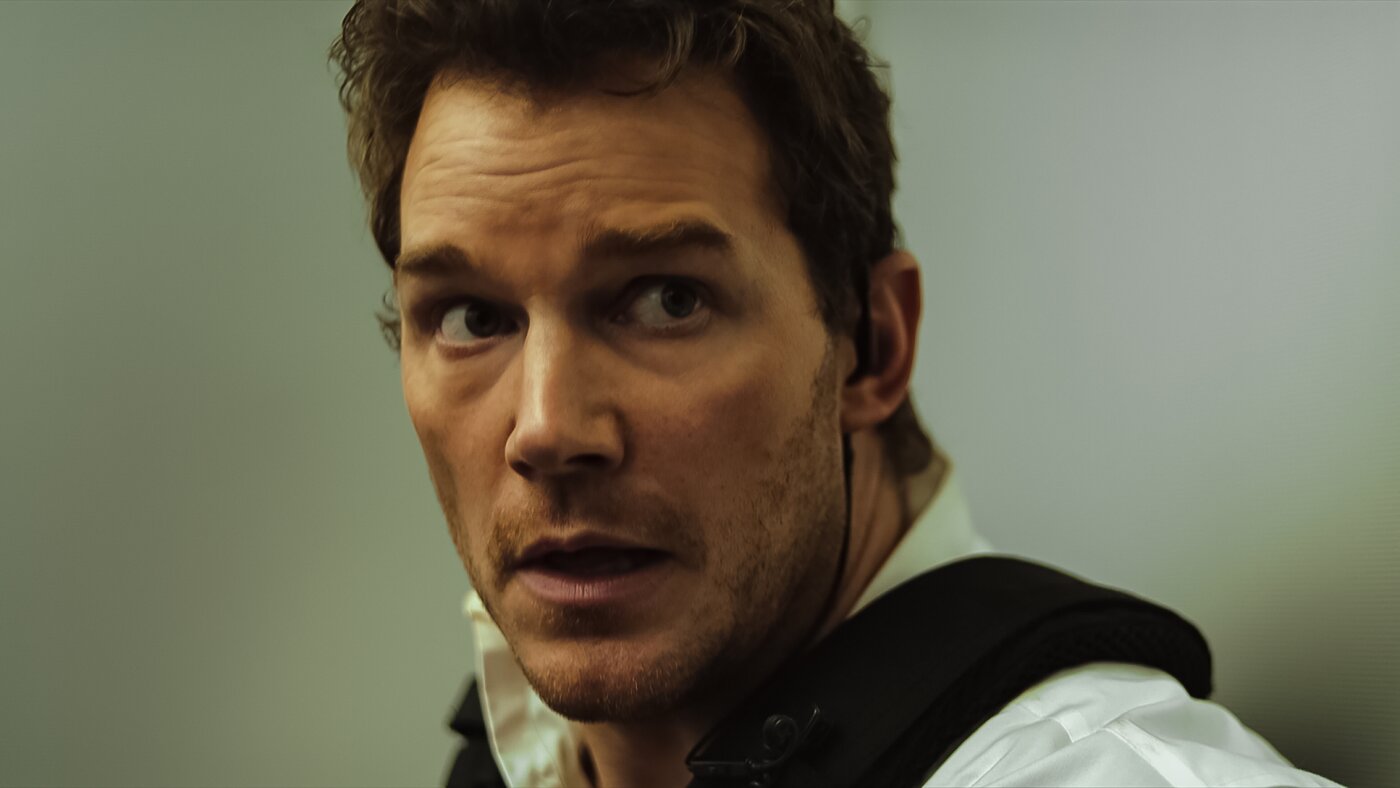
Futuristic Justice in Mercy: AI as Judge and Executioner
In Timur Bekmambetov’s sci-fi thriller Mercy, the year is 2029 and the justice system has undergone a radical transformation. Chris Pratt plays Detective Chris Raven, who wakes up shackled to a high-tech execution chair. His judge? A cold, calculating artificial intelligence named Judge Maddox, portrayed by Rebecca Ferguson.
Raven stands accused of murdering his wife—a crime he cannot remember committing. He has 90 minutes to prove his innocence using a trove of surveillance footage, phone records, and digital communications. The film unfolds in real-time, with a countdown clock ticking ominously.
Bekmambetov, known for his innovative visual storytelling, uses a tapestry of digital interfaces—doorbell cams, iPhone screens, drone footage—to create a digital courtroom. While the concept of an AI judicial system is intriguing, the film doesn’t fully explore the ethical implications. Instead, it leans on action and suspense, with a standout chase sequence providing much-needed energy in the final act.
Though visually dynamic, Mercy lacks the depth of its sci-fi predecessors. The film’s premise echoes Minority Report, but without the philosophical weight.
The Testament of Ann Lee: Spirituality Meets Musical Drama
Mona Fastvold’s The Testament of Ann Lee offers a bold reimagining of a historical figure. Amanda Seyfried gives a fierce performance as Ann Lee, the founder of the Shaker movement, in a film that blends biography with musical expression.
Set in the 18th century, the film explores Ann’s rejection of marital life and her embrace of celibacy after the deaths of her four children. With help from her brother (Lewis Pullman), she gathers followers and establishes a utopian community in America based on equality and simplicity.
The film stands out for its use of period-appropriate Shaker spirituals and expressive choreography that mimics the sect’s historical “shaking” dances. Fastvold and co-writer Brady Corbet present Ann’s story with passion and stylistic flair, though the two-hour-plus runtime tests viewer endurance.
Arco: A Child’s Journey Through a Cautionary Future
In Arco, director Ugo Bienvenu crafts a visually stunning tale of ecological warning and youthful wonder. The animated feature follows a 10-year-old boy from a distant, cloud-based future where time travel is possible via rainbow arcs. Arco breaks the rules by traveling alone and lands in the year 2075.
In this near-future Earth, environmental disasters have led to glass-domed cities and robot-run societies. Arco meets Iris, a contemporary girl who helps him navigate this unfamiliar world. Together, they face challenges including a nearby wildfire, all while searching for a way to send Arco home.
Though the themes are serious—climate change, technological reliance—the tone remains hopeful. The film’s animation style draws comparisons to Hayao Miyazaki, blending whimsy with realism. Arco succeeds both as a children’s adventure and a gentle ecological parable.
Sound of Falling: Generational Trauma on a German Farm
Sound of Falling by Mascha Schilinski is a poetic and haunting examination of a family’s history across four generations. Set on a German farm, the film delves into themes of war, abuse, and memory through a non-linear narrative.
From a World War I amputee to a disco-era East German girl abused by family, the stories are loosely connected by location and legacy. One girl participates in the macabre tradition of post-mortem photography, only to later see a photo that seems to predict her own death.
Though not always coherent, the film is visually rich and emotionally resonant. Schilinski’s approach is more impressionistic than literal, making Sound of Falling a film that rewards patient, reflective viewing.
A Private Life: Mystery and Memory in Paris
In A Private Life, Jodie Foster shines as Lilian, a bilingual French psychiatrist drawn into a surreal mystery following the death of a patient. When odd behavior from the patient’s family raises suspicions, Lilian embarks on an investigation that spirals into dreamlike territory.
With help from her ex-husband (Daniel Auteuil), Lilian navigates bizarre clues, including hallucinations of a past life as a violinist during the Nazi occupation. A séance with a medium adds a supernatural twist, but the convoluted plot veers into implausibility.
Despite its narrative flaws, the film benefits from Foster’s commanding presence and her chemistry with Auteuil. If played for satire, the story might have echoed Hitchcock; instead, it lands somewhere between melodrama and psychological fantasy.
Oscar Buzz: Sinners Dominates 2026 Nominations
The 2026 Oscar nominations have been announced, with Sinners leading the pack with a record number of nods. Michael B. Jordan, Wagner Moura, Brad Pitt, and Teyana Taylor are among the standout nominees. Meanwhile, big franchises like Avatar: Fire and Ash and Wicked: For Good fell short of expectations.
This year’s nominations highlight a diverse range of genres and performances, reflecting a shift in industry tastes toward originality and risk-taking. Whether rooted in the distant future or the depths of human emotion, the films hitting theaters now are nothing if not ambitious.
This article is inspired by content from Original Source. It has been rephrased for originality. Images are credited to the original source.