

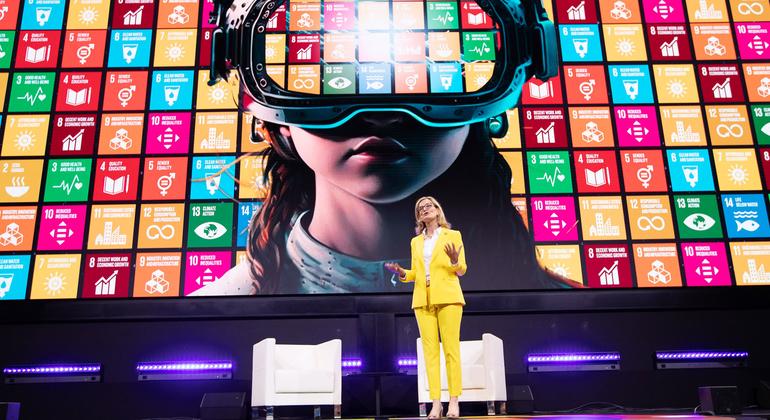
AI for Good: Transforming Lives Worldwide
Artificial intelligence for human rights is driving change across the globe, enabling new solutions for education, health, and environmental protection. The United Nations (UN) is at the forefront, using AI to break down barriers and enhance the quality of life for millions, especially the most vulnerable communities.
Empowering Children Through Accessible Learning
In Jamaica, six-year-old Ari, who faces learning difficulties, was given the opportunity to read in his own language thanks to AI-powered technology. The UN Children’s Fund (UNICEF) is leading this transformation with its Accessible Digital Textbooks for All (ADT) initiative. By leveraging AI, the program converts traditional textbooks into interactive, personalized formats that cater to the specific needs of children like Ari.
UNICEF’s Global Director of Education, Pia Rebello Britto, emphasizes that the goal is to put communities at the center of technology development. “There are countless more examples like Ari’s, showing what becomes possible when digital learning is designed to reach every child,” she said. With nearly 240 million children worldwide living with disabilities, the ADT initiative addresses a critical educational gap. Currently active in 17 countries and reaching almost two million children, the program aims to expand to 50 countries by 2030, further advancing artificial intelligence for human rights.
Fighting Climate Change with AI
The UN Environment Programme (UNEP) is tackling another major challenge: methane emissions. Methane is a potent greenhouse gas, and reducing leaks is essential in the fight against global warming. UNEP’s Methane Alert and Response System (MARS) utilizes AI to analyze satellite data from 30 satellites, detecting methane leaks with speed and accuracy. According to UNEP’s Climate Change Division Director, Martin Krause, “fixing methane leaks is the emergency brake” for climate change mitigation.
Since its launch in 2024, MARS has issued 7,500 alerts and triggered 42 mitigation actions, helping to prevent emissions equivalent to 24 million gas-powered cars. Companies respond swiftly to these alerts, reducing environmental harm and avoiding product loss—a win-win scenario. By leveraging artificial intelligence for human rights and the environment, the UN demonstrates how technology can protect both people and the planet.
Accelerating Health Solutions in Developing Nations
In Ethiopia, gold miners are at high risk for tuberculosis (TB) due to their working conditions. The World Health Organization (WHO) is using AI to analyze chest X-rays for TB, allowing for quicker screenings in areas with limited medical specialists. This technology, known as computer-aided detection (CAD), provides rapid TB likelihood scores, helping radiologists in low-resource settings to diagnose and treat patients more efficiently.
WHO scientist Dr. Vanessa Veronese highlights the significance: “It’s really helping people to move through the diagnostic cascade onto treatment much sooner.” Early detection reduces the spread of TB, which is crucial in high-risk communities. The WHO supports countries in adopting CAD, offering guidance, software calibration, and health outcomes research. This AI-driven approach is breaking down barriers to healthcare, further promoting artificial intelligence for human rights.
Using AI in Crisis Response and Governance
Beyond education, health, and the environment, UN agencies use AI to detect landmines, assess disaster damage, monitor financial transactions, and track radioactive contamination. These efforts showcase the vast potential of artificial intelligence for human rights in crisis response and public safety.
However, the UN recognizes the importance of ethical oversight. UN Secretary-General António Guterres has described AI as both “humanity’s greatest opportunity in the 21st century” and “one of its greatest risks.” He stresses the need for inclusive governance to ensure AI serves humanity. The UN’s Global Dialogue on AI Governance and the Independent International Scientific Panel on AI, established in 2025, aim to guide the ethical development and deployment of AI worldwide.
Promoting Equity and Setting Global Standards
The UN is committed to ensuring AI is safe, equitable, and inclusive. UNESCO set a milestone by adopting the first global AI ethics standard in 2021, and WHO continues to provide ethical guidelines for AI in healthcare. These initiatives reinforce the UN’s dedication to aligning artificial intelligence with human rights and sustainable development goals.
Conclusion: A Future Powered by Ethical AI
Through its diverse programs and initiatives, the UN exemplifies how artificial intelligence for human rights can drive positive change. From accessible education and rapid disease detection to environmental protection and ethical governance, the UN is setting a global standard for AI’s role in advancing human dignity and well-being.
This article is inspired by content from Original Source. It has been rephrased for originality. Images are credited to the original source.