

Emotion AI has crossed the threshold from laboratory curiosity to operational necessity. In 2026, the best emotion AI tools combine multimodal sensing – facial analysis, voice tone, text patterns, physiological signals – with actionable intelligence that actually shapes business outcomes. This guide walks you through the landscape of best emotion AI tools, tested and ranked by capability, real-world applicability, and honest assessment of where each excels and stumbles.
Finding the right emotion AI tool means understanding your specific use case. Are you optimizing customer service interactions? Testing creative content? Monitoring employee engagement? Analyzing user research? The best emotion AI tools specializing in each area reveal themselves through hands-on evaluation – not by scrolling marketing copy. We’ve put ten standout platforms through their paces to identify which ones deliver measurable intelligence from the signals humans naturally emit.
How We Picked
Our methodology prioritizes platforms with proven deployment in production environments, transparent technical architecture, and demonstrated ROI across industries. We evaluated emotion AI tools for accuracy of emotion classification, speed of processing, ease of API integration, and quality of insights output. Platforms that merely detect faces without meaningful emotion modeling, or that rely on outdated facial coding systems, were excluded.
 | 1. Decode |
Website: https://www.decode.ai
Decode stands out as the most comprehensive emotion AI platform we evaluated. Its integration of emotion AI, behavior AI, and generative AI within a single unified research stack eliminates the fragmentation that plagues competitive solutions. The standout feature is its predictive creative analytics module – real-time eye-gaze tracking and attention measurement powered by neuro AI – which lets marketers optimize creative assets before full-scale deployment. For enterprises running consumer research at scale, Decode’s insights intelligence hub centralizes analysis across calls, meetings, documents, and research data with genuine AI reasoning rather than surface-level scoring.
Content Capabilities:
- Consumer insights with AI-powered surveys, qualitative research, diary studies, and social media analysis
- User experience research including remote testing, journey mapping, and prototype validation
- Real-time eye-gaze tracking and attention measurement powered by neuro AI
- Centralized AI copilot that surfaces connected insights across all customer touchpoints
Best for: Enterprise teams conducting consumer and UX research who need multimodal emotion analysis with creative optimization capabilities.
 | 2. Cogito |
Website: https://www.cogitocorp.com
Cogito pivots emotion AI toward the contact center – where real conversations happen and emotional misalignment costs money in lost customers. The real-time guidance layer is where this tool gets interesting. Rather than post-call analysis, Cogito coaches agents during live calls by detecting emotional tone shifts, spotting objection patterns, and surfacing suggested responses. The integration depth with leading CRM platforms means emotion data flows directly into operational workflows. This is emotion AI designed for velocity and measurable business outcomes, not just sentiment scoring.
Content Capabilities:
- Real-time emotional intelligence guidance during active customer interactions
- Seamless API integration with major CRM systems for workflow automation
- Post-call analysis with emotion scoring, pattern detection, and agent coaching
- Sentiment tracking across call center operations for quality management
Best for: Sales, service, and care management teams who need live emotional coaching and CRM-integrated emotion insights.
 | 3. EchoDepth |
Website: https://www.echodepthinsight.com
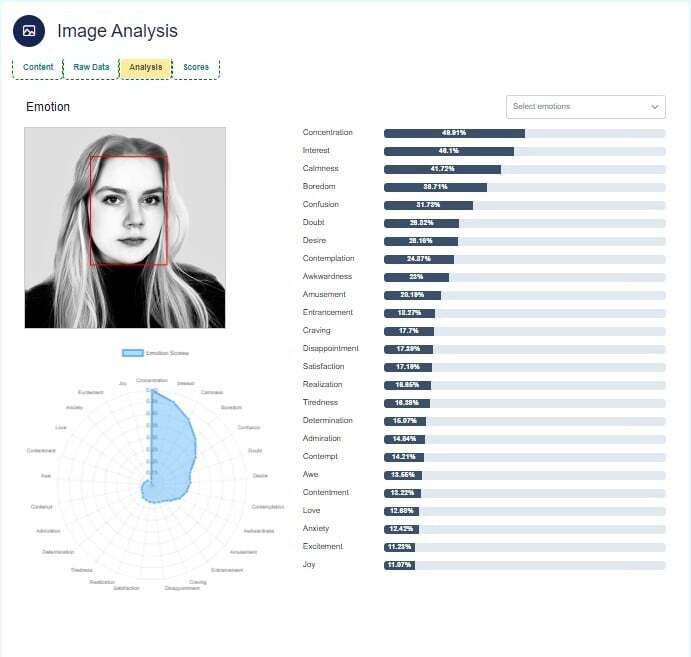
EchoDepth solves a fundamental problem in research: people’s verbal responses don’t match their actual emotional reactions. By analyzing involuntary facial action units and emotional state modeling – measuring valence, arousal, and dominance in real time – this platform detects genuine emotional responses before cognitive filtering kicks in. The standout for product testing and marketing evaluation is its ability to distinguish surface-level approval from authentic desire or resistance. EchoDepth maps emotional response moment-by-moment, turning millisecond-level facial signals into strategic insights about whether decisions will land emotionally before they’re finalized.
Content Capabilities:
- Facial action unit analysis capturing involuntary micro-expressions and emotional signals
- Three-dimensional emotional state modeling: valence, arousal, and dominance
- Moment-by-moment emotional mapping during stimulus exposure
- Real-time detection distinguishing genuine emotional response from filtered reactions
Best for: Product teams, marketing departments, and leadership communication professionals validating creative and strategic decisions with emotional authenticity data.
 | 4. AB Tasty |
Website: https://www.abtasty.com
AB Tasty treats emotion AI as part of a broader optimization ecosystem alongside A/B testing, personalization, and recommendations. The emotions-based segmentation solution is the differentiator – rather than segmenting users by demographics, AB Tasty enables segmentation by emotional response patterns detected during site interaction. This shifts personalization from crude demographic buckets to genuinely responsive experiences. The platform serves over 1,100 brands and integrates deeply with retail and cosmetics workflows, making it the practical choice when emotion AI needs to drive immediate ecommerce optimization rather than pure research insights.
Content Capabilities:
- Emotions-based audience segmentation for personalized user experiences
- Integration with A/B testing and experimentation frameworks
- Web and API solutions for unified experience optimization
- Real-time personalization powered by emotional response detection
Best for: Ecommerce and marketing teams running large-scale optimization who need emotion AI integrated into testing and personalization workflows.
 | 5. Clarifai |
Website: https://www.clarifai.com
Clarifai positions itself as an AI orchestration platform where emotion AI sits alongside vision models, LLMs, and RAG pipelines. The strength lies in its flexibility – available as cloud, on-premises, or hybrid deployment – and the ability to chain emotion detection with other AI workflows. The diverse model variety means you’re not locked into a single emotion classification approach. However, this flexibility introduces complexity. Teams with in-house AI expertise find the powerful pre-trained models and extensive customization worth the steeper learning curve. After building over 1.5 million AI models, Clarifai’s infrastructure scales where niche emotion AI platforms might strain.
Content Capabilities:
- Large vision models (LVMs) combined with LLM reasoning for contextual emotion analysis
- Data labeling and inference infrastructure for custom emotion models
- Multi-modal orchestration enabling emotion detection as part of broader AI pipelines
- Cloud, on-premises, or hybrid deployment flexibility
Best for: Technical teams and enterprises building complex AI systems where emotion detection integrates with vision, language, and reasoning models.
 | 6. Opsis Emotion AI |
Website: https://opsis.ai
Opsis brings multimodal emotion analysis – facial, speech, text, and posture – with psychological annotation, uncommon in most platforms. The native SAP integration positions it for enterprise operations already embedded in SAP ecosystems. The award-winning machine learning algorithm refines classification for individual or large-group analysis, making it suitable for both personal interaction scenarios and crowd response monitoring. The specificity of psychological annotation sets Opsis apart for teams needing research-grade emotion classification rather than basic sentiment scoring.
Content Capabilities:
- Multimodal emotion detection across facial expression, speech, text, and posture
- Psychological annotation for refined emotional classification
- Native SAP platform integration for enterprise deployment
- Large-group and individual emotion analysis capabilities
Best for: SAP-integrated enterprises and research organizations requiring psychological-grade emotion classification across multiple modalities.
 | 7. FaceReader Online |
Website: https://facereader-online.com
FaceReader Online remains the accessible entry point for webcam-based emotion analysis. As a web-based facial coding platform with integrated eye tracking, it avoids complex installation while maintaining scientific rigor rooted in the Facial Action Coding System. Advertising professionals, academic researchers, and UX specialists appreciate the straightforward interface for testing creative impact and design effectiveness. The simplicity works as both strength and limitation – you get reliable facial emotion detection without the advanced features of larger platforms, making it ideal for teams whose primary need is measurable emotional response to visual stimuli.
Content Capabilities:
- Webcam-based facial action coding using established FACS methodology
- Integrated eye tracking for attention measurement
- Web-based deployment eliminating complex installation requirements
- Responsible AI integration with behavior AI
Best for: Researchers, UX professionals, and marketing teams testing creative effectiveness through facial emotion coding and attention tracking.
 | 8. AI Coach Amotions |
Website: https://www.amotionsinc.com
Amotions AI narrows emotion AI to a specific professional context – real-time sales coaching during live calls. The system coaches reps on discovery, objection handling, and technical questions while simultaneously analyzing emotional cues and conversation dynamics. The dual-mode value proposition is powerful: live coaching improves in-the-moment decision-making, while post-call feedback builds skill over time. AI roleplay scenarios let sales teams practice at scale. For organizations struggling with ramp time and win rates, the emotional intelligence coaching layer adds nuance beyond script adherence.
Content Capabilities:
- Real-time coaching during live sales calls with emotional cue detection
- AI roleplay scenarios for sales practice and objection handling
- Post-meeting feedback and performance scoring
- Conversation dynamic analysis with coaching recommendations
Best for: Sales organizations prioritizing coach-guided ramp time reduction and win rate improvement through emotionally aware real-time assistance.
 | 9. Conversation Insights Agent |
Website: https://www.uniphore.com
Uniphore’s Conversation Insights Agent applies large language models to conversational analytics at scale – extracting trends, intents, and emotional insights from thousands of customer interactions. The generative AI approach captures nuance that traditional rule-based emotion classification misses. For enterprises drowning in contact center data, this tool surfaces patterns linking emotional content to business outcomes. The scale advantage matters: at 875 employees and enterprise-focused positioning, Uniphore has the infrastructure to handle organizational-level conversation analysis where smaller platforms would strain.
Content Capabilities:
- Generative AI-powered trend and intent extraction from customer interactions
- Large language model analysis of conversation emotional content
- Enterprise-scale processing of thousands of conversations
- Actionable insight generation for contact center optimization
Best for: Large enterprises managing high-volume customer interactions who need LLM-powered emotional and intent analysis at organizational scale.
10. Lucid
Website: https://www.lucidapp.com
Lucid attacks a different problem than most emotion AI platforms: bias detection in AI-generated content. By identifying 74 types of cognitive biases in AI outputs with 98% precision in under 2 minutes, Lucid shifts emotion AI toward governance and fairness. The tool ensures AI-generated content is accurate, fair, and free from systematic distortion – increasingly critical as organizations rely on LLMs for customer-facing copy. Available as both Chrome extension and API, Lucid integrates into development and governance workflows without friction. For AI governance teams and compliance officers, this represents emotion AI applied to a structural problem most platforms ignore.
Content Capabilities:
- Cognitive bias detection in AI outputs with 98% precision
- Identification of 74 bias types in under 2 minutes per analysis
- Chrome extension and API deployment options
- Integration into AI governance and compliance workflows
Best for: AI governance teams and compliance officers ensuring fairness and accuracy in AI-generated content.
Final Thoughts on Emotion AI Tools
The best emotion AI tools in 2026 share a common thread: they move beyond sentiment scoring toward operational intelligence. Whether you’re optimizing creative effectiveness through facial analysis, coaching sales conversations in real time, or governing AI bias, the standout platforms deliver measurable business outcomes rather than abstract emotion scores. Select based on your specific use case – contact center, research, ecommerce, or governance – rather than chasing the most feature-complete platform. Depth in your area of need beats breadth across capabilities you’ll never use.
Manage Your Way Into Coverage
Want your emotion AI tool featured in our future roundups? Build in transparent third-party testing, publish case studies demonstrating customer outcomes, and maintain clear documentation of your emotion classification methodology. We prioritize platforms demonstrating real-world impact over marketing claims.
Frequently Asked Questions
What is emotion AI?
Emotion AI uses machine learning to detect, analyze, and classify human emotions through facial expressions, voice tone, text, and physiological signals. It enables personalized interactions in customer service, healthcare, research, and marketing applications.
How much do emotion AI tools cost?
Emotion AI tools range from free research trials to enterprise contracts exceeding $10,000 monthly depending on usage volume and features. Most platforms offer tiered pricing with free trials so you can evaluate before committing.
Can I use emotion AI for free?
Several emotion AI tools offer free trial periods and research-grade free tiers. FaceReader Online and some Clarifai models provide complimentary testing, though enterprise features require paid plans.
How do I choose the right emotion AI tool?
Evaluate based on your specific use case – whether you need contact center analysis, creative testing, research insights, or AI governance. The best emotion AI tools excel in their targeted domain rather than offering broad functionality across all applications.