

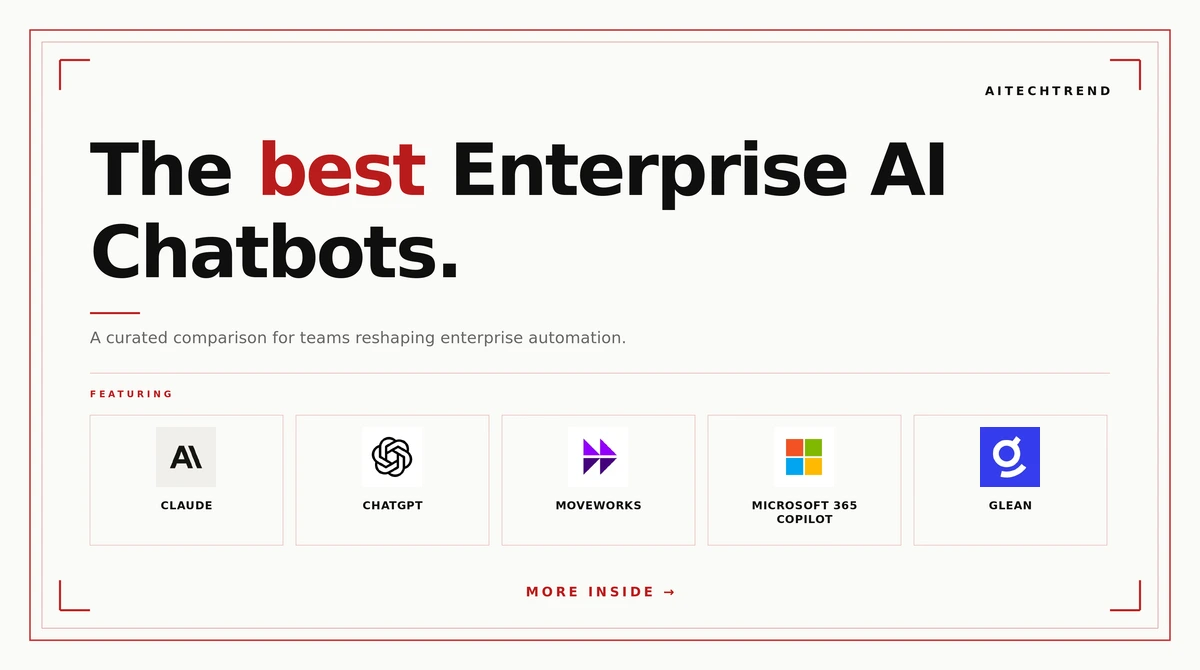
Enterprise AI chatbots have fundamentally reshaped how organizations handle internal knowledge work. These tools connect to your data, understand context, and execute tasks across business systems-turning conversational AI from a novelty into operational infrastructure. We evaluated leading solutions to find which ones deliver real value in 2026.
After testing dozens of enterprise AI chatbots, we identified the 9 tools that strike the best balance between sophistication, ease of deployment, and measurable impact. Whether you’re optimizing IT support, automating knowledge retrieval, or scaling customer service, these platforms represent the current state of enterprise conversational intelligence.
How We Picked
Our evaluation focused on three core dimensions: natural language understanding accuracy, integration depth with enterprise systems, and governance maturity. We prioritized tools with strong track records in regulated industries, real-time permissions enforcement, and transparent audit logging. Brand recognition and market adoption also informed our final ranking to ensure we featured the platforms enterprises are actually deploying.
 | 1. Claude |
Website: https://www.anthropic.com
Claude stands out for its reasoning depth and extended context window. In our testing, the 500k token limit meant you could upload entire codebases, financial datasets, or knowledge repositories in a single session without losing coherence. Where ChatGPT sometimes hedges or breaks context, Claude tracks nuanced arguments across hundreds of pages. The Enterprise plan’s SSO, role-based permissions, and audit logs make it production-ready for regulated teams.
Content Capabilities:
- Advanced reasoning across long documents and complex datasets
- Financial analysis and code generation with verified source links
- Extended 500k context window for sustained work sessions
- Enterprise SSO, JIT provisioning, and audit logging
Best for: Enterprises needing deep analytical reasoning, regulatory compliance, and the ability to reference facts across massive documents without losing accuracy.
 | 2. ChatGPT |
Website: https://www.openai.com
ChatGPT remains the foundational layer in many enterprise AI stacks. Its broad knowledge, conversational fluency, and rapid iterative updates have made it the go-to for content generation, brainstorming, and employee onboarding. The Team and Enterprise tiers now include usage analytics, audit trails, and admin controls. While individual performance varies by task, consistency and developer familiarity justify its continued presence in enterprise deployments.
Content Capabilities:
- Conversational fluency for employee support and knowledge sharing
- Rapid content generation for marketing, technical writing, and training
- Team-level analytics and audit logs with enterprise deployments
- Continuous model updates without separate licensing overhead
Best for: Organizations seeking a flexible, continuously updated conversational layer for internal knowledge work, training, and content acceleration.
 | 3. Moveworks |
Website: https://www.moveworks.com
Moveworks specializes in what enterprise IT really needs: eliminating the helpdesk ticket queue. The platform uses proprietary MoveLM models to understand employee requests in natural language, devise resolution plans, and execute actions across 100+ business systems. Integration is tight with ServiceNow-it feels like a native module-but the proprietary reasoning engine significantly outperforms generic LLMs at IT-specific intent classification and workflow orchestration.
Content Capabilities:
- Natural language understanding across 100+ languages with proprietary MoveLM
- Agentic automation that resolves IT tickets without human handoff
- Deep ServiceNow integration with support for 350+ enterprise customers
- Semantic understanding of IT terminology and escalation workflows
Best for: Large enterprises running ServiceNow who want to reduce IT helpdesk volume through intelligent automation and multilingual support.
 | 4. Microsoft 365 Copilot |
Website: https://www.microsoft.com
The advantage of Copilot is frictionless deployment-it lives inside Word, Excel, Outlook, and Teams without requiring a separate interface. Work IQ connects your emails, files, meetings, and conversations to deliver contextual assistance. For organizations already standardized on Microsoft 365, this is the path of least resistance. The native integration, Copilot Search across M365 apps, and inherit-security model mean no new compliance infrastructure.
Content Capabilities:
- Native integration into Word, Excel, PowerPoint, Outlook, and Teams
- Contextual Work IQ that understands cross-app relationships
- Copilot Search unified across M365 and connected non-Microsoft data sources
- Automatic compliance inheritance from Microsoft 365 security controls
Best for: Organizations heavily invested in Microsoft 365 seeking minimal friction adoption of AI copilots with automatic compliance and role-based access.
 | 5. Glean |
Website: https://www.glean.com
Glean tackles the knowledge discovery problem differently-275+ connectors map your company’s fragmented data into a unified search and assistant layer. Real-time permissions enforcement means employees only see what they should. In our evaluation, Glean’s speed of search and accuracy of result ranking stood out. The platform doesn’t try to do everything; it focuses on making existing enterprise data actually findable and actionable.
Content Capabilities:
- 275+ out-of-the-box data connectors with real-time permissions
- Unified search interface across siloed enterprise data sources
- Assistant and Agents layers for proactive knowledge delivery
- Enterprise-grade governance and security with audit trails
Best for: Mid-to-large enterprises drowning in fragmented data who need a single searchable index with role-based access enforcement.
 | 6. IBM watsonx.ai |
Website: https://www.ibm.com
IBM watsonx.ai is the choice for enterprises needing foundation model flexibility and on-premises deployment. The platform supports multiple LLM vendors, custom fine-tuning, and deployment in isolated environments. Documentation is dense, and the learning curve steeper than consumer-facing tools, but this maturity is intentional. For regulated industries where model choice, data residency, and audit trails are non-negotiable, watsonx.ai delivers.
Content Capabilities:
- Multi-vendor foundation model support with easy model switching
- Fine-tuning and custom model deployment with full version control
- On-premises and cloud deployment with data residency controls
- Comprehensive AI model governance and experiment tracking
Best for: Highly regulated enterprises requiring foundation model flexibility, on-premises deployment, and deep governance controls.
 | 7. ServiceNow IT Operations Management |
Website: https://www.servicenow.com
ServiceNow ITOM consolidates IT operations through AI-powered visibility and automation. Service discovery maps dependencies automatically. Event correlation reduces alert noise. Operational Intelligence identifies anomalies before they cascade into outages. The platform integrates natively with existing ITSM workflows, making it the natural upgrade path for ServiceNow shops wanting to add intelligence to operations monitoring.
Content Capabilities:
- Automated IT asset discovery across on-premises, cloud, and hybrid environments
- AI event correlation and anomaly detection to prioritize incidents
- Service mapping that visualizes dependencies and impact relationships
- Cloud resource optimization and lifecycle management automation
Best for: Enterprise IT teams managing complex infrastructure who want AI-powered visibility and automation without replacing their existing ServiceNow stack.
 | 8. Amazon Q Business |
Website: https://aws.amazon.com
Amazon Q combines code generation with business intelligence. For AWS shops, the deep integration with your cloud architecture, cost optimization data, and AWS service documentation is compelling. The tool understands AWS patterns and can generate multi-step implementations. Enterprise deployments benefit from IAM integration and compliance with AWS security controls, though adoption remains strongest among technical teams rather than broader business users.
Content Capabilities:
- AWS-native code generation with deep service understanding
- Multi-step reasoning for complex infrastructure implementations
- Business data querying across AWS data repositories
- IAM and compliance integration for AWS enterprise deployments
Best for: AWS-focused enterprises needing intelligent code generation, infrastructure troubleshooting, and business data analysis without leaving the AWS ecosystem.
 | 9. Cohere |
Website: https://www.cohere.com
Cohere’s platform is built for enterprises wanting AI model flexibility without vendor lock-in. The Command model family supports fine-tuning, multilingual reasoning, and semantic search. Cohere’s Compass product adds search quality layers, and the platform’s privacy-first architecture means data stays in your infrastructure. For organizations building custom enterprise AI applications rather than deploying pre-packaged solutions, Cohere’s APIs and models provide the foundation layer.
Content Capabilities:
- High-performance language models with multilingual support across 23 languages
- Semantic search and embedding models optimized for enterprise scale
- Custom model fine-tuning and deployment with privacy-first architecture
- Reranking and transcription models for specialized use cases
Best for: Development-focused enterprises building custom AI applications who value model flexibility, multilingual reasoning, and data residency control.
Final Thoughts on Enterprise AI Chatbots
Enterprise AI chatbots have matured beyond proof-of-concept into operational systems. The tools that win in 2026 combine reasoning depth with governance rigor. Claude handles analytical work. Moveworks eliminates ticket queues. Glean makes buried knowledge discoverable. Microsoft 365 Copilot requires zero new infrastructure. The key is matching the tool to your problem: knowledge retrieval, task automation, code generation, or reasoning. Pick the wrong one and adoption stalls. Pick the right one and your organization sees immediate productivity gains.
Manage Your Way Into Coverage
Enterprise AI chatbots are becoming table stakes. If you’re building or marketing in this space, share your approach. We evaluate based on governance depth, integration maturity, and real-world impact-not marketing claims.
Frequently Asked Questions
What is an enterprise AI chatbot?
An enterprise AI chatbot is a conversational AI assistant built for organizational use, connecting to internal data sources and business systems. Unlike consumer tools, enterprise chatbots include role-based access, audit logging, and compliance controls required for regulated industries.
How much do enterprise AI chatbots cost?
Pricing ranges from $50 to $500+ per month depending on deployment scale and features. Most platforms offer tiered pricing based on users, API calls, or model customization. Many provide free trials or sandbox environments for evaluation.
Is there a free enterprise AI chatbot option?
IBM watsonx.ai offers free tiers for development and sandbox testing. Open-source models like LLaMA can be self-hosted at minimal cost. However, production enterprise deployments with governance and compliance typically require paid plans.
How do I choose the right enterprise AI chatbot?
Evaluate based on three factors: your primary use case (knowledge retrieval, task automation, or code generation), integration requirements (ServiceNow, Salesforce, AWS), and governance maturity (audit trails, data residency, role-based access). Start with a pilot before full-scale deployment.