

China’s Rapid Growth in Humanoid Robots
China is making significant strides in the deployment and manufacturing of humanoid robots. These advanced machines, powered by sophisticated robotics technology, are now capable of performing tasks ranging from making coffee to directing traffic and even executing backflips. As manufacturers ramp up production, the focus_keyword “humanoid robots” has become central to discussions about the future of automation in China and beyond.
Production Capacity Outpaces Demand
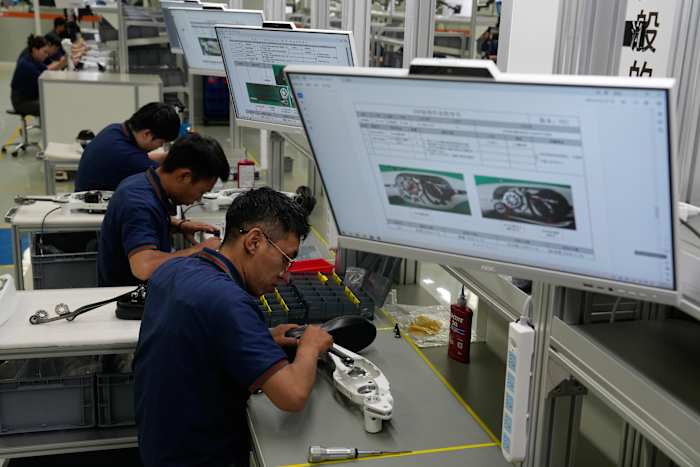
Chinese companies have rapidly developed the infrastructure needed to mass-produce humanoid robots. Leading the charge are startups like Matrix Robotics, whose flagship model stands at 5.6 feet and is capable of finely controlled hand movements. Priced at around $99,000 per unit, Matrix Robotics has received approximately 1,000 orders from clients such as coffee chains and hotels. Yet, despite this initial interest, real-life demand for humanoid robots has not kept pace with the burgeoning manufacturing capacity.
Another notable company, EngineAI, based in Shenzhen, offers humanoid robots for roles like security guards and museum guides, with basic models retailing for $26,600. While these robots are attracting attention for their ability to dance, box, or perform in public venues, many experts argue that the practical use cases for humanoid robots are still limited. The machines often struggle in unpredictable environments, and most deployments remain performative rather than functional.
Global Competition and Market Dynamics
The global market for humanoid robots is estimated to be worth $5 trillion, with China and the United States dominating research and development. While the U.S. leads in artificial intelligence for high-level robotic computing, China excels in hardware production and the collection of data necessary for training humanoid robots. According to research, Chinese companies accounted for approximately 85% of global humanoid robot shipments in 2025, benefiting from strong state support and a robust industrial base.
However, achieving widespread adoption remains a challenge. The Chinese government has cautioned against a potential industry bubble, citing the lag between commercialization and the state of technology. Many of the more than 2 billion yuan in orders reported last year came from state-owned enterprises and research labs, rather than the consumer market. This highlights a key issue: while production capabilities are impressive, the real-world demand for humanoid robots lags behind.
Barriers to Widespread Adoption
One of the biggest hurdles for the humanoid robots industry is price. Although Chinese-made robots are now 20% cheaper than their foreign counterparts, with some models priced as low as $6,000, most remain too expensive for mass-market deployment. Morgan Stanley estimates that average prices could drop to $21,000 by 2050, but this remains out of reach for many businesses and households today.
Another challenge is functionality. As Samm Sacks, a senior fellow at the New America think tank, notes, humanoid robots are “fragile in operation and dependent on highly structured environments.” For these robots to move beyond niche or performative roles, they must become more adaptable and robust.
Applications and Future Potential
Despite current limitations, the future for humanoid robots in China appears promising. Startups are exploring a range of applications, from heavy lifting in warehouses to assisting with household chores. As technology matures, robotics experts believe humanoid robots could eventually take on dangerous or repetitive tasks, filling gaps in industries facing labor shortages.
Data collection is another critical factor. Companies like SenseTime and ACE Robotics are amassing vast amounts of human-centric data to train robots for more complex functions. However, truly versatile humanoid robots will require exposure to a wide variety of real-world scenarios, a process that could take years to perfect.
China’s Leadership and Outlook
China’s commitment to advancing humanoid robots is evident in both policy and practice. The government’s five-year plan specifically targets robotics as a frontier technology, and leading companies like Unitree and AGIBOT are already reporting profits. In 2025, over 13,000 humanoid robots were shipped, with forecasts suggesting shipments could surpass 1 million units by the early 2030s.
While there is optimism about reducing costs and improving performance, manufacturers acknowledge that achieving true mass-market appeal for humanoid robots will require continued investment and innovation. As the industry evolves, China is poised to remain at the forefront of the global humanoid robots market, balancing the challenges of scaling production with the need to generate sustainable demand.
This article is inspired by content from Original Source. It has been rephrased for originality. Images are credited to the original source.