

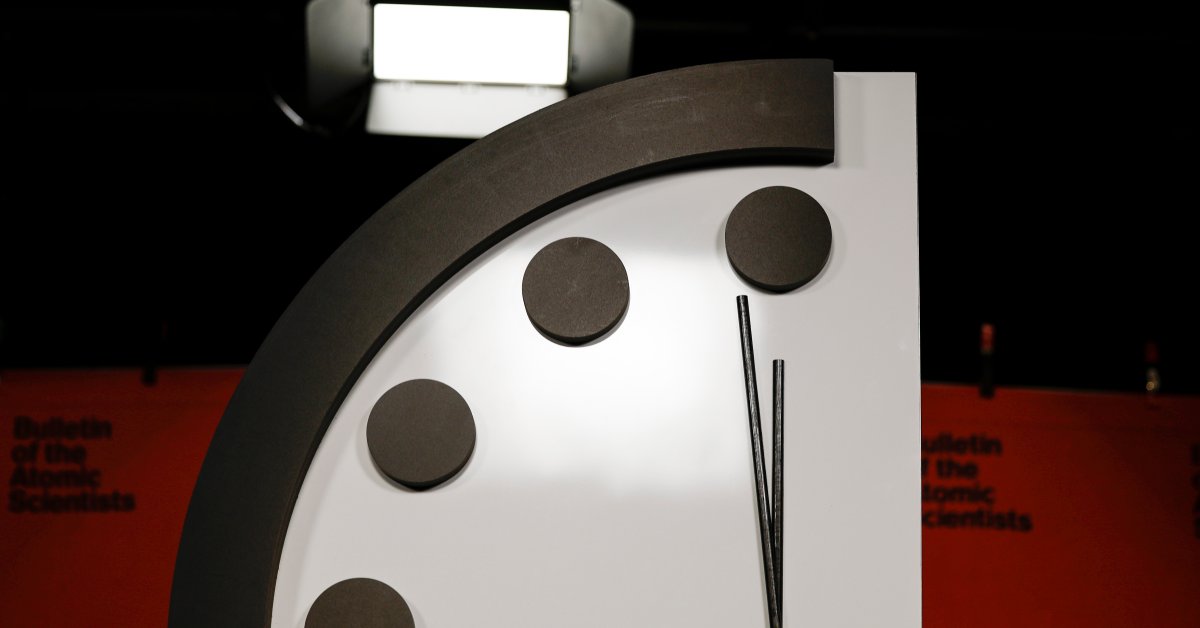
Doomsday Clock Now at 85 Seconds to Midnight
On Tuesday, the Bulletin of the Atomic Scientists moved the hands of the symbolic Doomsday Clock to just 85 seconds before midnight, the closest it has ever been to signaling global catastrophe. The decision reflects the growing existential threats humanity faces, including nuclear conflict, climate change, and the rapid advancement of artificial intelligence.
This marks the third time in five years that the clock has ticked closer to midnight, a metaphorical representation of how near the world is to self-destruction. The clock was originally conceived in 1947 during the Cold War, when tensions between the United States and the Soviet Union were escalating due to nuclear arms proliferation.
Artificial Intelligence Emerges as a New Threat
In this year’s announcement, artificial intelligence (AI) was highlighted as a major concern. Scientists warned that AI is now being used to amplify disinformation, posing a significant threat to democratic institutions and public trust. Nobel Peace Prize laureate Maria Ressa described the current state of global information as an “informational armageddon,” driven by the unchecked spread of social media and generative AI technologies.
“Human beings have been commodified by a predatory and extractive industry,” Ressa said during the announcement. She emphasized the dangers of a digital ecosystem that prioritizes engagement over truth, arguing that misinformation could destabilize societies and governments.
Nuclear Risks and Diplomatic Tensions Escalate
The scientists also pointed to mounting tensions among nuclear-armed nations as a pressing concern. They urged the United States to reengage diplomatically with Russia and work toward renewing the New START Treaty, the last remaining arms control agreement between the two countries. The treaty, which limits deployed intercontinental-range nuclear weapons, is set to expire on February 4, with no clear indication it will be extended.
In 2023, President Vladimir Putin suspended inspections and data exchanges required by the treaty, citing the ongoing war in Ukraine. However, he has since expressed willingness to resume nuclear arms talks in 2025. Former U.S. President Donald Trump has yet to respond to this proposal, prompting criticism from arms control experts.
“This is a piece of low-hanging fruit that the Trump Administration should have seized months ago,” said Jon B. Wolfsthal, a member of the Bulletin’s Science and Security Board. He emphasized that both nations could reach an agreement quickly if political will existed.
Global Leadership Under Fire
Alexandra Bell, the President and CEO of the Bulletin of the Atomic Scientists, addressed the broader failures of global leadership. She stated that not only has the Trump Administration implemented policies that contributed to the current crisis, but that leaders worldwide have failed to take meaningful action to reduce existential risks.
“No matter the government, a shift toward neo-imperialism and an Orwellian approach to governance only serves to push the clock closer to midnight,” Bell said. She stressed that while the challenges may seem insurmountable, they are human-made—and therefore solvable.
Hope Through Science and Public Engagement
Despite the grim outlook, Bell expressed optimism that change is possible. She pointed to previous moments in history when the hands of the Doomsday Clock were turned back, crediting scientific advancement and public advocacy as key factors. “Every time we’ve been able to turn back the hands of the clock, it’s been because scientists and experts worked to find solutions, and the public demanded action,” she said.
She emphasized that there are no quick fixes, but proactive collaboration and informed decision-making can avert disaster. “There is not a single elegant solution for any of the problems we are facing, but these problems are solvable,” Bell concluded.
The Road Ahead
As the world teeters closer to midnight, the Bulletin calls for renewed international cooperation, responsible technological development, and a reinvigoration of public discourse grounded in facts. They urge global citizens to recognize the urgency of the moment and advocate for policies that prioritize sustainability, peace, and truth.
The Doomsday Clock remains a powerful symbol of our collective vulnerability—and our capacity to change course. Whether humanity can summon the political will and scientific ingenuity to turn back the clock remains an open question.
This article is inspired by content from Original Source. It has been rephrased for originality. Images are credited to the original source.