

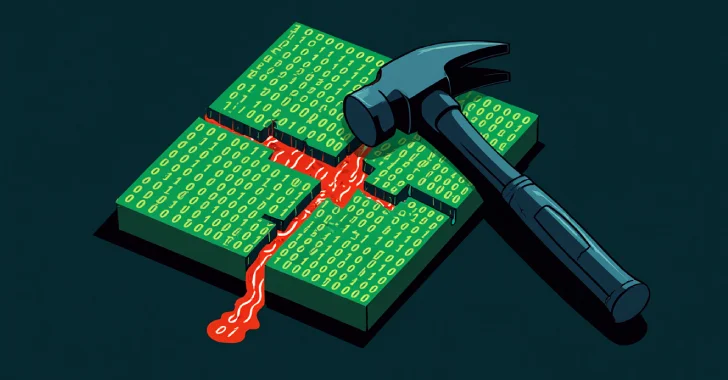
New GPUHammer Exploit Undermines AI Model Accuracy
NVIDIA has issued a security advisory urging customers to enable system-level Error Correction Codes (ECC) to counter a newly discovered variant of the RowHammer attack, known as GPUHammer. This vulnerability impacts its graphics processing units (GPUs), posing a significant threat to AI model reliability.
GPUHammer represents the first known RowHammer exploit that successfully targets NVIDIA GPUs, including models such as the NVIDIA A6000 with GDDR6 memory. The attack enables malicious users to provoke bit flips in GPU memory, altering other users’ data in shared environments.
Understanding the Threat: What is RowHammer?
RowHammer is a well-documented hardware-level vulnerability found in dynamic random-access memory (DRAM). It occurs when rapid and repeated access to a row of memory causes electrical interference, flipping bits in adjacent rows. This phenomenon can lead to data corruption or unauthorized data manipulation.
While past RowHammer attacks primarily targeted CPUs and system RAM, GPUHammer extends the threat to GPUs, a key component in AI and machine learning operations. The University of Toronto researchers behind GPUHammer demonstrated that the attack could degrade a deep neural network’s (DNN) accuracy from 80% to under 1% using a single induced bit flip.
GPUHammer vs. Traditional RowHammer and Spectre
Unlike speculative execution vulnerabilities like Spectre and Meltdown, which exploit CPU architecture to leak sensitive data, RowHammer compromises data integrity through physical flaws in memory design. In 2022, researchers introduced SpecHammer, combining RowHammer with Spectre to insert malicious values into memory locations.
GPUHammer, however, is unique in its ability to bypass existing mitigations such as target row refresh (TRR), making GPUs vulnerable even with current defenses in place. This marks an escalation in the RowHammer threat landscape, especially for workloads relying heavily on GPU-based computation.
Impact on AI and Cloud Platforms
Artificial intelligence models rely on high-performance GPUs for training and inference tasks. A compromised GPU can introduce subtle but devastating changes to model outputs, undermining trust in AI-driven decisions. Cloud platforms that offer shared GPU resources are particularly exposed to such risks, as one rogue tenant could potentially corrupt another’s AI workloads.
According to the researchers, the ability to manipulate AI models via GPU memory corruption could open doors to adversarial attacks, data poisoning, and other integrity violations that are difficult to detect and mitigate.
Mitigation Strategies and Hardware Protections
To guard against GPUHammer, NVIDIA recommends enabling ECC using the command nvidia-smi -e 1. This feature detects and corrects memory errors, although it comes with trade-offs. Enabling ECC can reduce available memory by 6.25% and cause up to a 10% performance drop in AI inference workloads on the A6000 GPU.
Fortunately, newer NVIDIA GPUs such as the H100 and RTX 5090 come equipped with on-die ECC, which offers built-in protection against bit flips caused by voltage fluctuations. These newer chips are not affected by the GPUHammer exploit, providing a safer option for organizations with high security requirements.
Emerging Variants and Broader Security Implications
The disclosure of GPUHammer follows another recent RowHammer-based threat dubbed CrowHammer. Developed by researchers from NTT Social Informatics Laboratories and CentraleSupelec, CrowHammer enables key recovery attacks against Falcon, a post-quantum signature scheme selected by NIST.
By targeting Falcon’s reverse cumulative distribution table (RCDT), CrowHammer can trigger precise bit flips that skew the algorithm’s randomness. Researchers demonstrated that even a single targeted bit flip could facilitate full key recovery, given sufficient signature data.
Conclusion: A Call for Hardware-Level Security
GPUHammer underscores the growing importance of hardware-level security in modern computing. As GPUs become the backbone of AI and cloud infrastructure, ensuring their reliability is critical. Organizations should evaluate their hardware configurations, enable ECC where applicable, and consider upgrading to newer GPU models with built-in protections.
Security researchers continue to explore the limits of RowHammer-style attacks, pushing vendors and users alike to adopt proactive defenses. As demonstrated by GPUHammer and CrowHammer, what once seemed like a theoretical memory glitch has evolved into a tangible threat to data integrity and cryptographic security.
This article is inspired by content from Original Source. It has been rephrased for originality. Images are credited to the original source.