

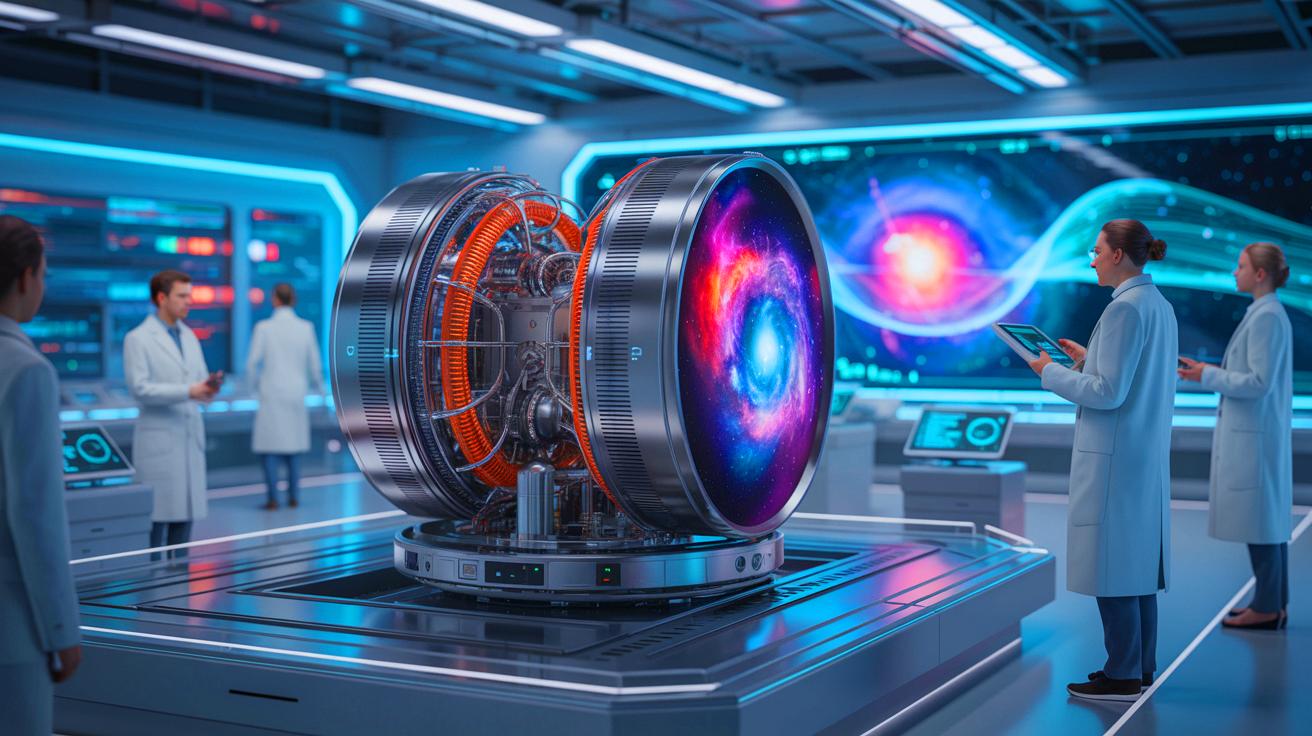
AI Ushers in a New Era of Gravitational Wave Detection
In a groundbreaking leap for astrophysics, researchers have developed an artificial intelligence (AI) system named Urania that has outperformed human scientists in designing advanced gravitational wave detectors. These novel AI-generated models have the potential to significantly augment our ability to study the cosmos, offering unprecedented insights into black hole mergers, neutron stars, and the universe’s earliest moments.
Gravitational waves—ripples in the fabric of space-time caused by cataclysmic cosmic events—were first observed directly in 2015. Since then, instruments like LIGO and Virgo have made important contributions to our understanding of phenomena such as black hole collisions. However, Urania is now helping scientists push the boundaries of what’s detectable.
AI Surpasses Human Ingenuity
Quantum physicist Mario Krenn and his team at the Max Planck Institute for the Science of Light in Germany led the development of Urania. Designed to innovate beyond traditional human engineering, the AI was tasked with reimagining the architecture of gravitational wave detectors. The result? An astonishing 50 new detector designs, each outperforming current systems in sensitivity and frequency range.
These designs promise to elevate instruments like LIGO and Virgo, enabling them to capture fainter and more distant signals. With this enhanced sensitivity, researchers could observe events previously beyond reach—such as mergers involving the universe’s first stars or faint signals from the early cosmos.
Expanding the Reach of Observation
One of Urania’s most transformative contributions is its ability to design detectors that operate over a vastly expanded frequency range—from 10 to 5,000 Hz. This increase could boost the observable universe’s volume by a staggering 50 times. Such a shift is comparable to moving from hearing a whisper across a room to understanding a conversation across a city block.
These designs also present a 1.6-fold improvement in sensitivity over LIGO’s latest upgrade plans, such as the Voyager project. In practical terms, this could mean a fourfold increase in the number of detectable cosmic events, ushering in a new era of astrophysical discovery.
Unlocking Secrets of Neutron Stars and Supernovas
Beyond black holes, Urania’s detector designs are particularly well-suited for studying binary neutron star mergers. These incredibly dense celestial bodies emit gravitational waves during and after their collisions. The so-called “post-merger” signals hold vital information about exotic states of matter under extreme conditions—data that existing instruments struggle to capture.
By facilitating the detection of these signals, Urania’s designs could help scientists unlock the mysteries of ultra-dense matter and the inner workings of supernovas. These explosive events, which disperse the elements essential for life, are among the universe’s most energetic occurrences. Improved detection will allow researchers to study them in greater detail than ever before.
AI’s Broader Scientific Impact
Urania exemplifies a broader trend in science: the increasing role of AI not just as a support tool, but as a creative force in research and development. Unlike traditional methods, which rely on human-conceived blueprints, Urania explores vast design spaces and unearths configurations that humans might never consider.
This collaboration between human intuition and machine intelligence is redefining how scientific instruments are created. According to Krenn, the next step for researchers is to interpret Urania’s results—decoding the AI’s thought process to better understand what makes these new detector designs so effective.
“We are entering an era where AI doesn’t just assist science—it drives it,” Krenn emphasized. The implications for astronomy, physics, and beyond are vast, potentially leading to innovations in everything from subatomic particle studies to deep-space exploration.
The Future of Scientific Discovery
As Urania’s designs move from theoretical models to implementation, the scientific community stands on the brink of a new observational frontier. These next-generation detectors could transform our understanding of the universe’s structure, origins, and evolution.
The success of Urania highlights the potential of AI to unlock new realms of knowledge. By merging computational power with human curiosity, science is poised to tackle questions that were once thought unanswerable. Whether it’s discovering hidden cosmic events or redefining the laws of physics, AI is proving to be an indispensable partner in the quest for understanding.
This article is inspired by content from Original Source. It has been rephrased for originality. Images are credited to the original source.