

India Aims to Lead in Artificial Intelligence Innovation
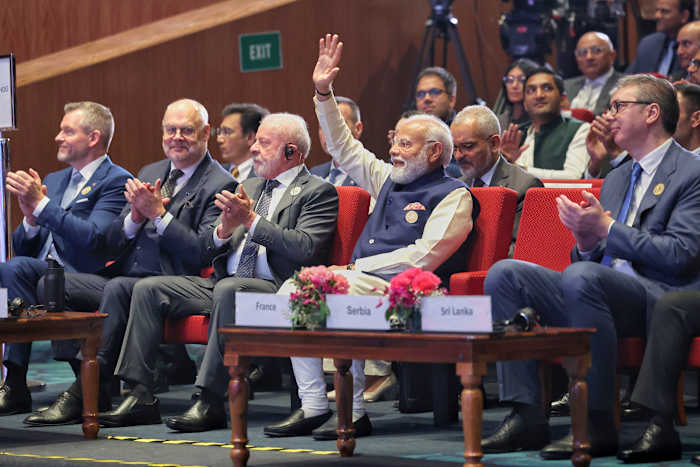
At the India AI Impact Summit in New Delhi on Thursday, Prime Minister Narendra Modi made a resounding pitch for India to become a central force in the global artificial intelligence (AI) landscape. Addressing a diverse audience of world leaders, tech executives, and policymakers, Modi emphasized India’s commitment to developing cutting-edge AI technology domestically and deploying it worldwide.
“Design and develop in India. Deliver to the world. Deliver to humanity,” Modi declared, setting an ambitious tone for the summit. The event marked a significant step in India’s ongoing efforts to establish itself as a competitive, cost-effective AI innovation hub, building on its rapid advances in digital infrastructure.
Global Leaders Rally for Inclusive AI
The summit attracted prominent figures, including French President Emmanuel Macron, Google CEO Sundar Pichai, and United Nations Secretary-General António Guterres. Guterres called for the creation of a $3 billion fund to help developing nations build foundational AI capabilities—ranging from workforce skills to affordable computing power.
“The future of AI cannot be decided by a handful of countries, or left to the whims of a few billionaires,” Guterres said, advocating that AI should “belong to everyone.”
Bridging Advanced Economies and the Global South
India used the summit as a platform to position itself as a bridge between technologically advanced economies and the Global South. Indian officials highlighted the country’s digital ID system and online payments infrastructure as examples of scalable, low-cost technology that could benefit developing nations.
“We must democratize AI. It must become a tool for inclusion and empowerment, particularly for the Global South,” Modi emphasized. Later, Modi met with major tech leaders, many of whom outlined their investment plans for India while affirming their commitment to principles supporting “inclusive and multilingual” AI development.
Big Tech Commits to India’s AI Growth
The summit also featured significant announcements from the tech world. Sam Altman, CEO of OpenAI, revealed a new collaboration with India’s Tata Group to work on AI initiatives, including the development of robust data center infrastructure in India. “We believe the democratization of AI is the only fair and safe path forward,” Altman remarked.
Meanwhile, India’s substantial digital market, boasting nearly a billion internet users, continues to attract massive investments. In December, Microsoft announced a $17.5 billion commitment to expanding cloud and AI infrastructure over the next four years. Google pledged $15 billion for the next five years, including its first AI hub in India. Amazon has set its sights on investing $35 billion by 2030, aiming to accelerate AI-driven digitization. Furthermore, India is seeking up to $200 billion in further data center investments in the coming years.
Challenges on the Path to AI Leadership
Despite these advances, India faces hurdles in developing homegrown, large-scale AI models akin to those created by U.S.-based OpenAI or China’s DeepSeek. The country contends with barriers such as limited access to advanced semiconductor chips, scalable data centers, and a vast array of local languages requiring AI adaptation. Nonetheless, the summit showcased India’s determination to overcome these challenges and establish itself as a leader in AI technology.
Summit Highlights and Setbacks
The high-profile event was not without its difficulties. Opening day saw organizational glitches, with attendees reporting long lines and delays. Some exhibitors took to social media to complain about stolen belongings and display items, though organizers later confirmed the recovery of the missing items.
Further controversy emerged when a private Indian university was expelled from the summit after a staff member presented a commercially available Chinese-made robotic dog as the university’s own creation. The situation was compounded by the sudden withdrawal of Microsoft co-founder Bill Gates from his scheduled keynote address. While no official reason was given, the Gates Foundation stated the decision was made to keep the focus on the summit’s key priorities, amidst ongoing questions about Gates’ ties to the late Jeffrey Epstein.
The Road Ahead for India’s AI Ambitions
Despite the setbacks, the India AI Impact Summit underscored India’s resolve to shape the global future of artificial intelligence. Modi’s vision of AI innovation “for the world, for humanity” resonated with participants and highlighted India’s potential to influence the evolution of AI on a global scale. As India continues to attract significant investments and foster international collaboration, its role in the AI revolution is set to expand, bridging technological divides and promoting inclusive, human-centered progress.
This article is inspired by content from Original Source. It has been rephrased for originality. Images are credited to the original source.