

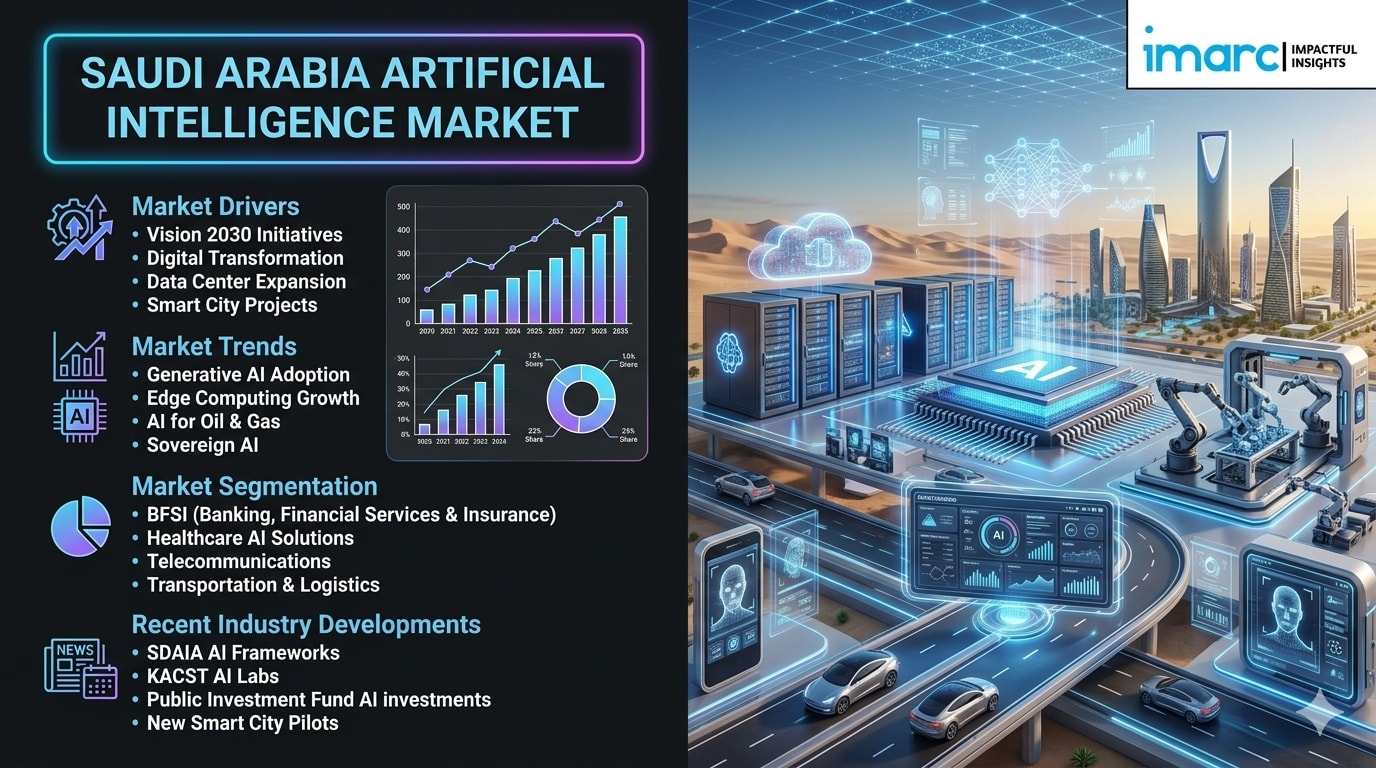
Saudi Arabia’s AI Market: Accelerating Growth Under Vision 2030
Saudi Arabia artificial intelligence market is undergoing a transformative journey, fueled by significant government backing, robust investments, and a clear focus on digital transformation as part of the Kingdom’s Vision 2030 strategy. With AI adoption accelerating across sectors, the country is positioning itself as a regional technology powerhouse, driving innovation, automation, and sustainable economic growth.
Market Size and Growth Outlook
According to the latest research by IMARC Group, the Saudi Arabia artificial intelligence market size was valued at USD 1,242.5 million in 2025. Projections indicate substantial growth, with expectations to reach USD 4,374.5 million by 2034, reflecting an impressive CAGR of 15.01% from 2026 to 2034. This rapid expansion is a testament to the country’s ambitious digital transformation agenda and the increasing enterprise adoption of AI-driven solutions.
AI-Driven Transformation in Key Sectors
AI technology is reshaping multiple sectors in Saudi Arabia. In the smart city domain, NEOM exemplifies how AI powers autonomous systems, energy management, and traffic optimization. Over 90% of NEOM’s operations are designed for AI-driven automation, setting a global benchmark for cognitive urban environments.
Healthcare is another major beneficiary. Machine learning algorithms now analyze medical imaging in Saudi hospitals with up to 95% accuracy, cutting diagnosis times by 60% and supporting the nation’s aim for predictive and accessible healthcare. In financial services, banks have deployed AI chatbots that handle 70% of customer inquiries, while advanced fraud detection systems process millions of transactions daily—reducing costs and enhancing security.
The oil and gas sector leverages AI to monitor more than 200 oil fields in real-time, predicting equipment failures weeks ahead and optimizing extraction processes, which helps save billions in maintenance costs. Meanwhile, natural language processing models tailored for Arabic enable government e-services to achieve 85% accuracy in understanding regional dialects, ensuring digital inclusivity.
Vision 2030: Powering AI Innovation
Vision 2030 has established artificial intelligence as a cornerstone of Saudi Arabia’s economic transformation. The government has invested over USD 20 billion in AI infrastructure and talent development. The Saudi Data and Artificial Intelligence Authority (SDAIA) leads the national AI strategy, digitizing services for 34 million residents and visitors across more than 200 government entities. Major initiatives, such as the National Strategy for Data and AI, aim to contribute USD 50 billion to national GDP through widespread AI adoption.
Education and talent development are at the heart of this transformation, with dedicated AI universities, training for over 20,000 specialists, and the creation of regulatory sandboxes allowing 100+ startups to pilot AI solutions. Partnerships with global tech leaders have spurred the launch of advanced AI research centers in Riyadh and Jeddah, while mandatory AI integration into Vision 2030 megaprojects drives demand for intelligent automation across construction, tourism, entertainment, and logistics.
Trends, Investments, and Talent Development
The Saudi Arabia artificial intelligence market is experiencing a surge in investments, with the Public Investment Fund allocating USD 40 billion to technology ventures, emphasizing AI startups and infrastructure. Over 300 government services now feature AI-powered chatbots and automation, reducing processing times by 75% and elevating citizen satisfaction.
Smart city projects in five major urban centers are deploying AI for traffic management, waste management, and public safety. Riyadh’s intelligent transport systems have already cut congestion by 30%. Special AI-focused free zones are attracting more than 150 international AI companies by offering 100% foreign ownership, zero corporate tax for 50 years, and streamlined licensing.
The Kingdom is also building a robust talent pipeline. More than 50 universities now offer AI and data science programs, enrolling over 25,000 students annually. The National Center for AI has graduated 5,000 certified professionals, with coding bootcamps training an additional 15,000 in machine learning. Women’s participation in tech sectors has grown to 35%, supported by scholarships for over 3,000 female students in AI specializations. Corporate training programs have upskilled 40,000 employees, ensuring a skilled workforce ready for the AI-driven future.
Industry Adoption and Economic Impact
Industry-wide adoption is propelling the Saudi Arabia artificial intelligence market forward. Enterprises are now allocating 15-20% of their IT budgets to AI implementation. In retail, computer vision reduces stockouts by 45% in over 500 stores, enhancing customer experience. Manufacturing facilities have integrated predictive maintenance AI, increasing equipment uptime from 75% to 92% and cutting unplanned downtime costs by USD 200 million each year.
Telecommunications providers use AI to optimize network performance for 45 million mobile subscribers, supporting efficient 5G rollouts. In agriculture, AI-powered precision farming has reduced water consumption by 35% across 50,000 hectares in arid regions. The government’s AI procurement mandate, requiring 30% local AI content in public contracts, is creating opportunities for over 200 homegrown AI solution providers.
Recent Developments and the Road Ahead
Recent milestones include the launch of a national AI governance framework, a USD 1 billion AI innovation fund by Saudi Aramco, and the opening of advanced AI research centers. AI-powered 5G network optimization and the deployment of AI diagnostic systems in hospitals are further strengthening Saudi Arabia’s position as a leader in digital transformation.
As the Saudi Arabia artificial intelligence market continues to mature, the focus remains on fostering domestic innovation, creating high-value jobs, and driving sustainable economic diversification through intelligent technologies.
This article is inspired by content from Original Source. It has been rephrased for originality. Images are credited to the original source.