

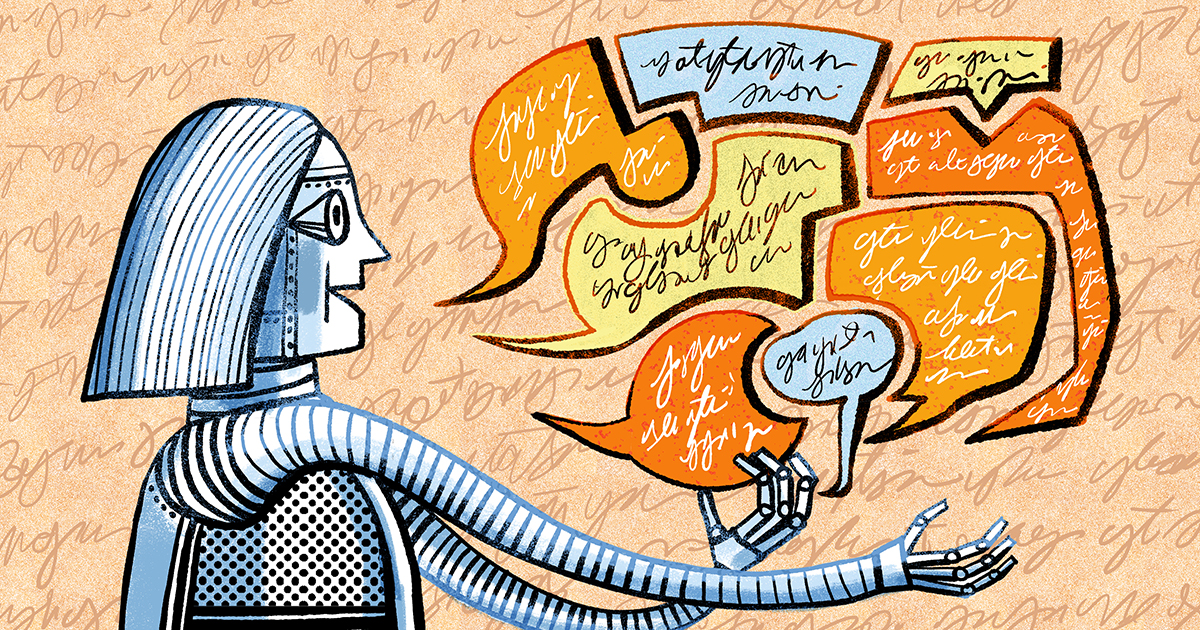
AI Emerges as a Linguistic Analyst
Language has long been considered a defining human trait, with thinkers like Aristotle referring to humans as “the animal that has language.” But as artificial intelligence systems continue to evolve, this once-clear boundary is growing increasingly blurred. A new study has found that some large language models (LLMs) are demonstrating metalinguistic abilities—skills not just to use but to analyze language—on par with human experts.
In a groundbreaking study led by Gašper Beguš of the University of California, Berkeley, alongside Maksymilian Dąbkowski and Ryan Rhodes of Rutgers University, researchers put various LLMs through a battery of rigorous linguistic tests. The results were startling: one AI model performed at a level comparable to a graduate student in linguistics, showcasing a deep understanding of syntax, ambiguity, and recursion.
Challenging Long-Held Assumptions
The linguistic community has long debated whether AI can truly grasp the complexity of human language. Prominent linguist Noam Chomsky and others have argued that language’s intricacies cannot be learned from mere exposure to massive datasets. However, the recent findings challenge this perspective, suggesting that at least some models can engage in sophisticated linguistic reasoning.
“This challenges our understanding of what AI can do,” said Beguš. The study’s results sparked interest across the scientific community, with Yale computational linguist Tom McCoy calling the work “very important” in understanding the strengths and limitations of AI.
Testing for True Understanding
To ensure the models weren’t merely regurgitating memorized data, the researchers designed a four-part test, including the use of syntactic tree diagrams first introduced by Chomsky in 1957. These diagrams break down sentences into hierarchical components, such as noun and verb phrases.
One part of the test focused on recursion, a unique feature of human language that allows phrases to be nested within other phrases. For example, the sentence “Jane said that the sky is blue” includes a recursive clause. AI model o1 successfully interpreted complex recursive structures and even generated more intricate ones, like: “The astronomy [the ancients [we revere [who lived in lands we cherish]] studied] was not separate from astrology.”
Decoding Ambiguity and Phonology
Another area in which o1 excelled was in handling sentence ambiguity, a task notoriously difficult for computational models. For instance, in the ambiguous sentence “Rowan fed his pet chicken,” the model correctly identified two distinct interpretations and produced syntactic trees for both. This level of understanding is typically enabled by human common sense, something AI has traditionally lacked.
The researchers also explored phonology, the study of sound patterns and phonemes. Using 30 entirely invented mini-languages composed of 40 made-up words each, the models were tasked with identifying phonological rules. In one case, o1 correctly deduced that “a vowel becomes a breathy vowel when it is immediately preceded by a consonant that is both voiced and an obstruent.” Since these languages were newly constructed, prior exposure during training was impossible, confirming the AI’s analytical capabilities.
Implications and Future Directions
The implications of this research are profound. It suggests that AI systems might be able to analyze language at a level once thought exclusive to human cognition. Still, no model has yet made original linguistic discoveries or taught humans something fundamentally new about language.
“It’s only a matter of time before we are able to build models that generalize better from less data in a way that is more creative,” said David Mortensen, a computational linguist at Carnegie Mellon University. However, he and others caution that current models are still restricted by their training paradigms, which focus on predicting the next word in a sequence rather than fostering true creative understanding.
For Beguš, the study marks a significant shift in how we perceive human uniqueness. “It appears that we’re less unique than we previously thought we were,” he concluded. As AI continues to evolve, the line between human and machine linguistic ability may continue to fade, raising new philosophical and practical questions about what it means to understand language.
This article is inspired by content from Original Source. It has been rephrased for originality. Images are credited to the original source.