

AI Cybersecurity Threats Accelerate in 2026
AI cybersecurity threats are reshaping the digital landscape, as artificial intelligence plays an increasing role in both cyberattacks and defense strategies. In recent months, experts have noted a dramatic surge in AI-powered cybercrime, forcing organizations and governments worldwide to rethink their security protocols.
AI’s Dual Role: From Defender to Accessory in Cybercrime
Artificial intelligence is swiftly becoming a double-edged sword in the world of cybersecurity. According to the Verizon 2026 Data Breach Investigations Report, nearly a third of data breaches now originate from software vulnerabilities, surpassing stolen passwords as the primary entry point for hackers. The emergence of AI cybersecurity threats has enabled malicious actors to swiftly identify weak points in digital infrastructure and craft sophisticated malware at an unprecedented speed.
CrowdStrike reported an 89% year-on-year increase in AI-enabled attacks in 2025. This sharp rise demonstrates how generative AI is empowering both novice hackers and seasoned cybercriminals, making cyberattacks more frequent and complex. As hackers use AI to automate and accelerate their campaigns, cybersecurity professionals are under immense pressure to detect and neutralize threats faster than ever before.
Industry leaders stress the urgent need to leverage AI for defense. Nasrin Rezai, Verizon’s Chief Information Security Officer, emphasized the importance of using AI proactively to anticipate and counteract cyberattacks. A notable example is the European Central Bank’s ongoing efforts to defend against attacks leveraging Anthropic’s new AI model, Claude Mythos. Although designed to bolster cybersecurity, this advanced model has also posed risks by exposing vulnerabilities in the very systems it was intended to protect. During a month-long pilot program, Mythos helped uncover over 10,000 vulnerabilities among 50 partner organizations.
Ransomware Attacks Continue to Escalate
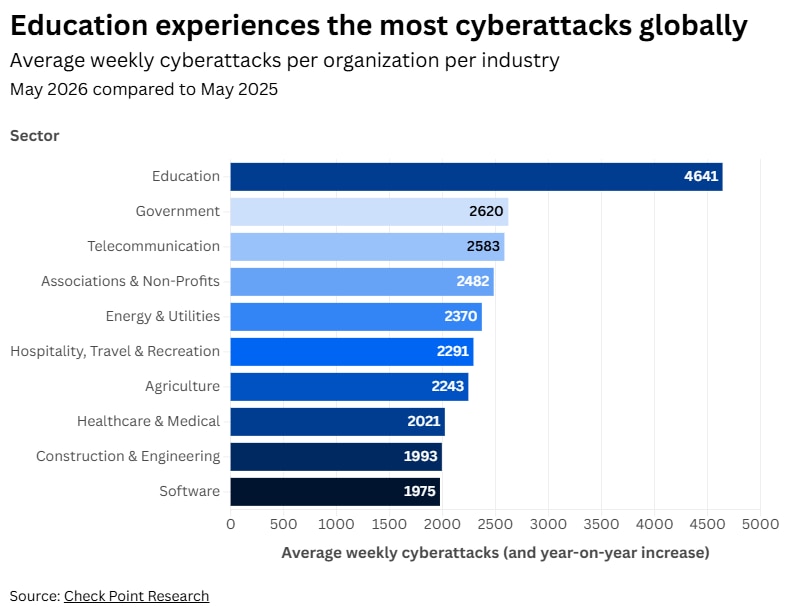
While overall cyberattacks dipped in May 2026, ransomware incidents surged by 48%, according to Check Point Research. The education sector faced the highest volume of attacks, with an average of 4,641 weekly incidents per organization—a 7% year-on-year increase. Government, telecommunications, and retail sectors also remained prominent targets.
One high-profile case involved the convenience store chain 7-Eleven, which suffered a breach after hackers known as ShinyHunters accessed sensitive franchisee documents. This led to the leak of 9.4GB of data after failed ransom negotiations. Even technology supply chain giants like Foxconn were not spared, as hackers claimed to have stolen over 11 million files containing confidential client information, including data related to Apple, Google, Nvidia, and Sony.
Major Cybersecurity News Briefs
- Anthropic Suspends New AI Tools: Security concerns led Anthropic to suspend access to its Claude Fable 5 and Mythos 5 AI models after US authorities raised alarms about potential exploitation.
- US Congress Proposes AI Act: The draft Great American AI Act aims to establish a federal governance framework for AI, requiring transparency, risk assessments, and fines up to $1 million for violations.
- 23andMe Sued Over Data Breach: Chrome Holding (formerly 23andMe) faces legal action in California after a 2023 breach exposed genetic and family data of nearly 7 million customers.
- Carnival Cruises Data Leak: Hackers used social engineering to compromise systems, potentially exposing the data of 6 million passengers. The company is offering complimentary credit monitoring to affected US travelers.
- GitHub Suffers Data Breach: Attackers exploited a Visual Studio Code extension to steal approximately 3,800 internal repositories, though no customer-facing systems were compromised.
- Anthropic Eyes IPO: The AI company recently raised its valuation to nearly $1 trillion and filed for an initial public offering, with OpenAI and Perplexity following suit.
AI: The Biggest Driver of Cybersecurity Change
The World Economic Forum’s “AI and Cyber: Empowering Defenders” report highlights how artificial intelligence is now the single most significant force reshaping cybersecurity. Organizations that heavily utilize AI in areas like phishing detection and anomaly monitoring can shorten breach lifecycles by around 80 days and reduce average breach costs by up to $1.9 million.
As AI cybersecurity threats continue to evolve, sectors like education, healthcare, and NGOs are particularly vulnerable. Experts recommend a collective approach to resilience, including tailored strategies, shared services, and targeted government support. Protecting critical infrastructure, often managed by resource-constrained teams, requires advanced AI tools to monitor subtle anomalies and respond to incidents swiftly.
Moreover, AI is making cybersecurity more accessible by allowing professionals to express security intentions in natural language, simplifying processes that once required complex technical knowledge.
Conclusion: Staying Ahead of AI Cybersecurity Threats
The rapid advancement of AI cybersecurity threats underlines the need for constant vigilance and innovation. As attackers become more adept at exploiting AI, defenders must harness the same technology to stay ahead. The future of cybersecurity will depend on proactive strategies, collaboration, and the responsible development of AI tools to protect critical data and infrastructure.
This article is inspired by content from Original Source. It has been rephrased for originality. Images are credited to the original source.