

Artificial Intelligence in the Final Frontier
Artificial Intelligence (AI) is revolutionizing how we live and work on Earth. From healthcare and agriculture to finance and manufacturing, AI’s influence is undeniable. However, as our planet faces growing constraints and challenges, researchers and technologists are now looking beyond our atmosphere. Enter Space AI—an emerging interdisciplinary field that bridges artificial intelligence with space science and technology.
Space AI encompasses a broad range of technologies and applications aimed at enhancing space exploration and translating those advancements into solutions for life on Earth. As AI capabilities grow, their potential to transform the way we explore, operate, and even inhabit space becomes increasingly tangible.
Introducing the Framework of Space AI
Researchers have proposed a systematic framework that categorizes the diverse applications of Space AI into four mission contexts:
- AI on Earth: This domain focuses on intelligent mission planning, optimizing spacecraft design, running complex simulations, and performing in-depth ground-based data analytics before missions even launch.
- AI in Orbit: Once in space, AI supports satellite and International Space Station (ISS) operations. This includes autonomous robotics, real-time data processing, enhanced communication systems, and maintaining orbital safety.
- AI in Deep Space: Farther from Earth, AI enables autonomous navigation, adaptive scientific discovery, and long-term collaboration between humans and machines. These systems must function under severe communication delays and unpredictable conditions.
- AI for Multi-Planetary Life: As humanity eyes long-term habitation on the Moon, Mars, and beyond, AI will be essential in areas like resource utilization, habitat construction, ecosystem management, and building resilient interplanetary networks.
Real-World Examples: Astrobee and CIMON
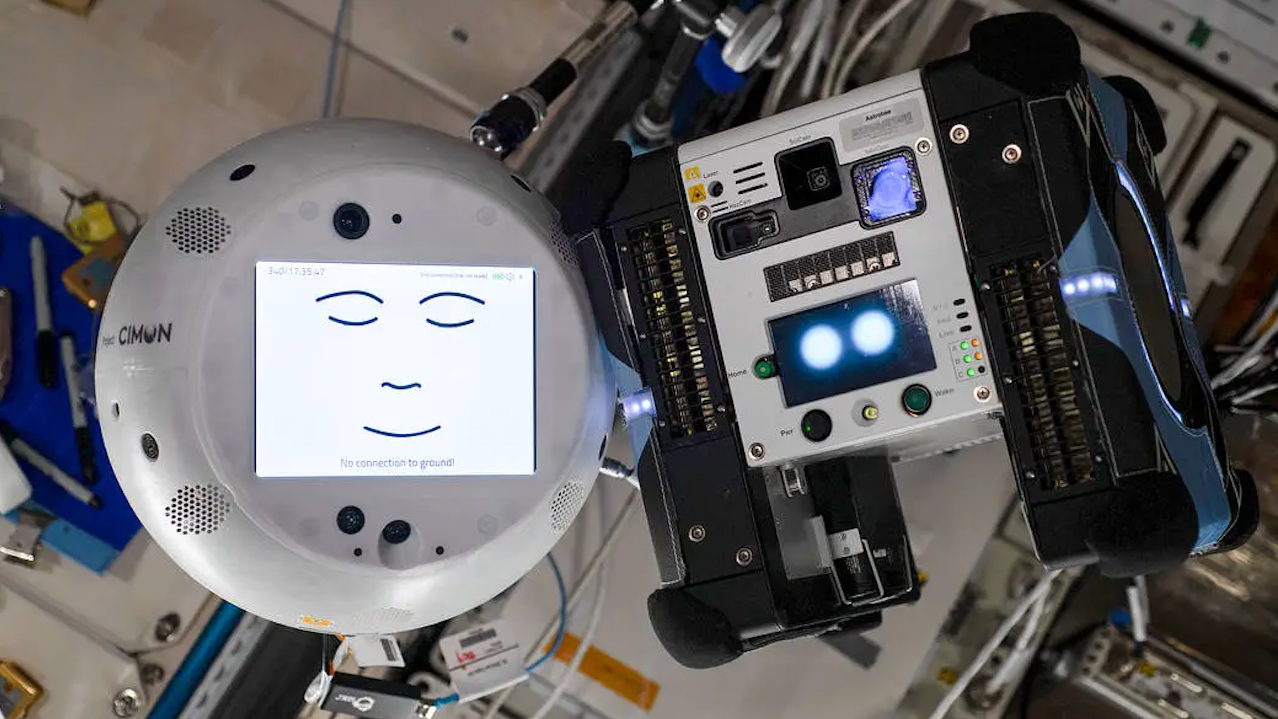
NASA’s Astrobee and the European Space Agency’s Project CIMON (Crew Interactive MObile companioN) are prime examples of AI-driven space robotics. These assistant robots have operated aboard the International Space Station, supporting astronauts with tasks ranging from equipment diagnostics to scientific experiments.
After two years of separate operations, Astrobee and CIMON were recently photographed together in space—a testament to the growing presence and collaboration of AI-enabled systems in orbit. These robotic companions demonstrate how AI can reduce the cognitive and physical burdens on astronauts, making long-duration missions more feasible.
Scientific and Societal Impacts
The benefits of Space AI extend far beyond the vacuum of space. Insights gained through these technologies can improve Earth-based systems in several ways:
- Advanced Sensing and Imaging: High-resolution sensors and AI algorithms used for planetary mapping can be adapted for environmental monitoring on Earth.
- Robotics and Automation: Techniques developed for space robotics can revolutionize manufacturing and logistics industries.
- Resource Optimization: AI models for extraterrestrial resource management can be applied to sustainable energy and material usage on our planet.
- Trustworthy AI Systems: The rigorous reliability required for space missions drives the development of more secure and dependable AI systems for Earth applications.
The Road Ahead for Space AI
Space AI is still in its infancy but rapidly gaining momentum. Researchers like Ziyang Wang are helping to formalize this field, bringing together experts from astrophysics, computer science, and engineering. Their goal is to create a unified vision for how AI can serve space missions and, in turn, improve life on Earth.
According to Wang’s recent publication, Space AI is not just a set of technologies but an evolving ecosystem that could reshape humanity’s relationship with the cosmos. By leveraging AI’s growing capabilities, space missions can become more efficient, autonomous, and far-reaching than ever before.
Conclusion: From Orbit to Earth
As artificial intelligence continues to expand its reach, its integration into space exploration marks a pivotal moment in technological evolution. Whether it’s navigating deep space autonomously or constructing habitats on other planets, Space AI is poised to play a crucial role in shaping the future of humanity—both on Earth and beyond.
By investing in Space AI today, we are not only advancing our understanding of the universe but also developing tools and systems that can address some of our most pressing challenges at home.
This article is inspired by content from Original Source. It has been rephrased for originality. Images are credited to the original source.